

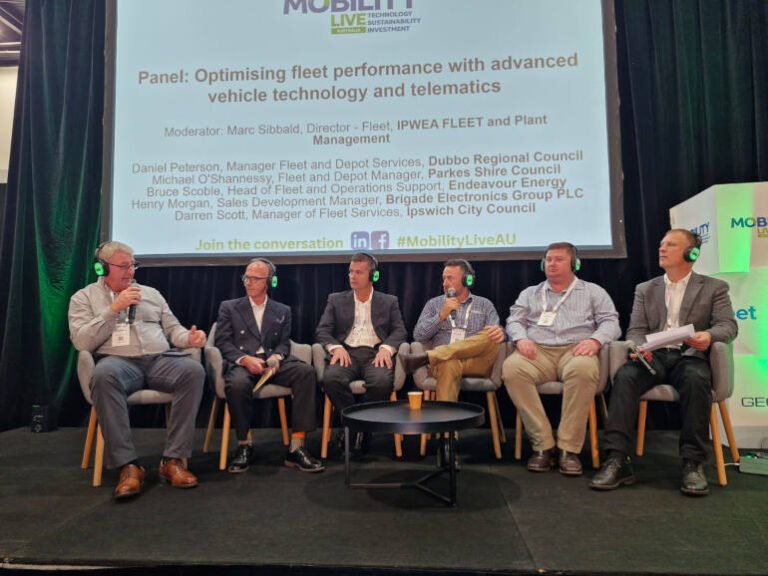
Fleet managers across Australia are moving beyond simple tracking systems to embrace technologies that drive measurable improvements in utilisation, safety, and operational efficiency. That was the key message from the Mobility Live 2025 panel discussion, “Optimising Fleet Performance with Advanced Vehicle Technology and Telematics.”
The panel featured Daniel Peterson (Dubbo Regional Council), Michael O’Shannessy (Parkes Shire Council), Bruce Scoble (Endeavour Energy), Henry Morgan (Brigade Electronics Group PLC), and Darren Scott (Ipswich City Council), moderated by Marc Sibbald, Director of Fleet News Group and IPWEA Fleet.
Utilisation and Availability at the Core
For Daniel Peterson, effective fleet management starts with understanding how assets are used — and just as importantly, when they aren’t.
“Most fleet managers say utilisation is the most important thing — and that’s correct — but you can’t have utilisation without availability,” Peterson said.
“We geo-fence our workshop, depot, and suppliers around town to identify vehicles that have been sitting idle. That data lets us spot when something’s been parked up for a week and hasn’t moved.”
By tracking both engine hours and location data, Dubbo Regional Council has been able to increase efficiency by identifying underused assets and improving workshop turnaround times.
Telematics Driving Accountability and Safety
At Parkes Shire Council, Michael O’Shannessy described how live telematics data has transformed the way his team manages driver behaviour and safety across a vast operating area.
“Telematics gives us visibility back at the command centre,” he said.
“We can focus on behaviours like speeding, harsh braking, or seatbelt use and make it a team focus — one week we’ll target speeding, another week seatbelts.”
The council has introduced driver ID fobs, giving accountability for each machine. O’Shannessy said the results were immediate once data was made visible to drivers and supervisors.
“Our seatbelt incidents went from 1,200 a week to about 350 as soon as we started sharing the results,” he said.
“Once people know they’re accountable, the behaviour changes.”
Parkes also uses geo-fencing to ensure vehicles return safely after hours, sending automated alerts if any remain outside their designated zones.
Technology as a Necessity, Not a Luxury
Bruce Scoble from Endeavour Energy said the increasing complexity of fleets makes technology “no longer optional”.
“The demands on people who manage fleets are increasing — compliance, safety, chain of responsibility, maintenance. You can’t manage a modern fleet without technology to show you what’s happening and help you act proactively,” he said.
Scoble’s team has focused on simplifying systems to make them driver-friendly.
“We run a system built around QR codes in vehicles,” he explained.
“It helps with navigation, fatigue management, pre-start checks, and defect reporting — all from one platform. The simpler it is, the more likely drivers are to use it correctly.”
COVID Accelerated Digital Adoption
Darren Scott from Ipswich City Council described how the pandemic forced rapid digital transformation.
“Before COVID, it wasn’t broken, so we didn’t fix it — we had paper forms and spreadsheets,” he said.
“When COVID hit, suddenly we needed live data. ICT helped us build dashboards, predictive maintenance tools, and automated reporting. That shift changed everything.”
Scott said this acceleration helped fleet teams become more data-driven and less reliant on manual processes — a legacy that remains today.
Suppliers See the Same Shift
From a global supplier perspective, Henry Morgan of Brigade Electronics said fleets worldwide have evolved from simply collecting data to using it constructively.
“There’s a huge amount of data available, but the challenge is getting the right data in the right place at the right time,” he said.
“Most drivers want to do a good job — telematics helps them see their own performance and feel included in the business, not punished.”
Morgan believes fleet technology has become much easier to use:
“The systems are improving, interfaces are simpler, and in time we’ll see vehicles that simply won’t start if conditions are unsafe — predictive safety will be built-in.”
Integrating Systems for the Bigger Picture
Finally, O’Shannessy explained how connecting telematics to other enterprise platforms has streamlined operations across Parkes Shire Council.
“We designed our system so telematics data automatically dumps into our fleet system every night — hours, kilometres, and even production data,” he said.
“Now our predictive maintenance schedules are always up to date, and our managers can see real-time dashboards for better planning.”
The integration extends even to small equipment, with an internal booking system generating $6,000–$8,000 a month in recovered internal hire revenue.
Mobility Live 2025 made it clear: fleet technology is no longer just about tracking vehicles — it’s about building smarter, safer, and more connected operations that deliver measurable results.
- City of Salisbury modernises pool vehicle access with automated key management
 The City of Salisbury has improved the way staff access pool vehicles by integrating its booking platform with an electronic key cabinet, creating a secure and fully automated system for managing vehicle keys. Previously, while the council already had a reliable booking system for hire and pool vehicles, the physical handling of keys remained a
 - Isaac Regional Council Turns Fleet Data into Actionable InsightsIsaac Regional Council is demonstrating how better data can lead to better fleet decisions. By integrating telematics, fuel card transactions and benchmarking analytics into a single set of dashboards, the council has improved oversight of a fleet of more than 420 assets that support essential services across its geographically dispersed region. The project combines information
- NZ Police redesign canine vehicles to improve safety, welfare and fleet governanceNew Zealand Police have introduced a nationally standardised operating model for police dog vehicles, improving canine welfare, officer safety and fleet lifecycle management while maintaining operational capability. The new Police Dog Vehicle Operating Model, delivered through the Škoda Dog Wagon programme, moves away from the traditional approach of modifying general fleet vehicles at a local level.
- NZ Police transforms fleet replacement planning with risk-based methodologyManaging a national fleet of more than 3,700 vehicles is a complex task, particularly for an organisation such as New Zealand Police where vehicles are mission-critical assets supporting frontline operations. In 2025, NZ Police introduced a new Vehicle Replacement Programme Methodology designed to improve how replacement decisions are made across the fleet. The approach moves
- Cost Alone Is Not Enough: The Three-Dimensional Model of Fleet Decision-MakingDelegates at the 2026 IPWEA Fleet Conference in Melbourne heard a consistent message across multiple sessions: fleet management is becoming a strategic discipline that requires balancing competing priorities—not just controlling costs. In a practical and thought-provoking presentation, Emad Loka, Director – Fleet Management at Fire and Rescue NSW, challenged fleet leaders to rethink how decisions are