
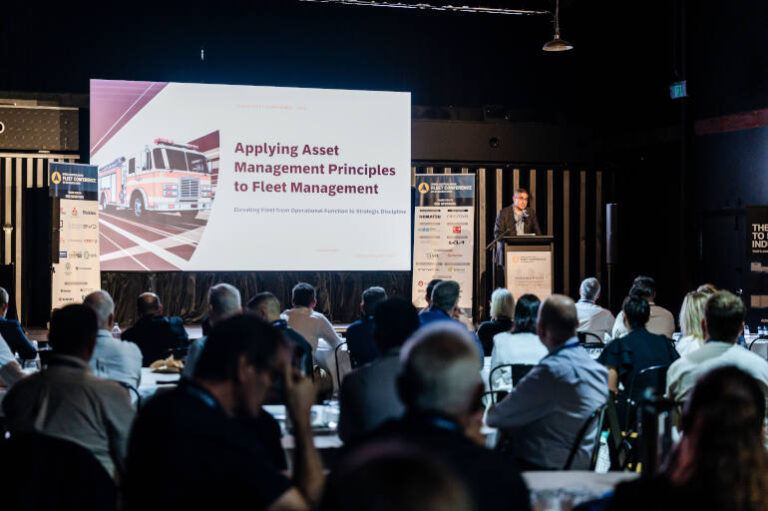
Delegates at the 2026 IPWEA Fleet Conference in Melbourne were challenged to rethink one of the most common assumptions in fleet management—that breakdowns are maintenance problems.
In a thought-provoking presentation, Emad Loka, Director – Fleet Management at Fire and Rescue NSW, shared a practical lesson drawn from frontline emergency operations: many of the problems fleet teams deal with today were designed into the fleet years earlier.
For those who couldn’t attend the conference, his message captured one of the central themes of the event—fleet management is evolving from a technical function into a strategic discipline grounded in asset management, governance, and lifecycle thinking.
A 2:17am Phone Call That Changed the Perspective
Loka began with a story that immediately resonated with fleet professionals across local government, emergency services, and utilities.
In the early hours of a rainy morning, he received a call about a critical frontline vehicle failure.
“One morning at two o’clock in the morning, and it was raining quite heavily, I get a phone call at 2:17 in the morning from my Fleet Manager. One of our frontline aerial appliances is offline. It’s a critical appliance in our fleet.”
The situation quickly became more complicated. The required spare part wasn’t available locally, and the supplier was overseas. While technicians worked to diagnose the issue, the operational capability of the service was reduced.
But the real lesson from the incident wasn’t about maintenance—it was about decision-making.
“That technician did not design the vehicle. That technician did not select the platform. He did not negotiate the procurement strategy. He didn’t approve the lifecycle. But at 2:17 in the morning, that technician, that Fleet Manager, myself, the crew and the community carry the consequences of all these decisions.”
The Real Source of Fleet Problems
One of the strongest messages from the session was that most fleet challenges originate long before a vehicle reaches the workshop.
Loka encouraged fleet leaders to look beyond the immediate symptoms—breakdowns, downtime, and maintenance costs—and examine the earlier decisions that shape long-term performance.
“Fleet pain mostly is not created in the workshop. It’s created in meeting rooms, and it’s created years earlier when decisions are made without full consideration of the full lifecycle.”
These decisions typically involve:
- Vehicle and platform selection
- Level of customisation
- Supplier and parts availability
- Specification standards
- Lifecycle planning assumptions
Once a vehicle is purchased, many of the future costs and reliability risks are already determined.
“By the time I already procured my vehicles, the cost of maintenance has already been locked in. The cost you will pay for the next 10 or 20 years has already been locked in—you just don’t know it.”
Why Workshops Carry the Consequences
Fleet teams are often measured on operational metrics such as downtime, breakdown rates, and workshop productivity. But these indicators only reflect the visible outcomes of earlier decisions.
Loka used the analogy of an iceberg to explain the challenge.
“We spend most of our time fixing the tip of the iceberg, not the bottom of the iceberg.”
The visible part of the iceberg includes:
- Breakdowns
- Downtime
- Maintenance backlog
- Workshop overtime
But the hidden portion—the part that determines long-term performance—includes:
- Specifications
- Supplier strategy
- Customisation levels
- Lifecycle planning
This perspective aligns closely with the broader theme of the conference: improving fleet performance requires stronger governance and better decision-making upstream.
Designing Reliability Instead of Repairing Failure
Rather than focusing solely on maintenance capability, Loka encouraged fleet leaders to shift attention to the design and procurement stages of the asset lifecycle.
“We need to focus on upstream—on specifications, on platform selection, on standardisation, and on supplier relationships.”
This approach reflects the growing maturity of fleet management as a profession. Vehicles are becoming more complex, more expensive, and more critical to service delivery, particularly in emergency services and local government operations.
As a result, reliability must be built into the fleet from the start—not managed after the fact.
A Key Takeaway for Fleet Leaders
The presentation reinforced a message that was repeated throughout the 2026 IPWEA Fleet Conference: fleet management is no longer just about keeping vehicles on the road—it’s about managing risk, value, and service capability over the life of the asset.
For organisations looking to improve performance, the starting point is not the workshop floor—it’s the meeting room where specifications and procurement decisions are made.
Loka left delegates with a simple but powerful question.
“The question we need to ask ourselves is: how many of those moments are unavoidable, and how many are already designed into our fleet?”
For those who missed the conference, this insight offers a clear reason to attend next year. The conversations are no longer just about maintenance—they’re about leadership, strategy, and the future of the fleet profession.
- From incident to fleet redesign: what City of Gold Coast can teach fleet practitioners
 A serious workplace incident involving a City of Gold Coast tipper truck provides a powerful example of why fleet safety goes well beyond driver behaviour — and why fleet practitioners have an important role in designing, procuring and managing safer vehicles. The lessons from the incident, and the extensive work undertaken by the City of
 - City of Salisbury modernises pool vehicle access with automated key managementThe City of Salisbury has improved the way staff access pool vehicles by integrating its booking platform with an electronic key cabinet, creating a secure and fully automated system for managing vehicle keys. Previously, while the council already had a reliable booking system for hire and pool vehicles, the physical handling of keys remained a
- Isaac Regional Council Turns Fleet Data into Actionable InsightsIsaac Regional Council is demonstrating how better data can lead to better fleet decisions. By integrating telematics, fuel card transactions and benchmarking analytics into a single set of dashboards, the council has improved oversight of a fleet of more than 420 assets that support essential services across its geographically dispersed region. The project combines information
- NZ Police redesign canine vehicles to improve safety, welfare and fleet governanceNew Zealand Police have introduced a nationally standardised operating model for police dog vehicles, improving canine welfare, officer safety and fleet lifecycle management while maintaining operational capability. The new Police Dog Vehicle Operating Model, delivered through the Škoda Dog Wagon programme, moves away from the traditional approach of modifying general fleet vehicles at a local level.
- NZ Police transforms fleet replacement planning with risk-based methodologyManaging a national fleet of more than 3,700 vehicles is a complex task, particularly for an organisation such as New Zealand Police where vehicles are mission-critical assets supporting frontline operations. In 2025, NZ Police introduced a new Vehicle Replacement Programme Methodology designed to improve how replacement decisions are made across the fleet. The approach moves