
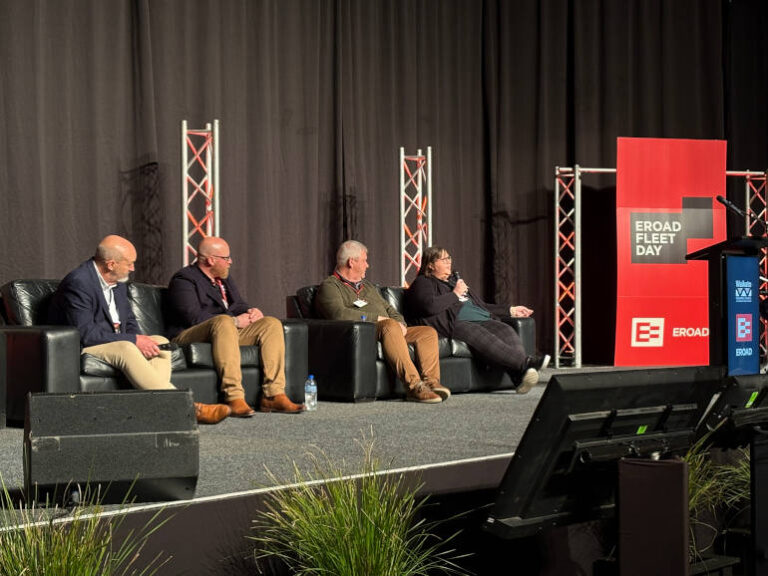
Getting people engaged with fleet programs isn’t just a box to tick—it’s the foundation for safer, more efficient, and more sustainable operations. That was the message from an insightful and often light-hearted panel discussion at EROAD Fleet Day, where four seasoned fleet leaders shared their experience in driving culture and change across some of New Zealand’s most complex fleets.
Moderated by Steve McIvor, the session brought together:
- Matt Gibson, Fleet Operations Lead, KiwiRail
- Blair Chalmers, Transport Operations Officer, New Zealand Defence Force
- Sarah Warrender, Light Fleet Coordinator, Fonterra
- Bryan Sherritt, Manager Transport Policy & Programs, Waikato Regional Council
Here are the key takeaways.
1. Trust is the First Barrier to Break
Blair Chalmers opened the discussion with a simple but powerful insight: the biggest barrier to fleet engagement is trust. Staff won’t buy into change if they don’t trust the message or the messenger.
Matt Gibson agreed, noting that perceptions—especially negative ones—are powerful and need to be acknowledged upfront.
“People’s perceptions are a key driver in any change… and you’ve got to turn that around.”
2. Communicate the ‘Why’—Then Listen
Whether you’re introducing EVs or rolling out new telematics, clarity and context are critical.
Sarah Warrender stressed the importance of engaging with frontline teams to understand their barriers and misconceptions. Bryan Sherritt added that data alone isn’t enough—you need the story behind it.
“There’s always a story to be told,” said Sherritt. “Listening to your people and understanding the context builds trust.”
Matt Gibson echoed this: “Know your audience. Try to understand where they’re coming from before you even start.”
3. Middle Management is Where the Magic Happens
Managers and supervisors play a make-or-break role in fleet engagement.
“They’re either helping you or hindering you,” said Gibson. “And if they’re not on board, they’re blocking the change.”
Bryan Sherritt summed it up nicely: “Where top-down meets bottom-up—that’s where the magic happens.”
This middle layer needs to be empowered to interpret senior leadership goals and translate them into practical actions for teams on the ground.
4. One Size Does Not Fit All
A common mistake? Assuming that the same engagement strategy works everywhere.
Sarah admitted that failing to understand the “bespoke” challenges at each of Fonterra’s 30 sites had tripped her up in the past. Matt shared a similar lesson—realising how different a team’s vehicle use was only after joining them on a ride-along.
The solution: spend time with your people. Understand what their day looks like. Then tailor the message.
5. Don’t Underestimate the Power of Influencers
It turns out peer influence—whether we call it “peer pressure” or “positive persuasion”—is a powerful engagement lever.
Matt Gibson shared a breakthrough moment when the most sceptical team member became the biggest advocate for EVs after trying one. Sarah reframed the dynamic as using influencers, rather than peer pressure, to build momentum.
“Our current EV drivers have become like car salespeople,” she laughed. “They’ve converted others just by sharing their experience.”
6. Make It Matter
Sustainability, safety, and efficiency need to feel relevant. Fonterra’s approach has been to show how fleet initiatives support a bigger purpose—like reducing emissions on the farm and beyond.
Recognition and rewards can help, but intrinsic motivation is more powerful. As Bryan put it:
“People need to know their part in the bigger picture—and then be given the tools and freedom to deliver.”
7. Simplicity Wins
Trying to implement too much too fast? That’s a common mistake.
“We’ve all made that error,” said Gibson. “You work on something for two months, then dump it on the team in one go. They need time to absorb it.”
Simplify the message. Break it down. And don’t be afraid to appoint local champions to lead by example in their areas.
8. Avoid These Engagement Killers
The panel wrapped up with a quick-fire Q&A, revealing their pet peeves and pro tips:
- One thing that kills engagement? “Lack of communication.”
- One thing that builds trust? “Empathy.”
- Most underrated tactic? “Team meetings.”
- Phrase that should be banned from fleet training? “This is the way we do things around here.”
If there’s one mantra to take away from the session, it came from moderator Steve McIvor:
“How you deliver the message is everything.”
When engagement falters, so does everything else—safety, efficiency, and sustainability. But with the right message, the right messengers, and a bit of empathy, change is not only possible—it’s lasting.