

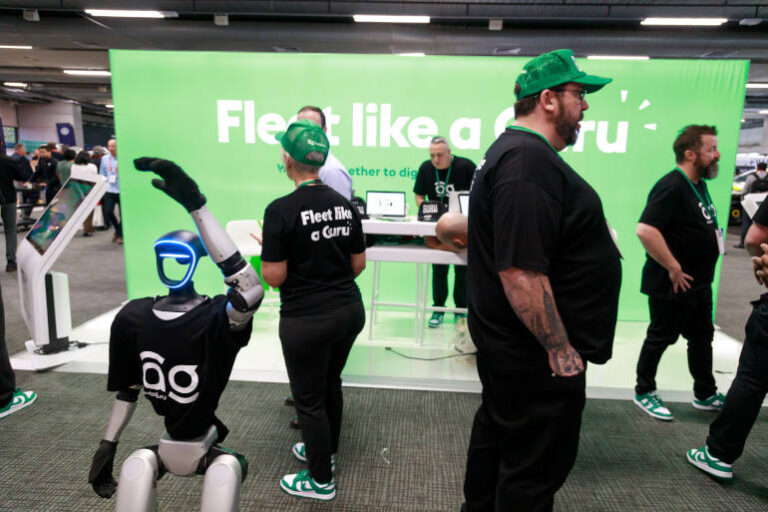
In a thought-provoking keynote that captured the attention of the entire audience at the 2025 Australasian Fleet Education & Leadership Summit, Eden Shirley, Founder of AutoGuru, made a compelling case for redefining what it means to be a Fleet Manager in the years ahead.
While the broader industry conversation remains fixated on electric vehicles and AI, Shirley looked further down the road — to a future where the assets under management won’t just be utes, vans and sedans. They’ll include drones, autonomous robots, and mobile machines that look nothing like a traditional vehicle but require the same level of oversight, compliance, and care.
And the punchline? “They sound like things you guys do now,” Shirley told the audience.
From Vehicles to Autonomous Assets
Shirley explained that as technology evolves, the nature of fleet assets is changing. Autonomous vehicles — once a concept reserved for science fiction — are now being trialled on roads in the US and in controlled environments across Europe and Asia. But perhaps even more significant are the strides being made in other categories of mobile machinery.
Autonomous drones are already being deployed in agriculture and emergency services. Industrial robots are entering distribution centres, performing tasks without human guidance. Shirley pointed to companies like Agility Robotics, Figure AI and UBTech, which are on track to mass-produce thousands of mobile robotic units over the next few years.
“These assets will be financed, leased, and deployed into operations just like vehicles are today,” he said. “They’ll need servicing networks, compliance checks, and infrastructure to support their usage. And that’s where you come in.”
Fleet Managers: Already Asset Managers
Shirley argued that fleet professionals are already equipped with the core competencies needed to manage these future assets. Whether it’s tracking total cost of ownership, planning for downtime, ensuring safety compliance, or coordinating maintenance schedules — the principles are the same, even if the asset moves on two legs instead of four wheels.
The transition will require new knowledge, particularly around charging infrastructure, software updates and component management. But Shirley believes the fleet profession already has the mindset required to take it on.
“You already understand what it takes to manage mobile assets at scale,” he said. “You’ve got the systems, the suppliers, the data — and most importantly, the thinking — to handle what’s next.”
Planning for What Comes After EVs
Shirley’s view was refreshing in its refusal to dwell on electric vehicles. “EVs are already embedded in the fleet conversation,” he said. “The real question is — what’s next?”
He pointed to the emergence of “non-vehicle” assets that still move and operate in the field. These include:
- Agricultural drones for crop spraying
- Autonomous delivery robots in logistics
- Warehouse bots that replace forklifts
- Robotic service assistants in customer-facing industries
All of these assets will need to be procured, tracked, serviced, insured, and eventually decommissioned. And for Shirley, that’s a familiar playbook for any experienced fleet professional.
Building the Support Network Now
AutoGuru has already begun preparing for this future. Shirley announced a partnership with CR Kennedy — a distributor of robotic systems and drones — to build a national service network capable of supporting these next-generation machines. The company is also working on data integrations and job scripting frameworks that can be applied across a wider range of asset categories.
“The future doesn’t come with a manual,” Shirley said. “We’re going to need new data, new tools, and new relationships to support it — but the good news is, we’re already on the path.”
The Message to Fleet Managers
The key message from Eden Shirley’s keynote was one of opportunity. As the definition of a “fleet” broadens to include all sorts of mobile technology, the role of the Fleet Manager becomes even more critical — and potentially more influential across the business.
Fleet managers aren’t just keeping vehicles on the road. They’re managing assets that move. And in the years ahead, that simple shift in perspective could unlock an entirely new frontier of responsibility — and career growth — for the profession.
“Your skill set is more valuable than ever,” Shirley concluded. “And your future isn’t just about vehicles. It’s about everything that moves.”