

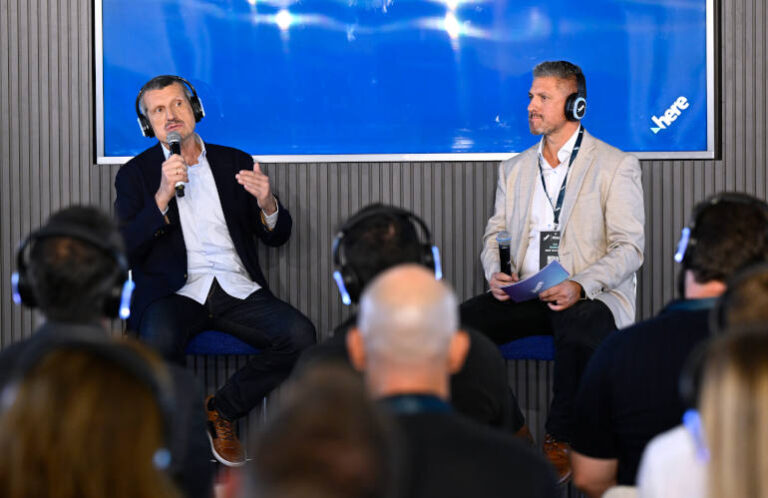
Guenther Steiner on efficiency, leadership and performance under pressure
At the HERE Directions event in Melbourne during the Formula One weekend, former HAAS F1 Team Principal Guenther Steiner offered a rare insight into what it takes to run one of the most complex and performance-driven operations in sport.
While Formula One might seem worlds away from fleet management or running a business, Steiner’s reflections reveal striking similarities between managing a racing team and managing fleets, logistics operations, or asset-intensive organisations.
From budget constraints and data analysis to leadership and team motivation, the lessons from the pit lane translate surprisingly well to the workplace.
Passion is not enough without structure
Steiner’s career began in rally racing during the 1980s, where he learned the value of accountability early. With limited communications and small teams, mechanics and engineers had to solve problems independently and make decisions quickly.
“If you had a problem, it was your job to solve the problem,” Steiner explained. “If you made the wrong decision, you had to fix that wrong decision.”
That experience shaped his leadership philosophy: passion alone does not deliver performance.
“You need passion, but you also need structure,” he said, noting that successful motorsport teams combine enthusiasm with systems, processes, and disciplined execution.
The same principle applies in fleet operations. Fleet teams are often passionate about vehicles and service delivery, but without strong governance, data systems, and clear accountability, performance improvements are difficult to sustain.
Efficiency matters more than budget
For many years, Formula One teams operated with vastly different budgets. Some teams spent more than US$500 million annually, while smaller teams operated with less than US$100 million.
Steiner said that imbalance created an unsustainable environment until Formula One introduced a budget cap in 2021.
“Money alone doesn’t make you successful,” he said. “You need the base of the money, but it doesn’t make you successful.”
Once spending limits were introduced, the competitive advantage shifted away from simply spending more money to using resources more effectively.
“The good teams put systems in place that use the budget best,” Steiner explained.
This shift mirrors the evolution of fleet management. Organisations rarely have unlimited budgets for vehicles, infrastructure, or technology. The real differentiator is how efficiently those resources are deployed.
Fleet Managers who focus on utilisation, lifecycle planning, data integration, and operational efficiency are essentially applying the same principles used by successful F1 teams.
Data is abundant — insight is scarce
Formula One cars generate enormous volumes of data during testing and racing. Analysing that information quickly and accurately is critical to performance.
However, Steiner noted that the sheer scale of data means human teams cannot review everything.
“There is not enough people to look at all the data,” he said. “You normally only look at the data when you have a problem.”
This is where artificial intelligence is becoming increasingly valuable.
AI systems can monitor telemetry continuously and identify anomalies before they become visible to engineers or drivers.
“AI can look at the data all the time and flag when something doesn’t seem right,” Steiner explained.
The lesson for Fleet Managers is clear: telematics, fuel data, maintenance records and utilisation metrics generate valuable insights, but only if organisations have the capability to analyse them effectively.
Advanced analytics and AI tools can identify trends, predict failures, and optimise operations in ways manual analysis cannot.
Simulation and digital tools reduce risk
Another major shift in Formula One has been the use of high-fidelity simulators.
Drivers now spend weeks preparing in virtual environments before getting behind the wheel of a race car.
Simulators allow teams to test setup changes, train drivers, and evaluate strategies without the cost and risk of real-world testing.
“You simulate setup changes in the simulator before putting them on the car,” Steiner said, explaining how teams refine performance between race sessions.
Fleet organisations are increasingly using similar digital tools.
Route optimisation software, telematics simulations, and predictive maintenance models allow fleet teams to test scenarios before implementing operational changes. This reduces risk and improves decision-making.
Leadership is hardest when performance drops
In Formula One, success brings energy and motivation across the team. When results decline, leadership becomes significantly more challenging.
“When you have success, everyone is self-motivated,” Steiner said. “The difficulty comes when you don’t have success and you need to keep people motivated.”
Large F1 teams can involve hundreds of staff, from engineers and mechanics to strategists and logistics specialists. Keeping those teams aligned during difficult seasons requires clear communication and a shared belief in the recovery plan.
Steiner’s advice is simple: remind people why they succeeded before and show them how the team will get back there.
“We haven’t gone stupid in a month or a year,” he told his teams during challenging periods. “We just need to go back to doing a better job.”
The same leadership challenge exists in fleet organisations when budgets tighten, projects fail, or operational disruptions occur. Maintaining morale and focus becomes a core leadership skill.
Safety remains non-negotiable
Despite the focus on performance, Steiner emphasised that safety always comes first in motorsport.
“Safety is number one in motorsport,” he said. “You never compromise your car design for safety.”
For fleet operators, the parallel is obvious. Vehicle performance, efficiency and cost savings are important, but they cannot come at the expense of driver safety or regulatory compliance.
Lessons from the pit lane
Formula One represents the extreme edge of engineering, speed, and competition. Yet many of the principles that underpin successful teams are directly applicable to fleet management and business operations.
Steiner’s experience highlights several universal lessons:
- Passion must be supported by structure and systems
- Efficiency matters more than raw budget
- Data must be analysed effectively to deliver insights
- Digital tools can reduce risk and improve decisions
- Leadership is most important during difficult periods
- Safety should always remain the top priority
In the end, whether running a Formula One team or managing a fleet of vehicles, success depends on the same fundamentals: people, processes, technology and the ability to make the best use of limited resources.
As Steiner put it simply, efficiency is about ensuring that every dollar — or every resource — delivers more value than it costs.
And that principle applies just as much in the fleet depot as it does in the Formula One pit lane.