

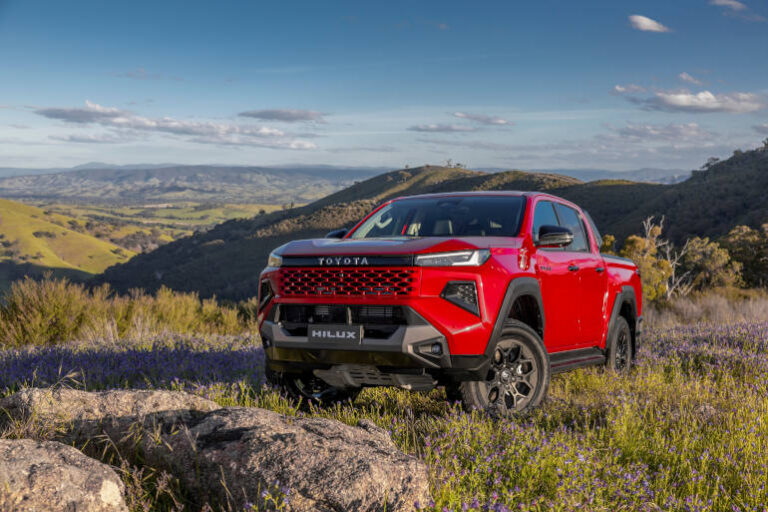
Toyota Australia has confirmed that diesel-powered HiLux models built from mid-2015 can operate on 100 per cent hydrotreated vegetable oil, giving fleet operators another potential pathway to reduce lifecycle emissions without replacing existing vehicles.
The announcement covers HiLux models equipped with Toyota’s 1GD and 2GD turbo-diesel engines. With more than half a million N80 and N90-generation HiLux vehicles currently on Australian roads, Toyota believes low-carbon liquid fuels could play a significant role in reducing emissions from the existing vehicle fleet.
Toyota and Ampol are currently trialling HVO100, a renewable diesel alternative that can be used without blending conventional diesel.
For fleet managers, particularly those operating utilities, local government, infrastructure, mining and regional fleets, the announcement is significant because it offers the potential to lower emissions while continuing to use vehicles already in service.

Decarbonising the existing fleet
While much of the fleet decarbonisation conversation has focused on replacing internal combustion vehicles with battery-electric models, Toyota is positioning low-carbon liquid fuels as another part of its multi-pathway strategy.
Toyota says all of its existing diesel models are already capable of operating on a blend containing up to 20 per cent low-carbon liquid fuel, while it is studying the expansion of HVO100 compatibility to additional models.
Toyota Motor Corporation Australia President and CEO Matthew Callachor said practical choices would be important as Australia moves towards lower-emission transport.
“At Toyota, we believe decarbonisation requires a multi-pathway approach that gives customers practical choices while supporting Australia’s transition to a lower-emissions future,” Callachor said.
“The confirmation that HiLux models from 2015 onwards can run on 100 per cent hydrotreated vegetable oil is validation that the vehicle technology exists today.”
For fleets with long replacement cycles, the ability to reduce the lifecycle emissions of vehicles already operating could become particularly important. It may allow organisations to make progress against emissions targets without waiting for every vehicle to reach its scheduled replacement date.
Regional fleets remain a key challenge
Toyota is also highlighting the potential role of renewable fuels in applications where battery-electric vehicles may not yet meet operational requirements.
The company says low-carbon liquid fuels can retain the towing capability, driving range, performance and practicality associated with diesel vehicles, making them particularly relevant for regional and remote operations.
That could make HVO particularly relevant for fleets with vehicles travelling long distances, towing equipment or operating away from established charging infrastructure.
Toyota recently demonstrated that capability by completing an approximately 3,000km journey through regional Queensland, New South Wales, Victoria and South Australia in a HiLux powered by HVO100 as part of the National Bush Summit.
What is HVO100?
Hydrotreated vegetable oil can be produced from renewable feedstocks including vegetable oils and recycled cooking oils.
Toyota says HVO100 has a higher cetane number than conventional fossil diesel, providing improved ignition quality and more stable combustion, while also containing substantially lower levels of sulphur and aromatics.
However, availability will be critical if renewable diesel is to become a meaningful option for Australian fleets.
Toyota has welcomed moves to establish a domestic low-carbon liquid fuels industry, including Ampol’s proposed Brisbane Renewable Fuels project being explored with GrainCorp and IFM Investors.
The company argues domestic production could help support regional industries, improve fuel security and increase the availability of lower-emission fuels.
For fleet operators, HVO100 is unlikely to replace the need to assess battery-electric and other zero-emission vehicles. Instead, it could give organisations another option for reducing emissions across vehicle categories where replacement technologies, charging infrastructure or operational requirements remain challenging.
The development also broadens the fleet decarbonisation discussion beyond what vehicle to buy next — and towards what can be done with the thousands of diesel vehicles already sitting in Australian fleet depots.