
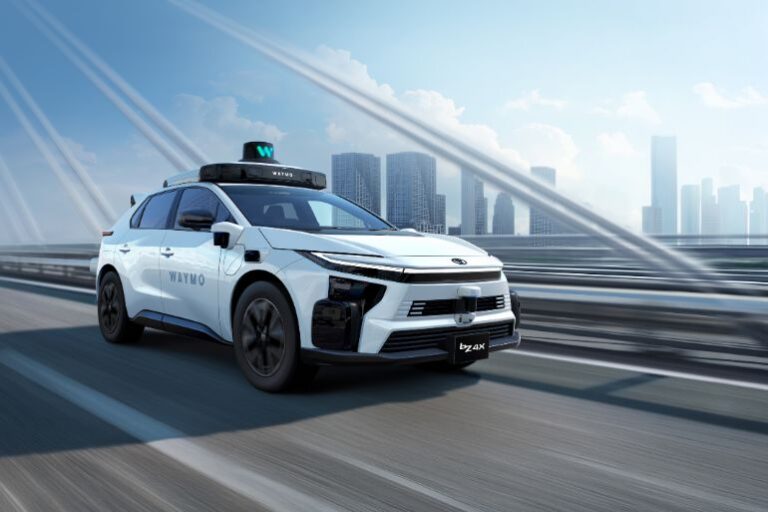
Toyota and Waymo will begin testing and validating an autonomous Toyota bZ4X fleet in Japan in 2027, taking their collaboration another step towards commercial driverless ride-hailing services.
Deployment in the United Kingdom and other markets serviced by Waymo is planned for subsequent years. The announcement does not include an Australian rollout or a date for passenger services to begin in Japan.
For fleet buyers, the development signals how autonomous vehicle technology could move towards factory-integrated production, with Toyota planning to assemble the vehicles and install Waymo’s autonomous driving hardware at the same manufacturing facility.
Factory integration supports fleet expansion
The autonomous bZ4X vehicles will be built at Toyota’s Takaoka plant in Toyota City, Japan. Production will bring base vehicle assembly and the integration of Waymo’s hardware under one roof.
The arrangement combines Toyota’s vehicle development and manufacturing capabilities with Waymo’s autonomous driving technology, with the companies aiming to scale Level 4 autonomous vehicles globally.
The next phase builds on the preliminary agreement announced in April 2025. Toyota and Waymo describe it as a milestone towards expanding Japan’s first fully autonomous ride-hailing service using high-volume, domestically manufactured vehicles.
For organisations watching the development of autonomous transport, the manufacturing approach is significant. Integrating the technology during production could provide a more consistent foundation for expanding fleets, although the announcement does not detail production volumes, vehicle costs or operating economics.
Passenger access shapes vehicle design
The vehicles will use a customised version of Toyota’s battery electric bZ4X, with features designed around passengers entering, travelling in and leaving a vehicle without a driver.
Toyota says the configuration will include generous rear legroom, automatic doors, a power liftgate and ambient lighting.
These changes highlight how vehicles developed for autonomous passenger services may differ from conventional fleet cars. Ease of access and passenger comfort become central considerations alongside the driving technology.
The companies say the service is intended to improve mobility for people who cannot easily get around, as well as reduce crashes caused by human error.
Safety remains central to the partnership
Dmitri Dolgov, Co-Chief Executive Officer at Waymo, said the companies shared a focus on road safety.
“Toyota’s commitment to zero traffic accidents resonates deeply with us at Waymo, and we’re proud to work together toward safer roads for all,” he said.
Dolgov also said Waymo had demonstrated it was “up to 20x safer than human drivers when it comes to serious crash injuries” in areas where it operates. That claim relates to Waymo’s existing operations; the announcement does not provide safety results for the planned Toyota fleet in Japan.
Hiroki Nakajima, Member of the Board of Directors and Executive Vice President at Toyota Motor Corporation, said wider deployment was important to the partnership’s goals.
“Safety technology makes the biggest difference when it reaches as many people as possible.”
Broader applications remain under consideration
Toyota and Waymo will also continue exploring autonomous driving technology for personally owned Toyota vehicles.
Alongside Woven by Toyota, they will investigate how insights from Waymo’s operations, data and technology could improve safety for other road users. Toyota will also continue exploring the integration of vehicles with traffic infrastructure.
For Fleet Managers, the immediate development is a planned testing programme rather than an autonomous vehicle available to purchase. The longer-term question is how factory-integrated driverless vehicles could influence passenger transport, shared mobility and the way organisations procure transport services.