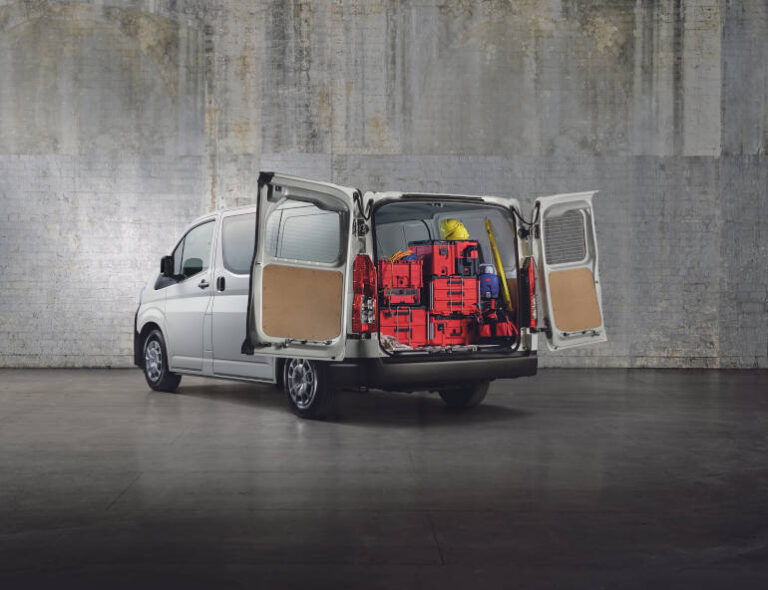
Toyota has updated its HiAce van range, adding new safety and convenience features that will appeal to businesses and operators who rely on the model as a workhorse.
Expanded Safety Suite
The HiAce now comes standard with an expanded Toyota Safety Sense package. Key additions include:
- Lane Trace Assist – helps keep the van centred in its lane when adaptive cruise control is active.
- Emergency Driver Support System – works alongside Lane Trace Assist to detect if the driver becomes unresponsive. If alerts are ignored, the system activates hazard lights and brings the vehicle to a safe stop.
- Safe Exit Assist – links with the blind spot monitor to warn occupants of approaching vehicles or cyclists when opening doors roadside.
Cruise control has also been updated, with high-speed adaptive capability on manual grades and full-speed function for automatic grades.
Existing safety features such as automatic high beam, lane departure alert, pre-collision safety system, and speed sign assist remain part of the package.
Passive safety has been bolstered too, with a new centre airbag taking the total to eight. LWB Crew variants now have 10 airbags thanks to two additional side units.
Driver Comfort and Convenience
The updates include electric power steering, making manoeuvring easier, and enabling the new Lane Trace Assist function.
All models now feature a 7.0-inch digital instrument cluster with nine driver-selectable displays. Other enhancements include:
- Electric parking brake (all grades except the entry-level manual LWB)
- Improved air conditioning performance with a new refrigerant
- Black exterior mirrors across the range
- Twin rear wipers for SLWB barn door variants
Range and Powertrain
The HiAce continues to be offered in a wide variety of configurations to suit commercial applications, including long wheelbase (LWB) and super long wheelbase (SLWB), with options for lift-up tailgates or barn-style rear doors.
All grades are powered by Toyota’s 2.8-litre four-cylinder turbo-diesel engine (130kW / 450Nm with automatic, 420Nm with manual). A six-speed automatic is standard, with the six-speed manual limited to the entry LWB Van.
Why It Matters for Fleets
For businesses that put drivers on the road for long shifts, the new driver monitoring and emergency stop system is a notable safety enhancement. It addresses fatigue and medical emergencies, offering an extra layer of protection.
The improvements to steering and instrumentation also support driver comfort, which can have flow-on effects for productivity and safety.
Sean Hanley, Toyota Australia Vice President Sales, Marketing and Franchise Operations, said:
“These latest upgrades ensure improved levels of safety for both occupants and other road users, which is of particular importance given how much time drivers spend on the road in their HiAce.”
Pricing (Manufacturer’s RRP)
- LWB Van MT – $51,880
- LWB Van AT – $53,880
- LWB Van Barn Door AT – $54,630
- LWB Van GL Package AT – $54,880
- LWB Van GL Package Barn Door AT – $55,630
- LWB Crew Van AT – $56,880
- SLWB Van AT – $62,440
- SLWB Van Barn Door AT – $63,190
(Excludes on-road costs. Pricing may vary by state.)
- ANCAP Puts BYD Sealion 5 Safety Systems to the Test
 The BYD Sealion 5 has received a three-star ANCAP safety rating, with testing identifying limitations in crash avoidance and driver monitoring despite stronger results in crash protection. The rating applies to both Essential DM-i and Premium DM-i plug-in hybrid variants sold in Australia and New Zealand, covering vehicles built from August 2025. Assessed against ANCAP’s
 - Repair or Replace? IAG Calls for a Rethink on Vehicle DesignIAG has joined international motor insurance research institutes in calling for closer collaboration between insurers and vehicle manufacturers to improve road safety and make vehicles easier and more affordable to repair. For fleet managers, the call highlights the importance of looking beyond purchase price and safety features when selecting vehicles. Repairability, parts availability and the
- Commercial Vehicle Safety Must Become a PriorityAustralia’s improving passenger vehicle safety record is not being matched across commercial vehicles, with new figures highlighting a sharper rise in fatalities involving light and heavy vehicles. ANCAP SAFETY has welcomed the Australian Government’s Mid-term Review of the National Road Safety Strategy 2021–2030, particularly its recognition of the contribution safer vehicles are making to reducing
- From incident to fleet redesign: what City of Gold Coast can teach fleet practitionersA serious workplace incident involving a City of Gold Coast tipper truck provides a powerful example of why fleet safety goes well beyond driver behaviour — and why fleet practitioners have an important role in designing, procuring and managing safer vehicles. The lessons from the incident, and the extensive work undertaken by the City of
- 379 million kilometres of data is changing how Euclidic thinks about fleet safetyFleet safety reporting has traditionally focused on obvious measures such as speeding, harsh braking and acceleration. But after analysing more than 379 million kilometres of real-world fleet driving, Euclidic Systems believes the next step is understanding the context behind those events. The Australian-owned telematics provider has analysed seven years of data covering more than 33