

Safety conversations in fleet management often focus on technology — autonomous emergency braking, lane departure warnings or driver monitoring systems. Those features matter.
But sometimes the biggest safety improvement comes from something more basic: how the load is carried.
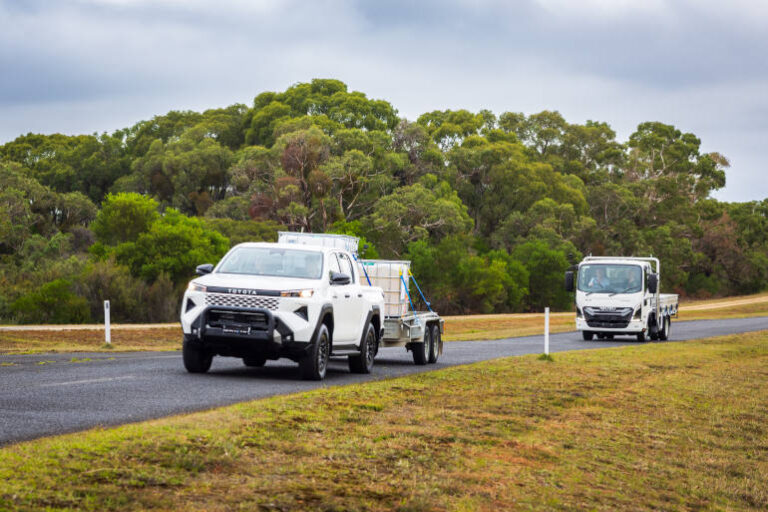
That was the focus of a recent drive event hosted by Isuzu Trucks, where Fleet News Group joined a group of motoring and fleet journalists to test loaded vehicles in real-world conditions. The exercise compared fully laden utes towing trailers with light-duty trucks carrying the same load in a single vehicle.
The objective wasn’t subtle. It was designed to demonstrate that when work demands increase, the safer option may simply be using one properly specified vehicle rather than managing a vehicle-and-trailer combination.
The Risk Starts When the Trailer Arrives
For many businesses, towing a trailer is a routine part of the job. It’s a practical way to carry more equipment without changing vehicles.
But trailers introduce additional risks that aren’t always obvious until something goes wrong.
These include:
- Increased braking distances
- Reduced vehicle stability under load
- Greater risk of jack-knifing or sway
- More complex reversing and manoeuvring
- Higher driver workload and fatigue
At the Isuzu event, both vehicles were loaded to simulate a typical workday. The ute carried material in the tray and towed a trailer, while the truck carried the same load within its own body.
Under braking and cornering, the difference was noticeable.
Drivers reported that the ute required significantly more effort to manage the load, particularly on downhill sections and during acceleration. By comparison, the truck handled the same conditions with greater stability and less strain on the braking system.
In practical terms, that means more predictable handling and more control — two factors that sit at the heart of workplace safety.
Stability Is a Safety System
Modern vehicles are equipped with sophisticated safety technologies, but physics still plays a central role in safe operation.
A vehicle operating close to its limits — especially while towing — places additional stress on brakes, tyres and suspension components. It also reduces the margin for error when conditions change unexpectedly.
One of the clearest observations from the drive comparisons was how much easier it was to control a single vehicle carrying the load compared with managing a vehicle and trailer combination.
As one participant noted after the test runs, manoeuvring and reversing became significantly simpler “when you’ve got everything in one unit, being the truck.”
That simplicity reduces risk, particularly in busy worksites or urban environments where space is limited.

Fewer Components, Fewer Failure Points
Safety is also influenced by mechanical reliability. A towing setup introduces additional components that must be inspected and maintained:
- Towbars
- Hitch mechanisms
- Trailer brakes
- Tyres and wheel bearings
- Electrical connections
Each component represents a potential point of failure.
By contrast, a single vehicle carrying the load reduces the number of systems that must be monitored. That simplification can improve compliance and reduce the likelihood of mechanical faults during operation.
For Fleet Managers responsible for workplace safety, fewer moving parts often means fewer incidents.
Designed to Carry the Load
Another safety advantage of light trucks lies in their design.
Unlike many passenger-based vehicles, trucks are engineered specifically to carry heavy loads every day. Their braking systems, suspension and chassis are built for sustained commercial use rather than occasional towing.
Industry data reflects this difference in capability. Rigid trucks transport significantly more freight per vehicle than smaller commercial vehicles, highlighting their ability to operate safely and efficiently under demanding conditions.
That purpose-built design supports better weight distribution and more predictable handling — both critical factors in reducing risk.
Driver Confidence Matters
Safety isn’t just about equipment. It’s also about driver confidence.
A vehicle that feels stable, predictable and easy to control reduces stress and fatigue over the course of a working day. That confidence becomes particularly important when operating in tight worksites, reversing into loading areas or navigating urban traffic.
During the event, drivers noted improved visibility and control when operating the truck compared with the ute-and-trailer combination. Features such as large mirrors, suspension seating and modern cabin layouts helped maintain control on uneven surfaces and during repeated manoeuvres.
These aren’t headline features, but they contribute directly to safe operation.
A Practical Safety Decision
The comparison between towing a trailer and carrying the load in a single vehicle isn’t about replacing utes. Both vehicle types remain essential tools across Australian fleets.
But the exercise highlighted a practical reality: Safety often improves when complexity is reduced.
For fleets regularly towing equipment, transporting heavy materials or operating in confined worksites, a light truck can provide:
- Greater stability under load
- Improved braking and control
- Simpler manoeuvring and reversing
- Reduced mechanical risk
- Lower driver workload
Those advantages don’t appear on a specification sheet. They show up on the job site. And sometimes, the safest solution isn’t adding another piece of equipment. It’s choosing the right vehicle to carry the load in the first place.