
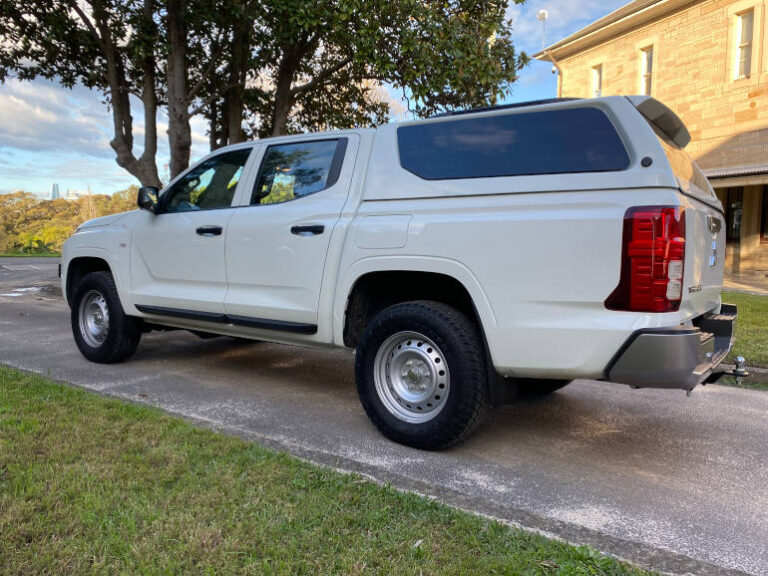
Mitsubishi Motors Australia Limited (MMAL) is quietly building up a customised vehicle subscription package for existing fleet customers that allows rapid deployment of additional vehicles for specific projects without the obligations of a purchase or lease structure.
Fleets that already operate Mitsubishi vehicles purchased from MMAL (or leased through the MMAL MiDiamond program) are able to approach the brand to discuss bringing additional vehicles into their fleet on a 12–24-month term via a one-stop subscription program with a monthly fee.
The Mitsubishi fleet subscription plan has two key goals:
- Assisting businesses who already operate the Triton ute to temporarily expand their Triton fleet for temporary additional corporate projects requiring extra vehicles; and
- Demonstrating the capabilities of the Outlander plug-in hybrid (PHEV) to corporate customers who may be reluctant to shift to EV or lower-CO2 technologies from existing internal combustion (ICE) vehicles.
Subscriptions Can Be Perfect For Short-Term Fleet Vehicle Needs
Speaking exclusively with Fleet Auto News, MMAL deputy director of fleet management and mobility solutions Fulvio Fattore explained the purpose of the subscription program.
“We own the vehicles. We work with corporates to understand what project they have on the horizon. It is not there to cannibalise purchasing or leasing; it is there to complement it as a solution that is fundamentally the right product at the right time for that customer,” said Mr Fattore.
Internal data used by MMAL shows that fleet vehicles operated on a subscription basis already account for around seven percent of the vehicle market.
“Over the last four years, we’ve seen a fundamental [change] in the way assets are used, away from ownership toward consumption. It is no different to videos [moving] to HBO or Netflix – we are seeing corporates exhibit an interest in subscripting,” Mr Fattore said.
While Mitsubishi dealers sell vehicles outright to fleet customers, and MMAL advertises its conventional fleet leasing product (MiDiamond) for terms of 24-60 months, the subscription product is currently being offered internally to existing fleet customers.
However, it could be rolled out more generally in future as the subscription package matures, helping more fleets enjoy the benefits of enhanced TCO for vehicles needed only for short projects across a subscription as short as 12 months.
Triton Subscriptions Get Extra Subcontractors Moving
Currently, the Triton ute is the main beneficiary of the product, with the ute in high demand by corporates particularly in the construction space who may be awarded a specific large project creating demand for extra utes which will not be required 12-18 months down the track.
“If you are buying [vehicles] from us, and you have an additional project which might not have the future revenues beyond that period of time where you are required to bring in an influx of new subcontractors who you do not have vehicles for, you can speak to us about creating a customised solution,” said Mr Fattore.
“That is filling the niche position between owning a vehicle, short-term rental, and [for periods of] 12-24 months when [a fleet] requires an asset. You can speak to us.”
Fleet managers take note
Already running a fleet of Tritons purchased or leased through Mitsubishi? A reduced-term subscription can be requested through MMAL where requirements run for shorter periods.
Trialling Outlander Plug-in Hybrid Is Lower-Risk via Subscription
The second key product involved in the subscription program is the Mitsubishi Outlander PHEV, an all-wheel drive midsize SUV that pairs a petrol engine with two electric motors and, in shortly-arriving facelift form, around 100km electric range when charged via a wall outlet.
MMAL sees the Outlander PHEV as an ideal interim step for fleets that would intend to reduce CO2 emissions without the perceived or real impracticalities of a full battery electric vehicle (BEV).
Mr Fattore told Fleet News Group that while government fleets and the salary sacrificing industry was shifting considerable demand to BEVs, due to CO2 mandates and fringe benefits tax exemptions for user-choosers, other fleets were not opting for BEVs.
“But the reality is we don’t see significant shifts or uptake in EV across in pure tool of trade, where there is still what I’d call a reluctance to transition a fleet entirely from ICE to EV for a whole host of reasons [including] charging infrastructure and range anxiety,” he said.
The Outlander PHEV, which can operate with or without being charged (with variable TCO, fuel economy and CO2 emissions as a result), is perceived to be a solid interim solution for fleet use.
“The intention is to help fleets understand there is an interim step [to electric vehicles], which is PHEV – and it has advantages over a hybrid. It helps the user experience it.
“Our subscription program allows us to work with customers purchasing ICE to effectively trial the midterm transition point with a [PHEV] product that has infrastructure, is readily available to help the transition toward EV, and can be subscribed to for 12-24 months.
“It is about enabling [fleet] market awareness of what a PHEV is. It is still a technology that is somewhat misunderstood. You can drive it without plugging it in. You enjoy the benefit of a hybrid without any form of range anxiety. If you do plug it in, you’re running in pure EV,” said Mr Fattore.
Advice to fleets
Plug-in hybrids (PHEVs) like the Mitsubishi Outlander provide a turnkey lower-CO2 solution for SUV and personnel transport needs.
Final Word for Fleets: Subscriptions Can Fit…for Some Operators
With considerable additional flexibility and reduced resale risk presented by MMAL’s subscription model, the product can suit fleet operators who:
- Need to temporarily add modern, safe vehicles to the fleet but who do not want to amortise with 24-month or longer leases; or
- Require a lower-CO2 SUV solution to bring down overall fleet carbon emissions but who are concerned about practicality or future resale.
However, for longer-term fleet operations, traditional lease or purchase options can still be more cost-effective and comparative outlay should be closely considered.
- Ampol Simplifies Payments for Mixed Fleets
 Ampol has expanded AmpolCard to include public electric vehicle charging through its AmpCharge network, giving businesses a single payment platform as their fleets diversify. The offering brings fuel, on-the-go convenience purchases and public EV charging onto one card and account, with unified billing, reporting and account management. All AmpCharge public charging sites across Australia are
 - MINI Countryman Unleashes its Untamed SideMINI will add a new Untamed Edition to its Australian Countryman range in early 2027, giving fleet and novated lease buyers a distinctive design option across petrol and fully electric models. The edition will be available on the Countryman S ALL4 and all-electric Countryman SE ALL4, pairing all-wheel drive with exclusive exterior finishes, interior materials
- How BYD plans to protect fleet resale valuesResidual values have become a key part of BYD’s fleet strategy as the brand works to build confidence among Fleet Managers considering whole-of-life cost rather than simply purchase price. Marcus Walker, National Fleet Sales Manager at BYD Australia and New Zealand, told the Fleet News Group podcast that protecting resale values has been an important
- AfMA’s new board signals a stronger voice for membersAfMA’s new board has signalled a shift towards greater member participation, clearer professional development pathways and more visible communication about the Association’s direction. In a statement published following its Strategy Day in September, AfMA outlined three areas for action: constitutional changes to support member participation, expanded training and development, and stronger career pathways and recognition
- NARVA Reverse Alarm Earns Australian FirstNARVA has secured what it says is Australia’s first Component Type Approval (CTA) for a reverse alarm, providing clearer compliance documentation for body builders and fleets specifying vehicle-warning equipment. The approval covers the reverse alarm integrated into the NARVA AeroTech Multi-Function Light Box. It is certified to Australian Design Rule ADR 42/05 clause 23.2 under