

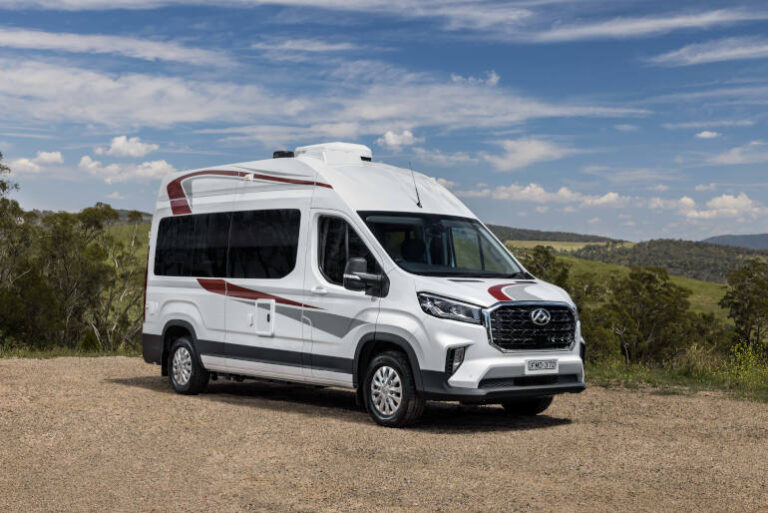
After strong demand for the original model, LDV Australia has introduced a significantly updated Series 2 version of its factory-built Deliver 9 Campervan, bringing more power, a new transmission, a revised cabin layout and a larger infotainment screen.
For buyers wanting a turnkey solution straight off the showroom floor, the Deliver 9 Campervan continues to undercut many similar-sized competitors, with the new two-seat model priced from $102,990 drive-away. An updated four-seat variant will follow in the second half of the year from $104,990 drive-away.
More Power, New Eight-Speed Auto
The Series 2 Campervan is based on the updated Deliver 9 long-wheelbase, high-roof van. Key upgrades include:
- New front grille design
- 12.3-inch infotainment screen
- Steering column-mounted gear selector
- Eight-speed automatic transmission (replacing the previous six-speed)
Under the bonnet is an upgraded 2.0-litre turbo-diesel producing 128kW and 420Nm – up 18.5 per cent in power and 12 per cent in torque over the previous version. The additional ratios in the eight-speed automatic should improve cruising efficiency and drivability, particularly on longer touring trips.
For those towing a small trailer or boat, braked towing capacity remains a solid 2800kg.
Two-Seat Layout Creates More Living Space
The biggest change is inside.
The original Campervan was a four-seater with an ‘east-west’ bed layout across the rear. The new two-seat configuration (driver and front passenger only) enables a ‘north-south’ bed layout, providing:
- More stretch-out space when sleeping
- A more usable lounge configuration
- Improved cabin flow
The reworked layout also introduces a compact under-bench drawer-style fridge and a relocated shower/toilet cubicle to optimise internal space.
Another practical change sees water outlets, the external shower port and the grey water exit relocated to the driver’s side — keeping the passenger side clear as the main recreation area under the awning.
Fully Equipped From the Factory
The Deliver 9 Campervan remains comprehensively equipped as standard, including:
- Kitchen sink and induction cooktop
- 83-litre drawer-style fridge (with 7-litre freezer)
- Microwave
- Indoor shower and toilet cubicle
- Outdoor shower
- 22-inch smart TV with roof-mounted antenna
- LED cabin lighting
- Lounge converting to double bed
- Collapsible dining table
- Retractable awning
- Electric side step
- Fly-screen door and window shades
The front passenger seat swivels to integrate with the living area, and the bed can be assembled or packed away in under a minute, with substantial storage underneath.
Off-Grid Capability
For buyers planning extended trips away from powered sites, the Campervan includes:
- 2.56kWh lithium-ion battery pack
- 190-watt roof-mounted solar panel
- 2000-watt inverter
- 100-litre fresh water tank
- 100-litre grey water tank
- 16-litre removable toilet waste tank
A roof-mounted Houghton Belaire 2800 air-conditioning unit can operate when connected to 240V mains power.
Key Technical Specifications (Two-Seater)
- Engine: 2.0L turbo-diesel four-cylinder
- Power/Torque: 128kW / 420Nm
- Transmission: Eight-speed automatic
- Drive: Rear-wheel drive
- Fuel tank: 80L (+ 20L AdBlue)
- Length: 5940mm
- Height: 2925mm
- Wheelbase: 3760mm
- Turning circle: 14.2m
- Towing: 2800kg braked
Warranty coverage includes seven years/200,000km for the vehicle, two years on campervan bodywork and cabinetry, and three years of roadside assistance.
Two Variants, Broader Appeal
LDV Australia says it has been “blown away” by demand for the original campervan, and the addition of a two-seat configuration broadens its appeal.
For couples or touring pairs who prioritise space over seating capacity, the north-south bed layout and more flexible living zone will likely be the standout feature. Meanwhile, those needing additional passenger capacity will soon have the updated four-seat option.
In a market where factory-built campervans often push well beyond the $110,000 mark, the Deliver 9 Campervan continues to position itself as a comparatively accessible entry point — now with more performance and a smarter use of space.