
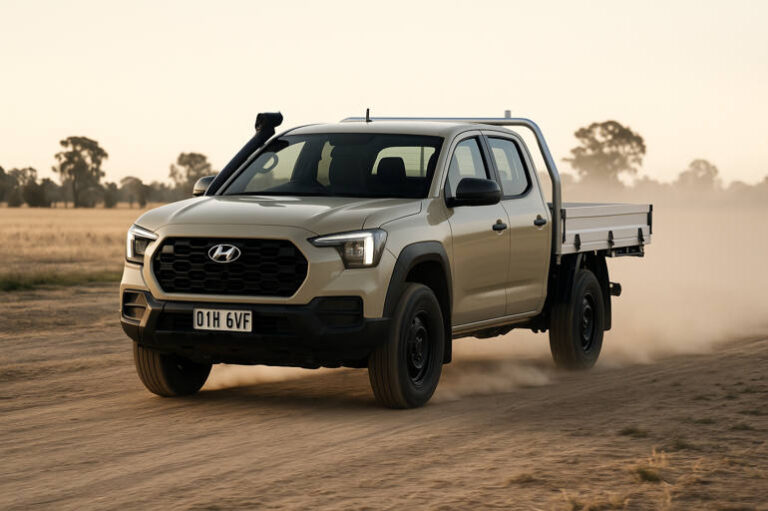
Despite tightening emissions policy and growing electric vehicle uptake, the Australian ute market is not disappearing anytime soon. If anything, it is becoming more competitive, more complex and more strategically important for brands that want long-term relevance with fleet and private buyers alike.
That reality was acknowledged directly by Hyundai Australia executives during a vehicle launch in late 2025, where discussion turned candidly to the future of utes, new market entrants and how NVES will shape — but not eliminate — demand.
The message was clear: utes are not going away, and Hyundai’s long-awaited entry into the segment is now firmly on the agenda.
NVES will reshape utes, not replace them
Much of the recent commentary around the New Vehicle Efficiency Standard (NVES) has assumed that large-volume segments such as utes will inevitably shrink. Hyundai’s leadership took a different view, recognising that utes remain deeply embedded in Australian buying behaviour — across trades, regional fleets and mixed-use households.
As Hyundai Australia Chief Executive Officer Don Romano explained, the importance of a ute extends beyond the vehicle itself.
“When I drive down my street and I see a ute in a driveway, there’s usually another car next to it… and wouldn’t you know that most of them are the same brand.”
For Hyundai, the absence of a ute is not just a missing model line — it is a missing connection to entire households and fleets that make brand decisions holistically. That reality sits alongside NVES, not in opposition to it.
Why Hyundai didn’t rush — and why timing matters now
Hyundai was open about the fact it could have pursued a ute earlier, but prioritised other segments and technologies first.
“We wanted to be the leaders in new technology and electrification. We can only do so much,” Romano said. “Now it’s time to look at other areas, and the ute is that area.”
From a fleet perspective, that sequencing matters. Hyundai arrives at the ute segment with established hybrid experience, EV capability and a clearer view of how emissions regulation will shape future procurement decisions.
Ranger and HiLux size confirmed
While Hyundai stopped short of revealing specifications, one point was made unambiguously: this is a Ranger and HiLux-sized ute.
When asked directly whether Hyundai was targeting that segment, Romano responded:
“Hilux and Ranger size. The answer’s yes.”
That confirmation alone positions Hyundai’s future ute squarely in the heart of Australia’s most contested vehicle category — one that continues to dominate fleet volumes despite growing policy and emissions scrutiny.
Not a rebadge, not a follower
Hyundai executives repeatedly stressed that simply sharing a platform or rebadging an existing vehicle would not be enough to succeed in today’s market.
“When you come out with a ute, you can’t come up with the same thing,” Romano said. “You’ve got to look at the best vehicles in the market… but you have to bring in some new technology.”
Platform sharing with General Motors has not been ruled out entirely, but Hyundai was clear that differentiation is non-negotiable — particularly with more Chinese-branded utes entering the market.
For fleet buyers, that signals intent beyond chasing volume. Hyundai appears focused on bringing something functionally and technologically distinct, rather than simply matching existing benchmarks.
Utes, hybrids and the reality of fleet transition
Hyundai’s broader strategy also provides important context. The brand has been vocal about offering choice — ICE, hybrid and EV — rather than forcing a single pathway.
That philosophy aligns closely with the ute market, where duty cycles, towing requirements and regional use cases make a one-size-fits-all solution impractical.
NVES will undoubtedly influence powertrain development, but Hyundai’s view — shared implicitly in the discussion — is that utes will evolve, not vanish.
What fleets should read between the lines
For Fleet EV News readers, the takeaway is not just that Hyundai’s ute is coming — but how it is coming.
- The segment remains strategically critical despite NVES
- Hyundai is targeting the core Ranger/HiLux size class
- Differentiation and technology are central to the brief
- The ute is seen as a gateway to broader brand and fleet relationships
- Electrification experience will inform, not override, the design
Romano summed up the mindset succinctly:
“We’re late, but we’re going to come on strong.”
In a market where utes remain essential tools for fleets — and emissions policy is driving smarter, not smaller decisions — Hyundai’s timing may prove more deliberate than delayed.