
Toyota has announced that a third powertrain option, and the second promising zero-tailpipe emissions compliance, will join the HiLux range in 2028, primarily for fleet buyers with heavy-duty needs.
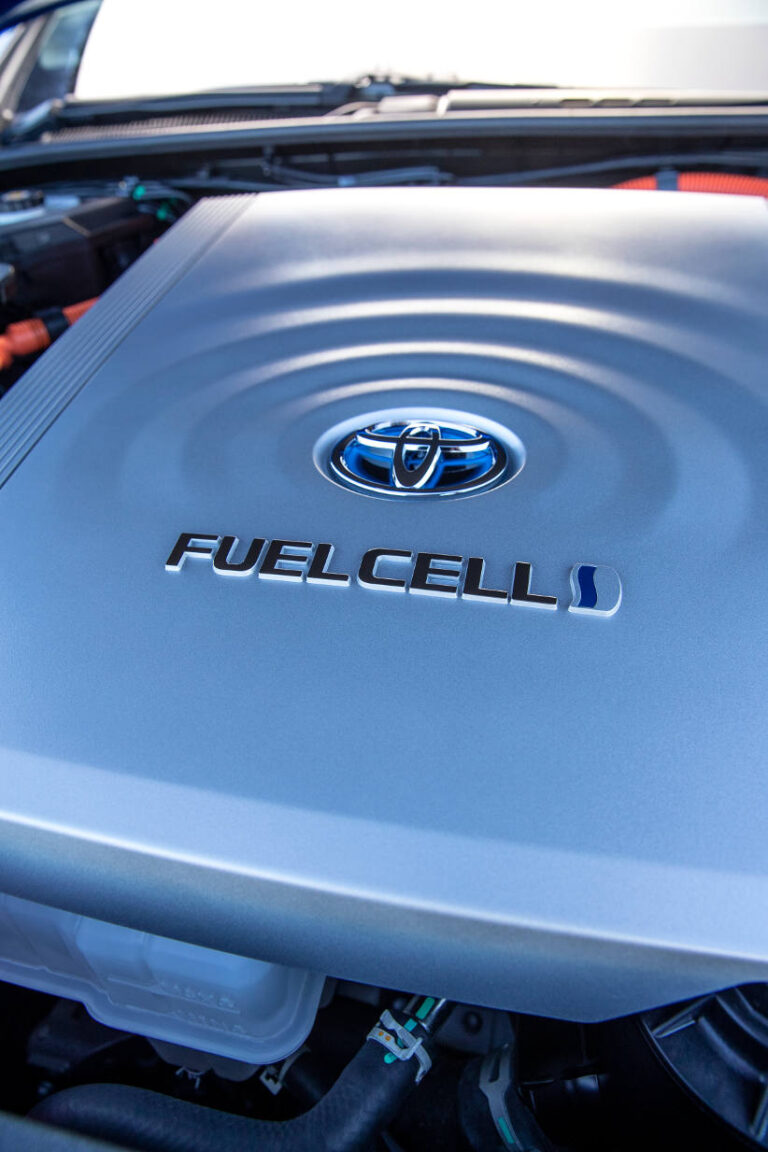
While a fully-electric (BEV) HiLux will quickly follow the diesel version of the next-gen ute, the future powertrain will be a hydrogen fuel-cell electric vehicle (FCEV).
That means that within three years, fleet operators managing growing ESG requirements will have two ‘electric’ HiLux options to choose from.
Toyota executives say that the BEV and FCEV versions of the HiLux will suit very different fleet customers, while the familiar 2.8-litre turbo diesel four-cylinder will continue to underpin the range with no hybrid engine option in sight.
“We have been talking about hydrogen for some time, and we really want to put a stake into the ground,” Toyota Australia vice president of sales and marketing Sean Hanley told Fleet News Group.
Toyota Investing in Mobile Refueller Infrastructure for Hydrogen HiLux Operators
Two hydrogen-fuelled cars are presently available on the Australian market in the form of the Toyota Mirai large sedan and Hyundai Nexo midsize SUV.
However, the sheer scarcity of hydrogen refuelling infrastructure means that the Mirai and Nexo have only been made available to very specialised fleet customers, and only directly via leases from the manufacturers themselves.
While FCEVs can typically be fully refuelled to around 500km range in less than 10 minutes, refuellers are complex and expensive. Low demand means only a handful exist in Australia, two of which are operated by Toyota (Altona, Victoria) and Hyundai (Macquarie Park, NSW) respectively.
“Between now and [2028, Toyota] will work very closely on further infrastructure,” Hanley told Fleet News Group.
“As part of our internal investment, we are looking to expand to mobile refuellers, which would be an interim step, not long term.”
These mobile refuellers, which will be transportable and likely containerised, would be placed in locations that suited fleets interested in acquiring a number of HiLux FCEV units—such as at mines.
However, Toyota sales boss Hanley told Fleet News Group that the infrastructure needs to grow to encompass “hydrogen highways” from Brisbane to Melbourne and on to Adelaide with hydrogen available at the bowser.
“It wouldn’t be beyond possibility to have [a hydrogen highway] across the Nullabor. On major highways, I think you could get that infrastructure fairly quickly,” he said.
Hanley pointed to the Australian Government’s multi-billion dollar investment in the nascent national hydrogen industry as a positive step.
Hydrogen HiLux May Be More Suitable Than EV for Heavy Towing
At launch, the HiLux FCEV is unlikely to be available through Toyota dealers on the open market as the purchase price will likely be prohibitive. It may be the case that the FCEV version is offered through leases from Toyota Australia to fleet operators, as is the case with the Mirai FCEV sedan.
“It is not our desire to be selling these direct for the long-term, but for the short term, it makes sense,” Hanley explained.
“We have to protect our dealers in terms of investments. They will have a role and I still believe that eventually, these fuel cell vehicles will become mainstream … I will sell it to anyone who wants it, but I think predominately, it will appeal to fleet and mining companies.”
The direct sales model would see the HiLux FCEV marketed to fleet managers differently to the BEV version that will beat the hydrogen HiLux to market by about two years.
Toyota is expected to sell and service the BEV through its extensive national dealer network.
But while Hanley said the BEV will offer the five-passenger capacity and similar payload to the 2.8-litre diesel HiLux, he acknowledged that outright range and towing capacity will not be diesel-like.
“One would suggest that a hydrogen FCEV has the capability to tow, and has the capacity to have range with heavy towing. In the longer term, [FCEV] is a far better solution than a battery EV for commercial use,” said Hanley.
“I don’t subscribe [to the view] that BEVs in the next five years will necessarily have low [driving] range [but] they won’t have the towing capacity.”
As a result, for operators requiring 500km-plus of daily driving range while towing around 3500kg, Toyota may be in a position to sell (or lease) the HiLux FCEV to fleets that require a low- or zero-CO2 solution.
Is a Hybrid HiLux the Missing Link for Fleets?
Despite the HiLux BEV being essentially ready for prime-time, and the hydrogen HiLux FCEV arriving in just three years, Toyota executives have dismissed suggestions that a hybrid-powered HiLux is a simpler solution for some fleets.
“While I think plug-in hybrids are a technology of the future [and] in the fullness of time we will probably bring that…to HiLux, right now we are going down the full BEV range and down the practical, fit-for-purpose route, which is what our customers desire,” said Hanley.
Toyota Australia continues to see diesel as the safe choice for fleets, while acknowledging that some niche operators will need a BEV now and possibly the FCEV later.
Speaking with Fleet News Group, Toyota global powertrain company president Takashi Uehara said that a hybrid-powered HiLux was “possible” but that developing it “depends on the customer.”
Meanwhile, Hanley said that Toyota was not concerned that it is missing an opportunity in light of the popularity of the BYD Shark 6 PHEV ute.
Still, the realities of Australia’s New Vehicle Efficiency Standard (NVES) legislation—and internal fleet carbon requirements—means that Toyota will likely need to eventually develop a regular hybrid or PHEV version of its ute.
While Chinese brands like BYD and GWM already have PHEV utes on the market, Japanese rival Mitsubishi is on the cusp of launching a Triton hybrid in global markets including Australia.
Final Word: The Days of Diesel-Only HiLux Are Over
While Toyota has moved towards full electrification at a relatively conservative pace, its decisions to develop BEV and FCEV versions of the HiLux ute reflect commercial realities in the Australian market and beyond.
National legislation is requiring carmakers to succeed in selling lower-CO2 models in order to avoid emissions penalties, while fleet managers are also facing internal ESG demands to green their fleets.
Many Aussie fleets have come to rely on dependable Toyota vehicles that can be serviced, maintained and put back on the road in an efficient time period, nationwide, and these fleets are demanding lower-CO2 options.
As a result, Toyota will:
- Launch the HiLux initially with the tried-and-tested 2.8-litre diesel engine
- Add a fully-electric HiLux in 2026 with similar passenger capacity and payload to the diesel, but with reduced range, especially when towing
- Supplement the HiLux line with a hydrogen fuel-cell powertrain from 2028 for operators that need to tow and can host a hydrogen refueller
- Continue to call for hydrogen to be available at the bowser on national highway routes
Establishing demand for the HiLux FCEV will be thoroughly dependant on the infrastructure picture in 2028. Unless emissions laws are watered down, it seems necessary that either BEV towing capacity and range improves, or hydrogen refuelling infrastructure is developed along popular routes.