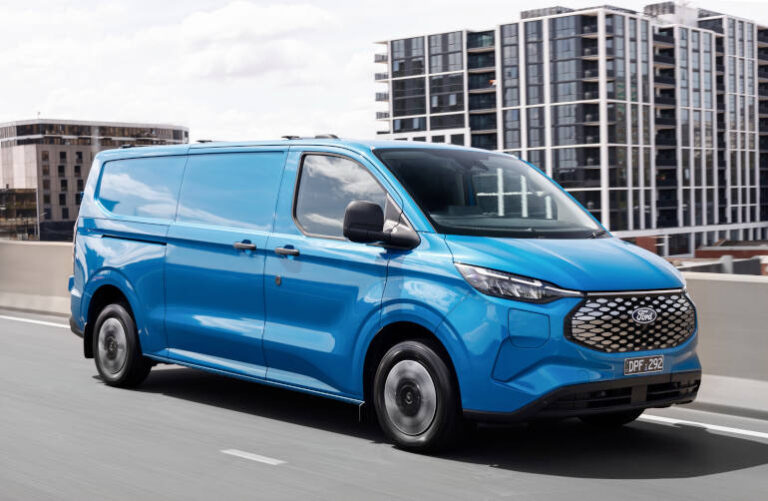
For six decades, the Ford Transit has been more than just a van. It’s been a mate to tradespeople, couriers, and small business owners — the quiet hero parked in driveways before sunrise, loaded with tools, ladders, and the promise of another day on the road.
But in 2025, the Transit story takes another leap forward. The new generation of Transit Custom — including the fully electric E-Transit Custom and plug-in hybrid variant — shows just how far vans have come. What was once purely about payload and toughness is now just as much about comfort, technology, and car-like handling.
The van that grew up with its customers
Since its first appearance in the 1960s, the Transit has mirrored the changing shape of work. It began as a basic box on wheels and became a benchmark for reliability. Along the way, it earned the loyalty of trades and small businesses across the world — and especially in Australia, where it quietly built a reputation for outlasting its owners.
Now, Ford has reimagined what a van can be. Underneath the 2025 Transit Custom is a new platform with independent rear suspension and electric power-assisted steering, both designed to give drivers a smoother, more confident feel behind the wheel. It’s a far cry from the rattly, truck-like drive of the past.
Ian Foston, Product Development Director Commercial Vehicles at Ford Pro Europe, explained at the launch that today’s van customers expect more than durability — they want comfort, safety, and refinement too.
“If I was an electrician carrying a lot of gear and wanted it to be secure, I’d choose a Transit Custom. It’s exactly the right tool for the job,” he said. “But it’s also great to drive.”
Driving dynamics that feel familiar
Fleet drivers who spend long days in traffic or on tight suburban streets will notice the difference immediately. The independent rear suspension and electric power steering transform the feel on the road, while the quieter drivetrains — especially in the E-Transit Custom — make every trip calmer and less fatiguing.
Ambrose Henderson, Marketing Director at Ford Australia, put it simply: “Until recently, there really hasn’t been a choice in vans that are great to drive, have great technology and straddle that work-to-play environment. The Transit Custom lineup is unique in that way.”
That shift in design thinking comes directly from Ford listening to how people actually use their vans. A large portion of Transit buyers are small business owners who use their vehicle as both a mobile office and their daily driver. As Henderson noted, “That’s their car. They’ve ordered it for themselves. It’s running their business, so that dual purpose becomes increasingly important.”
Comfort and technology now standard kit
Inside, the Transit Custom has caught up with passenger cars. The cabin features a 13-inch SYNC 4 touchscreen, digital instrument display, wireless Apple CarPlay and Android Auto, and even a fold-down tray table for paperwork or lunch. Heated seats, a heated windscreen, and premium materials turn long days into something closer to a commute than a shift.
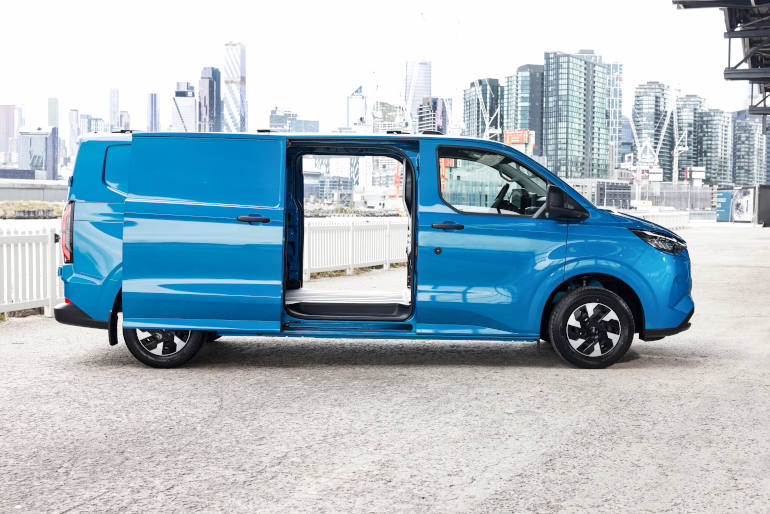
That comfort hasn’t come at the expense of practicality. Load areas still swallow up to four Euro pallets, and Ford’s mobile office pack — including universal mounting points and extra cabin lighting — makes it easier for tradies and couriers to use their van as a workspace.
A van that finally feels modern
Driving the new Transit Custom feels more intuitive than ever. One-pedal driving in the E-Transit Custom makes stop-start traffic easier, while regenerative braking extends the range between charges. The Trail AWD diesel variant adds versatility for those who still need all-terrain ability.
Even the steering wheel tells a story of evolution. Ford has been refining a tiltable steering wheel — part of the mobile office concept — designed to fold flat and become a laptop desk. It’s another nod to the way business owners actually live in their vehicles.
Still built for the long haul
Despite the comfort upgrades, the Transit Custom remains every bit a workhorse. Payloads stretch past 1,200 kg, and braked towing capacity reaches 2,300 kg for the PHEV and 2,500 kg for diesel variants. Both the electric and hybrid models are backed by Ford’s five-year, unlimited-kilometre warranty and 30,000 km service intervals, keeping ownership costs predictable.
The car-like van era has arrived
What started as a humble delivery van has evolved into something far more sophisticated. The 2025 Transit Custom proves that being a work vehicle no longer means sacrificing comfort or driving pleasure.
For many fleet drivers, it’s the first van that genuinely feels like a car — quiet, refined, and connected — yet still tough enough for the long haul.
After sixty years of helping small businesses move Australia forward, the Transit now moves the conversation too: what if your van didn’t just work for you, but worked with you?