

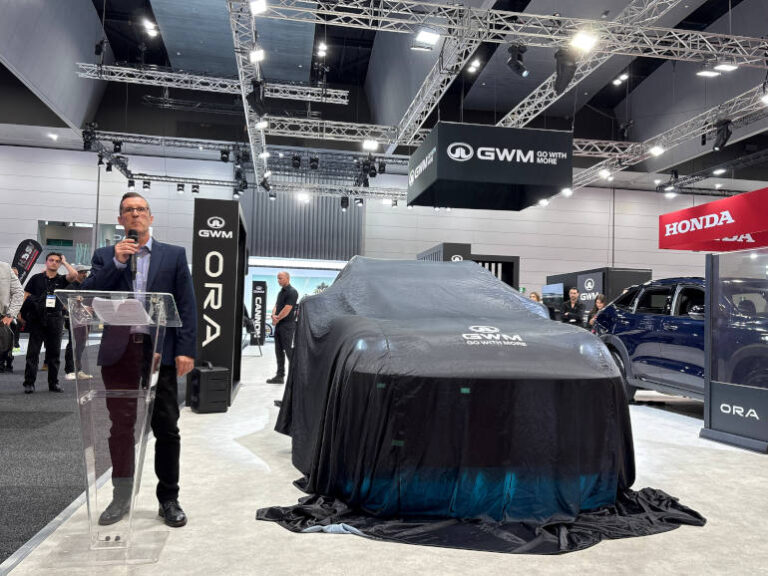
GWM used the Melbourne Motor Show to send a clear message to the Australian market: growth will be driven by electrification, competitive pricing, and a broader range of powertrain options aimed at mainstream buyers.
The announcements were less about a single hero vehicle and more about momentum. The brand highlighted record sales performance, strong demand for hybrid and plug-in hybrid models, and the relaunch of its electric vehicle strategy through the new Ora sub-brand.
For fleet buyers and procurement teams, the key takeaway is simple — GWM is positioning itself as a volume player across multiple fuel types, with a deliberate focus on price accessibility and rapid product expansion.
Record Sales Momentum Builds Confidence
The brand opened its presentation by reinforcing the scale of its recent growth in Australia. That context matters, particularly for fleet decision-makers assessing long-term supplier viability and resale value stability.
Steve Maciver, Head of Marketing and Communications at GWM Australia, pointed to sustained sales growth and increasing demand for electrified vehicles.
“After finishing 2025 in seventh position with 52,809 sales, a new record for GWM, 2026 has seen the brand continue to break records,” said Steve Maciver, Head of Marketing and Communications at GWM Australia.
He added that electrified vehicles are already playing a significant role in the brand’s performance.
“In March, new energy vehicles made up 46% of GWM’s total sales, with GWM being the nation’s biggest seller of plug-in hybrids and the fourth biggest seller of hybrids.”
That level of penetration is notable in the context of fleet procurement planning. It suggests the brand is building scale in electrified vehicles earlier than some competitors, which may support future parts availability, technician capability, and resale market confidence.
Ora Brand Relaunch Signals EV Expansion
The centrepiece of the announcement was the relaunch of the Ora sub-brand as GWM’s dedicated electric vehicle range.
The new Ora 5 SUV is the first model in what the company describes as a broader pipeline of electric vehicles arriving over the next two years.
“This is more than just the reveal of an important new model. It’s the relaunch of the Ora sub-brand as GWM’s fun electrified urban range,” stated Maciver.
From a fleet perspective, the strategy appears to be focused on affordability rather than premium positioning. The pricing structure is designed to lower the entry barrier for EV adoption, particularly for private buyers and novated lease customers — segments that are increasingly influencing residual values and total cost of ownership calculations.
Pricing Strategy Targets Mass Adoption
One of the most significant announcements was the pricing of the new Ora 5 SUV, which enters the market at a level typically associated with small petrol vehicles rather than battery electric vehicles.
“The Ora Lux will kick off in a very sharp $33,990 drive away, with the range-topping Ultra coming in at an incredibly attractive $36,990,” announced Maciver.
That pricing approach aligns with a broader strategy to make electrified vehicles accessible to a wider range of buyers.
“Our pricing strategy on this model sets the scene for the price positioning of those future GWM and Ora models you’ll see coming through later this year and into 2027.”
For fleet operators, the implications are practical rather than theoretical. Lower purchase prices reduce capital exposure, shorten payback periods, and create opportunities to trial new technology without committing to premium vehicle segments.
Broad Powertrain Strategy Reflects Market Reality
Rather than committing to a single technology pathway, GWM is continuing to offer a wide mix of petrol, diesel, hybrid, plug-in hybrid, and battery electric vehicles.
That approach reflects the current state of fleet operations in Australia, where infrastructure readiness, duty cycles, and asset replacement timing vary significantly between organisations.
“With petrol, diesel, hybrid, plug-in hybrid and now an increasing EV range, GWM has never been more ready to go with more than it is today.”
For Fleet Managers and Procurement Managers, this multi-powertrain strategy reduces risk during transition planning. It allows organisations to align vehicle selection with operational requirements rather than policy targets alone.
Local Tuning and Capability Remain Key Messages
Another consistent theme in the presentation was the emphasis on vehicles tuned for Australian conditions.
This remains an important signal for fleet buyers, particularly those operating in regional areas or demanding duty cycles where durability and reliability carry more weight than technology features.
The company highlighted its local ride and handling program as a core part of product development, involving collaboration between Australian engineers and global design teams.
That local validation process is increasingly becoming a baseline expectation for new entrants competing against established brands with long operating histories in the Australian fleet sector.
What It Means for Fleet Buyers
The announcements from GWM at the Melbourne Motor Show were not focused on a single breakthrough technology. Instead, they reinforced a long-term strategy built around scale, affordability, and product diversity.
Three practical signals stand out for fleet decision-makers:
- Electrification is moving into lower price segments faster than expected.
- New entrants are prioritising volume growth and accessibility rather than niche positioning.
- The transition to low-emission vehicles will likely be gradual and multi-pathway rather than a single technology shift.
For organisations planning fleet replacement cycles over the next three to five years, the message is clear. The competitive landscape is changing quickly, and price-driven electrification is becoming a realistic option for mainstream fleets rather than an early-adopter experiment.