

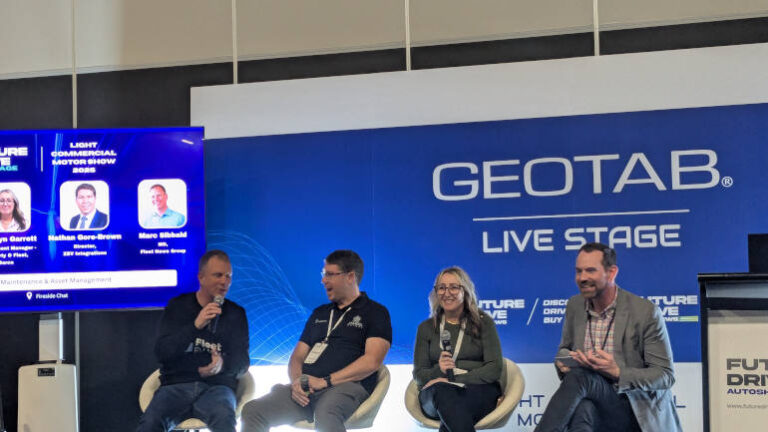
At the Light Commercial Motorshow in Sydney, an expert panel brought together three industry leaders to tackle one of the most pressing topics for fleet operators—how to shift from reactive maintenance and asset management to a proactive, data-driven approach that improves efficiency, reduces costs, and maximises uptime.
The session featured Marc Sibbald, Technical Director at WLC Fleet Consulting; Shannyn Garrett, Procurement Manager – Property and Fleet at Serco; and Nathan Gore-Brown, Founder of ZEV Integrations and Test EV. The discussion covered the evolution of maintenance strategies, breaking old habits, leveraging data and technology, and determining the optimal vehicle life cycle.
From Cost Centre to Strategic Asset
The panel opened with the question: How has fleet maintenance and asset management evolved from a reactive cost centre to a strategic driver of efficiency?
Marc Sibbald suggested the industry still has a way to go.
“We don’t quite have a seat at the boardroom table. If you took the keys for every vehicle in your business, the whole operation would stop—yet we have Chief Information Officers and Chief Technology Officers, but no Chief Fleet Officer.”
Shannyn Garrett countered that in highly fleet-dependent sectors like logistics, operations and fleet work closely, and the fleet’s role is already seen as essential.
“In logistics, fleet was so important to the business that operations and fleet had to work hand-in-hand. The importance really depends on how critical the fleet is for that organisation to run.”
Nathan Gore-Brown agreed that the maturity of maintenance practices depends heavily on the fleet’s role in operations.
“There’s a spectrum—fleets central to operations may do more preventative maintenance, while others with older, less critical vehicles tend to be more reactive.”
Breaking Old Habits
When asked about misconceptions that hinder effective maintenance, Shannyn noted that the old adage “if it’s not broken, don’t fix it” still lingers.
“It’s about moving away from the old-school style of needing to be a mechanic to run a fleet, and towards strategic thinking—implementing processes and procedures that are both effective and efficient.”
Nathan highlighted the persistence of outdated maintenance schedules.
“We’re still maintaining modern vehicles like it’s a HQ Holden in 1978. Old habits and old technical expectations sometimes trump what is just good business.”
Marc pointed out that while electric vehicles (EVs) need less routine servicing, they still require monitoring.
“EVs might need almost no servicing at all, but they still have maintenance needs. Telematics can identify where batteries are going flat or detect fault codes before they become big issues.”
The Predictive Maintenance Opportunity
Predictive maintenance emerged as a key theme, with Nathan sharing an example from an electric bus trial.
“We found one vehicle using 25% more energy than the others. The data showed it had a serious wheel alignment issue. That’s the power of using data—it flags a problem so you can fix it before it costs you.”
Shannyn emphasised that even non-technical fleet managers can make informed decisions by leveraging reliable data.
“You don’t have to be the expert in everything, but you do need to read the data and make informed decisions.”
Marc added that integrating maintenance into broader asset replacement policies makes fleets more efficient.
“Use the condition of the asset to set your replacement policies. That helps you either extend its life, shorten it, or reduce risk.”
Determining the Right Replacement Time
Many fleets still follow fixed replacement cycles—three, four, or five years—rather than basing decisions on asset performance. Marc argued that COVID-19 showed a better way.
“When COVID hit, we couldn’t replace vehicles on schedule, so we ran them longer. We assessed condition, moved underperforming assets out sooner, and kept the better ones longer. That’s smarter fleet management.”
Shannyn stressed the need for steady investment.
“You can’t just inject funds into the fleet every now and then because someone has a great business case. You need a 10-year plan so you hit that sweet spot consistently.”
Nathan said EV battery health testing will soon be a key factor.
“Replacement might not be driven by time or kilometres anymore—it could be based on battery health.”
Challenges: Data, Skills, and Culture
The panel identified three major challenges to improving maintenance and asset management:
- Data integrity – Shannyn:
“You can have all the data in the world, but if it’s no good, it’s garbage in, garbage out.”
- Skills shortages – Marc:
“Local governments that run their own fleet workshops are struggling to find skilled staff. It’s a big issue for the industry.”
- Organisational maturity – Nathan:
“Some fleets don’t even know the whole-of-life cost of a vehicle. You can’t make good decisions without that information.”
Key Takeaways for Fleet Managers
- Challenge the timeline mindset – Use asset condition and operational data to determine the optimal replacement point.
- Invest in data quality – Poor data means poor decisions.
- Leverage predictive tools – Telematics, AI, and battery health testing can prevent costly failures.
- Plan for the long term – Avoid bulk-buy cycles by embedding fleet into multi-year capital planning.
- Recognise maintenance as strategic – Fleet is a business enabler, not just a cost.
As Marc summed up:
“Determining fleet replacement cycles is like growing tomatoes—you have to pick them at just the right time. Get it wrong, and the value of the asset disappears.”