

An Australian fleet operating across some of the most remote parts of New South Wales has been recognised globally for its leadership in safety and sustainability.
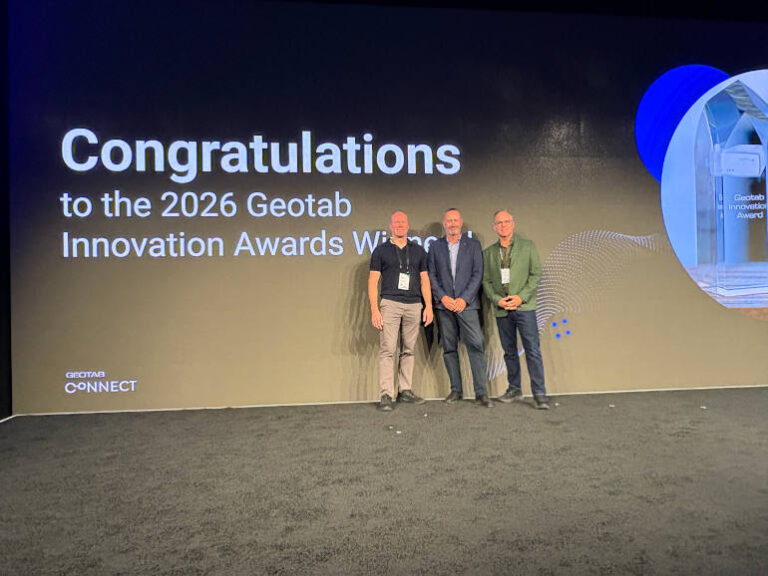
Essential Energy was named the 2026 Public Sector Champion at the Geotab Innovation Awards, announced at Geotab Connect in Las Vegas. The award recognises organisations that are using connected vehicle data and AI-driven telematics to deliver measurable outcomes across safety, efficiency and emissions.
For Michael Mills, Fleet Manager at Essential Energy, the moment was both significant and humbling.
“It feels quite humbling,” Mills said. “When you think about where we are on a world stage, we think we are a bit isolated in Australia. It’s great to see that what we do is recognised globally, particularly from a safety perspective and also an emission perspective.”
35 million kilometres of responsibility
Essential Energy’s crews travel around 35 million kilometres each year across regional, rural and remote NSW. Managing that level of exposure requires more than simple vehicle tracking.
Through the implementation of an in-vehicle monitoring system built on the Geotab platform, the organisation has:
- Nearly halved accident claims
- Reduced maintenance and fuel costs
- Lowered CO₂ emissions
- Strengthened emergency and duress response capability
Mills said the objective was always to keep the system simple from an end-user perspective while delivering meaningful outcomes.
“Our goal is to keep it simple from an end user point of view,” he said. “We wanted to offer that instant response in an emergency duress situation and give drivers the opportunity to have that self-correcting drive behaviour.
“Better drive behaviour drives down carbon emissions. It’s safer vehicles. We’ve chosen the community, so there are multiple benefits out of it.”
A three-way partnership model
The award also reflects the collaborative model behind the program. Essential Energy works closely with Nova Systems, a Geotab reseller, to tailor and support the solution locally.
Paul Weiss, Director Business Development and Alliances at Nova Systems, said the result highlights the strength of the three-way relationship between customer, reseller and platform provider.
“This award really underscores the power of the model that Geotab has put together,” Weiss said. “It really is a three-way relationship. We’ve got Michael’s leadership and an organisation that is absolutely focused on safety.
“As a partner, we’ve been innovating since 2012 and with Geotab since 2018. What we’ve always fostered is an absolute passion for customer service and support. We’re there to be inside the organisation, to be the fireside problem solver.”
Weiss described the partnership as “just unstoppable”, adding that the journey is only just beginning.
Learning from a global community
Attending Geotab Connect also reinforced the value of engaging with a global network of fleet leaders.
“Anytime you’re with people with a common goal, it’s exciting,” Mills said. “You hear what people are working on, what they’ve already done and how you can help each other.
“Some of the ideas we’ve had, people here have already brought to life. And some are looking at us saying, ‘Can we have a look in your folder?’ It’s a really cool place to be.”
For Essential Energy, the global recognition provides an opportunity to acknowledge the broader workforce that made the program possible.
“It puts us on that stage where we can get back and thank all of our people,” Mills said. “All those hundreds and thousands of conversations we had around implementing telematics and GPS solutions.”
Australian leadership in fleet safety
The award confirms that Australian public sector fleets are not merely adopting global best practice — they are helping to define it.
By combining clear safety objectives, behavioural change, and strong partnership support, Essential Energy has demonstrated how telematics can move beyond compliance to deliver tangible reductions in risk, cost and emissions.
For a fleet covering vast distances across regional Australia, that impact is measured not just in data points — but in safer journeys home.