

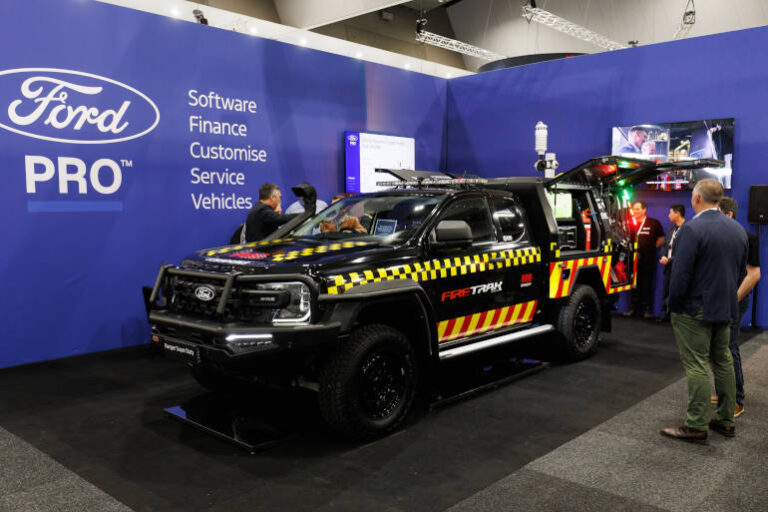
Ford Australia and Deakin University have unveiled a specialised Ford Ranger Super Duty Fire Response Unit designed to explore whether a lighter, highly mobile vehicle could help trained responders reach emergencies sooner.
Developed with XL Service Bodies, the custom-built unit was displayed at the AFAC conference in Melbourne and is intended to complement traditional fire appliances rather than replace them.
The concept highlights a familiar challenge for fleet operators: matching the vehicle to the task rather than simply relying on the biggest or most conventional option available.
Ford and Deakin mapped the emergency response process and identified an opportunity for trained personnel carrying essential equipment to arrive before a full-size appliance. With an eight-minute urban response benchmark, the idea is that a smaller vehicle could begin assessment, communications, initial suppression or first aid while additional resources are travelling to the incident.
Built around payload and mobility
The Ranger Super Duty was selected as the base vehicle because of its combination of payload, Gross Vehicle Mass and off-road capability.
With a 4,500kg GVM, the platform provides capacity for equipment and water while retaining the mobility required to reach locations that may be difficult for larger vehicles. Ford and Deakin selected the Super Cab configuration to maximise tray space while retaining secure and weather-protected storage for electronics and first aid equipment.
Jeremy Welch, Ford Pro Conversion development manager at Ford Australia, said the project was not intended to replace conventional firefighting vehicles.
“We are not trying to replace traditional fire trucks or the firefighters who crew them,” Welch said.
“But a Ranger Super Duty could carry the equipment needed to manage those critical first few minutes while the cavalry is on its way.”
For fleet managers, the project provides an interesting example of how vehicle capability can be evaluated around an operational requirement.
Rather than starting with an existing emergency vehicle format, the project considered what people, equipment and capability needed to reach the scene first, before selecting a suitable vehicle platform.
Designing the vehicle before building it
Ford and Deakin engineers used computer-aided design and full-scale virtual reality environments to develop the equipment layout before constructing a physical mock-up.
The process allowed the team to assess how equipment would be accessed in real-world operating conditions, placing ergonomics and usability alongside payload and vehicle performance as key parts of the design.
The unit also uses an integrated inverter and charging system supplied by Zeliox Australia to power its high-flow and ultra-high-pressure pumps. Solar capability is incorporated into the system, avoiding the need for a separate petrol or diesel generator.
It is an approach increasingly relevant to specialist fleets, where auxiliary power requirements can influence vehicle design, payload, maintenance requirements and operating costs.
A model for specialist fleet conversions
The project also demonstrates the growing role of vehicle converters in creating fit-for-purpose fleet solutions.
XL Service Bodies is a Ford Pro Convertor partner, while Ford’s broader converter program links vehicle owners with 12 certified upfitters operating across more than 45 accredited sites in Australia and New Zealand.
Ford can also undertake bespoke builds for specialised emergency services and mining fleets at its Broadmeadows manufacturing facility in Melbourne.
For fleet operators, particularly councils, utilities, emergency services and organisations operating specialist vehicles, the Fire Response Unit demonstrates the potential benefits of considering the vehicle, body, equipment, auxiliary power and operational workflow as one integrated fleet solution.
The Fire Response Unit remains a demonstration vehicle and has not been certified by a fire or emergency service authority.
However, the concept provides a practical example of how vehicle selection and specialist body design can be combined to reconsider established fleet operating models — and potentially get the right capability to where it is needed sooner.