

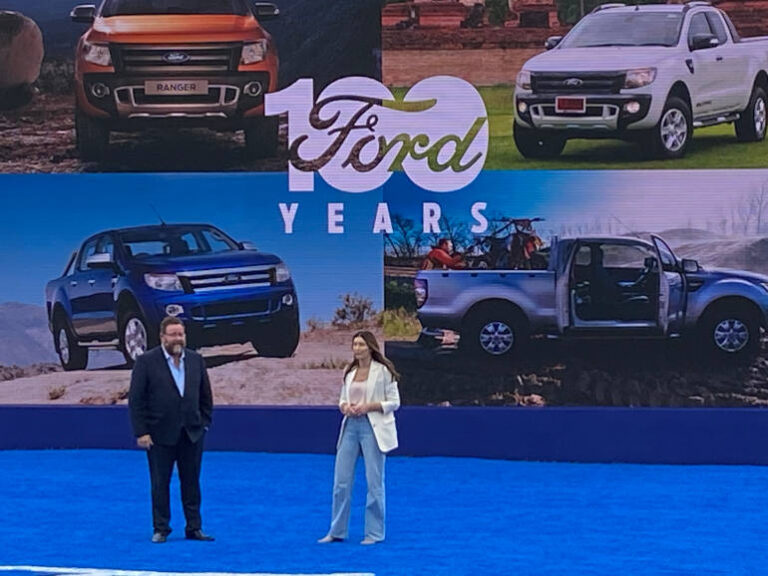
At the celebration of Ford’s 100-year history in Australia, Cleo Paradisis took the stage not just as a Chief Engineer, but as a symbol of what’s possible for women in automotive and young engineers looking to build meaningful careers on local soil.
“I actually wanted to work on airplanes,” Cleo shared during her interview with event host Shane Jacobson. “That’s why I studied aerospace engineering.” Her original career path wasn’t destined for automotive, but the opportunity to stay grounded—literally and professionally—brought her to Ford.
“Ford was one of very few companies here who offered true end-to-end product development right here [in Australia], and still is,” she explained. “That was really important to me, and I wanted to be part of that.”
That decision has not only shaped her own career—it has helped define some of the most significant vehicles in Ford’s global lineup. Cleo reflected on her proudest moment as being part of the team that worked on the first Ranger.
“It marked a real step change in our capability as an organisation and as a team,” she said. “From there, Ranger has grown strength to strength, and we continue to work on Ranger here—not just Ranger, but Everest, and we’ve also contributed to Bronco as well.”
It’s a quiet but powerful reminder that some of the most globally significant engineering work for Ford happens in Australia, and that those opportunities are accessible for young graduates and professionals—especially women—who may be underrepresented in engineering fields.
While the industry has long been male-dominated, engineers like Cleo Paradisis are reshaping the narrative. Her presence at a major public celebration, introduced as a key figure in Ford’s product development legacy, demonstrates how the organisation values technical expertise, leadership, and diversity.
When asked how it feels to help shape Ford Australia in its second century, her answer was as practical as it was optimistic: “Feels great. We have such an amazing history of innovation here, and we’ve evolved so much. I’m really excited to see how we continue to shape the future.”
That future won’t build itself—and that’s the opportunity. Ford remains one of the few Australian-based automotive companies offering full lifecycle product development. For engineering students and early-career professionals, especially women who might not yet see themselves represented in the industry, Cleo’s journey offers a clear message: you can make a global impact without leaving Australia.
As Ford moves into its second century, it’s clear the road ahead will be shaped by more engineers like Cleo—innovative, grounded, and committed to evolving the industry from within.