

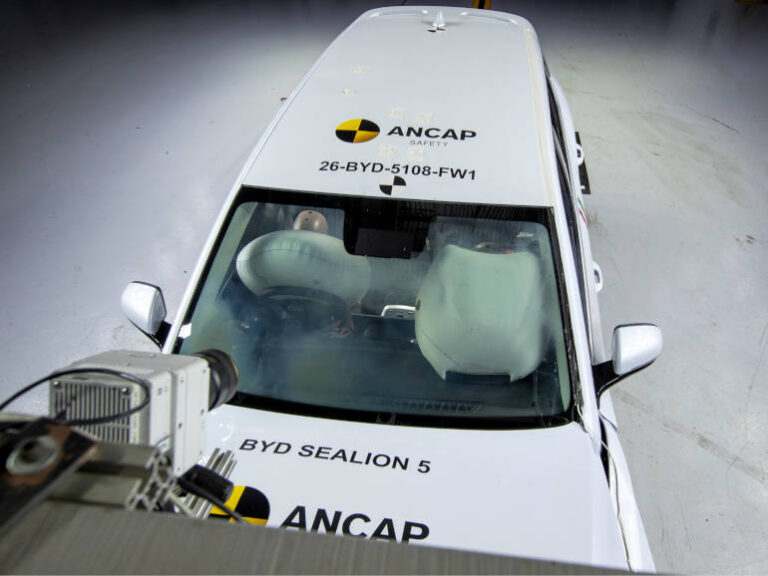
The BYD Sealion 5 has received a three-star ANCAP safety rating, with testing identifying limitations in crash avoidance and driver monitoring despite stronger results in crash protection.
The rating applies to both Essential DM-i and Premium DM-i plug-in hybrid variants sold in Australia and New Zealand, covering vehicles built from August 2025.
Assessed against ANCAP’s 2026–2028 criteria, the medium SUV scored 48 per cent for Safe Driving, 51 per cent for Crash Avoidance, 79 per cent for Crash Protection and 74 per cent for Post Crash.
For fleet buyers, the results highlight the importance of reviewing how safety systems perform in testing alongside the list of equipment fitted to a vehicle.
Crash avoidance delivers mixed results
The Sealion 5’s autonomous emergency braking system can detect vehicles, motorcyclists, pedestrians and cyclists. However, ANCAP found its performance varied across the scenarios assessed.
The report identified limitations in intersection situations, including potential T-bone collisions and when turning across the path of a pedestrian or cyclist.
Low-speed collision avoidance was another weaker area. Although reverse AEB is fitted, it avoided collisions in only a limited number of test scenarios.
Lane support testing also identified gaps. ANCAP reported no vehicle intervention when the Sealion 5 departed towards the road edge, while intervention to help prevent collisions with vehicles in an adjacent lane was limited to speeds below 70 km/h.
These findings are relevant to fleets operating across urban intersections, car parks and regional roads, where different crash avoidance functions may be called upon during everyday driving.
Driver monitoring has limitations
The Sealion 5’s driver monitoring system warned the driver and adjusted vehicle sensitivity for a range of common distractions. However, it could not detect phone use or intervene when a driver became unresponsive.
ANCAP also found that some controls relied on the central screen, including headlight adjustment, interior lights and climate control fan adjustment. These did not meet its requirements.
During an assessment on local metropolitan and regional roads, the vehicle correctly identified 66 per cent of speed limit change events, equivalent to 95 per cent of the distance driven.
The vehicle includes seatbelt reminders with occupant detection for all passenger seating positions, but child presence detection is unavailable.
Stronger performance in crash protection
Crash protection was the Sealion 5’s strongest assessment area, with maximum scores achieved for adult and child occupant protection in the side impact test.
The centre airbag also worked effectively to limit movement across the cabin and reduce the risk of the driver and front passenger striking each other during a side crash.
In the frontal offset test, protection for children in the second row was good. However, ANCAP identified a higher injury risk to the driver’s chest and lower legs, and the front passenger’s neck.
A deduction was also applied for crash compatibility because the Sealion 5 presented a higher risk to occupants of an oncoming vehicle in a head-on collision.
Full-width frontal crash protection was generally good, although additional sled and virtual testing showed weaker protection for different occupant sizes or crash severities.
Post-crash access performs well
Following the assessed crash tests, seatbelt buckles, interior and exterior door releases, and the tailgate remained operable, supporting occupant exit and access for rescuers.
Rescue information met ANCAP requirements, and the vehicle includes multi-collision braking and automatic hazard light activation. Automatic emergency calling, or eCall, is unavailable.
Battery voltage isolation met requirements in three of four destructive crash tests. A penalty was applied after voltage did not fall to the required level within the specified time during the full-width frontal test.
What it means for fleet procurement
For organisations requiring a five-star ANCAP rating, the Sealion 5’s three-star result will be a key consideration when assessing its suitability for fleet use.
The report also provides specific points to address during vehicle evaluation and driver familiarisation, particularly the limitations of AEB, lane support and driver monitoring.
Fleet managers considering the model should review the findings against their operating conditions and internal vehicle selection standards, with attention to both occupant protection and the ability to help prevent a crash.