

FleetPartners has suddenly become the hottest acquisition target in Australian fleet management.
SG Fleet, Element Fleet Management and ORIX are all circling the business, with FleetPartners now considering competing non-binding proposals.
It raises an obvious question: why now?
The answer may be that FleetPartners has spent the best part of a decade doing the difficult work that a new owner would rather not inherit.
The business has been through aggressive expansion, a failed diversification strategy, a proposed mega-merger, significant losses, asset sales, management changes, brand consolidation and a major technology transformation.
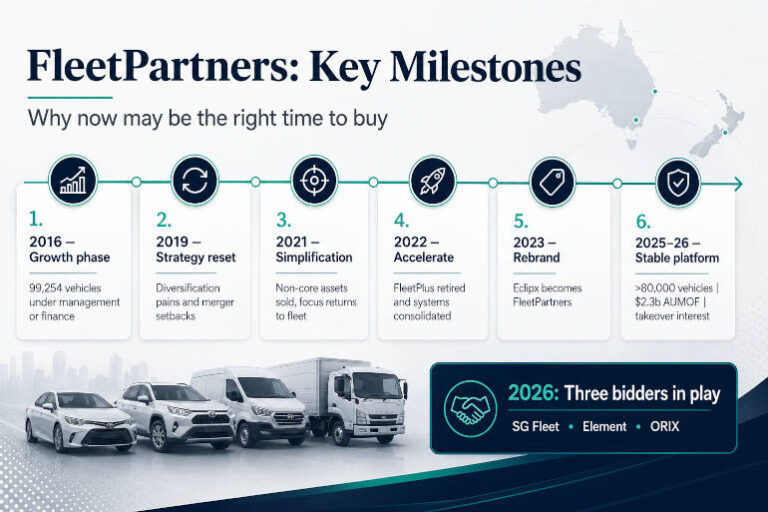
What is left in 2026 is a much simpler proposition: a focused fleet management and leasing business with more than 80,000 vehicles under management across Australia and New Zealand, $2.3 billion in Assets Under Management or Financed and a modernised operating platform.
In acquisition terms, the renovation has largely been completed.

The Eclipx growth years
Go back to 2016 and Eclipx Group was in expansion mode.
It had listed on the ASX in 2015 and by FY16 was reporting profit of $55.3 million, New Business Writings of $913 million and 99,254 vehicles under management or finance.
By 2017 it was managing more than 100,000 vehicles and pursuing growth beyond traditional fleet management.
The portfolio included FleetPartners and FleetPlus alongside CarLoans.com.au, FleetChoice, AutoSelect, Right2Drive and GraysOnline.
Then Chief Executive Officer Doc Klotz told investors that diversification into “horizontal and vertical adjacencies” would help continue the company’s growth.
At the time, acquisitions were also becoming a broader industry theme. Larger fleet and salary packaging companies were looking at bolt-on acquisitions because buying revenue and customers could accelerate growth faster than relying solely on organic sales.
Sound familiar?
Expansion came with a price
The broader Eclipx strategy eventually unravelled.
By FY19, the company reported a statutory loss after tax of $341.5 million, compared with a $53 million profit the previous year. Fleet Auto News reported at the time that the losses were linked to the failed diversification strategy.
The problems also killed what could have been an earlier fleet industry mega-merger.
McMillan Shakespeare had agreed in 2018 to merge with Eclipx after SG Fleet had itself made an unsuccessful approach earlier that year. By March 2019, however, deteriorating Eclipx earnings had effectively ended the proposed transaction.
It is worth remembering that history as SG Fleet again attempts to buy the business eight years later. The difference is the company it is bidding for today looks considerably different.

Simplify first
Julian Russell became Chief Executive Officer and began what became the Group Simplification Plan. The objective was to unwind the complexity accumulated during the expansion years and return the company to its strongest businesses.
Non-core operations including GraysOnline and Right2Drive were sold and attention returned to fleet management and novated leasing. By 2021, the transformation was largely complete.
Fleet Auto News reported that the Group Simplification Plan had been completed ahead of schedule, while net corporate debt had fallen substantially and the company had begun returning capital to shareholders.
Instead of trying to operate across numerous automotive businesses, Eclipx was becoming a much more focused fleet company.
From Simplification to Accelerate
The next job was fixing what remained inside the organisation. In 2022, Eclipx announced that FleetPlus and two other brands would be retired, leaving FleetPartners as the sole customer-facing brand.
The move formed part of the Accelerate program, designed to eliminate duplicated brands, processes and technology.
At the time, the project was expected to require around $24 million in capital expenditure and generate approximately $6 million in annual operating cost savings.
There was also another management change.
Damien Berrell, previously Chief Financial Officer, was selected to succeed Julian Russell as Chief Executive Officer in early 2023. A few months later, the Eclipx corporate name disappeared as well.
The company officially rebranded as FleetPartners in 2023, completing the shift back towards the brand at the centre of its original fleet management business.

The technology work is now done
Accelerate ultimately became a larger project than initially anticipated, but its significance to today’s takeover battle shouldn’t be underestimated.
The program consolidated Australian brands, systems and processes onto the Miles platform already used in New Zealand.
FleetPartners’ FY25 Annual Report says the completed program cost $31.5 million and is delivering annualised operating expense savings of more than $6 million.
Management says it has produced a more scalable and efficient operating platform across Australia and New Zealand.
There was disruption during implementation, particularly for Novated Leasing customers, and FleetPartners has openly acknowledged those issues.
But importantly for a potential buyer, the difficult systems migration has already happened. The operational backlogs created by the cutover were reported as cleared by the end of FY25.
A buyer doesn’t have to start that project.
It gets the platform after FleetPartners has spent the money, endured the disruption and worked through the implementation problems.

The numbers now look solid
The resulting business isn’t spectacular because of one extraordinary profit year. Its attraction is arguably that it looks predictable.
FleetPartners reported FY25 New Business Writings of $778 million, Assets Under Management or Financed of $2.3 billion and Core Income of $168.9 million. It generated $132.4 million EBITDA, $75.3 million statutory profit and $93 million in organic cash flow.
FleetPartners also reported retaining all material contracts across its Corporate, Government and Novated portfolios. And there are still more than 80,000 vehicles under management.
That provides something all three bidders understand very well: immediate scale.
Even the balance sheet story has changed
FleetPartners has also spent years returning surplus capital. Its multi-year share buy-back program returned approximately $281 million to shareholders from FY21 and resulted in 36 per cent of issued shares being cancelled.
The company then moved towards dividends.
FleetPartners finished FY25 with a corporate net cash position of $27.9 million while maintaining its warehouse and securitisation funding capabilities.
This isn’t a distressed company looking for a rescuer. Potential buyers are trying to acquire an operating business that FleetPartners itself says has predictable earnings, strong cash generation and a scalable platform.
That’s an important difference.

FleetPartners had even started buying again
Perhaps one of the clearest signs that the transformation phase was ending came when FleetPartners switched from selling businesses to buying one.
In November 2025 it announced the acquisition of Remunerator, expanding its salary packaging and Novated Leasing capability. That suggested FleetPartners believed its platform was ready to support another phase of growth. Instead, FleetPartners itself is now being pursued.
Someone else has already done the hard work
That may ultimately explain the timing better than anything else. A bidder buying Eclipx several years ago would have inherited multiple brands, non-core businesses, strategic questions and significant transformation work.
A bidder buying FleetPartners in 2026 gets something very different.
- The non-core assets have gone.
- The strategy has been narrowed.
- The management transition has occurred.
- The brands have been consolidated.
- The technology platform has been replaced.
- The cost reductions have been identified and largely delivered.
- And the underlying fleet portfolio remains substantial.
There will still be integration costs for whoever wins. Combining systems, people, customers and operating structures is never effortless.
But much of the work required to make FleetPartners a cleaner and more scalable fleet management business has already been paid for by existing shareholders.
And now everybody wants it
SG Fleet opened the latest contest at $3.60 per share. FleetPartners rejected that proposal as undervaluing the company.
Element arrived with $3.80 and a pathway to $4.00 under proposed exclusivity arrangements. SG Fleet responded by increasing its offer to $4.00. ORIX then entered with another $3.80 proposal.
Three experienced fleet management businesses examining the same asset and deciding they want to own it tells its own story.
Almost a decade ago, Eclipx was buying businesses in search of growth. Then it spent years undoing parts of that strategy.
Now, after simplification, management changes and a major technology overhaul, FleetPartners has become the thing everyone else wants to buy.
Sometimes the best time to buy a business isn’t before the transformation. It’s just after somebody else has finished paying for it.