

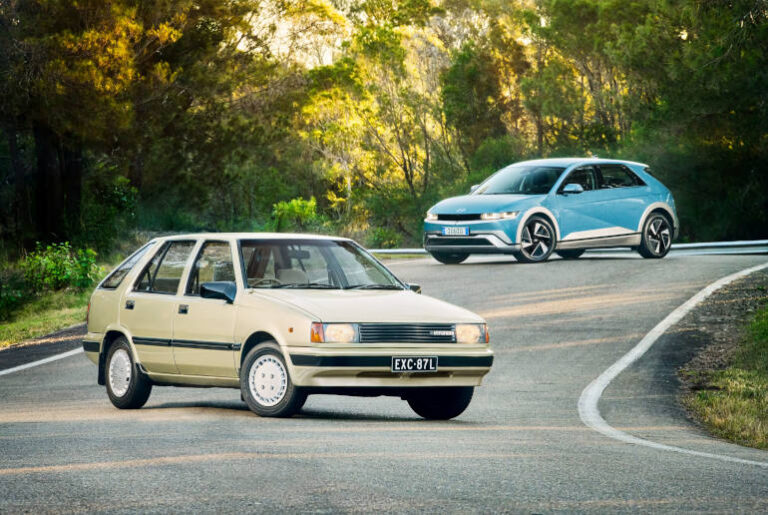
Hyundai is celebrating 40 years in Australia, marking a transformation from a little-known Korean brand sold through a single Perth dealership to one of the country’s most established automotive manufacturers.
The first Hyundai vehicles went on sale in Australia in August 1986, when Perth dealer John Hughes and entrepreneur Alan Bond secured the local distribution rights. Just eight vehicles were sold in the first month, but by the end of 1986 sales had reached 1,756.
Four decades later, Hyundai says more than 2.2 million of its vehicles have been sold in Australia.
The Excel was the vehicle that established the Hyundai name with Australian buyers. More than 250,000 were eventually sold locally, helped by pricing campaigns that made the small hatchback a familiar sight on Australian roads during the 1990s.
Hyundai’s next major volume success was the i30, launched locally in 2007. More than 450,000 have since been sold, making it Hyundai Australia’s best-selling model. At its peak, the i30 was Australia’s top-selling vehicle outright seven times between 2015 and 2017.
Building confidence beyond the purchase price
While competitive pricing was important to Hyundai’s early growth, the company also used warranty coverage and local vehicle development to build its position in the Australian market.
In 1999 Hyundai became the first mainstream automotive brand in Australia to introduce a five-year warranty, before moving to five-year unlimited kilometre coverage in 2007. New Hyundai vehicles are now covered by a seven-year unlimited kilometre warranty when serviced within the Hyundai dealer network.
The company also developed local suspension and steering programs to better suit Australian driving conditions, with Australian engineers increasingly collaborating with Hyundai’s global engineering teams.
Those developments helped shift the brand from being primarily associated with affordability to competing on areas including quality, safety, technology and whole-of-life ownership considerations.
From Excel to electrification
Hyundai’s Australian story has also tracked the broader transformation taking place across the automotive industry.
The IONIQ range launched locally in 2018 as the first nameplate in Australia to offer hybrid, plug-in hybrid and fully electric powertrains. KONA Electric followed in 2019, while the hydrogen-powered NEXO became certified for sale in Australia in 2021.
The IONIQ 5 arrived in 2021 and went on to win the 2022 World Car of the Year, while the high-performance IONIQ 5 N became Hyundai’s first Wheels Car of the Year winner.
Hyundai has continued expanding its electrified range with the IONIQ 6, INSTER and flagship IONIQ 9, while its commercial vehicle portfolio took another step towards zero-emission transport with the Australian launch of the MIGHTY Electric Truck in 2023.
For fleet operators, Hyundai’s evolution over the past 40 years also reflects how vehicle procurement has changed. Price remains important, but safety, warranty support, local suitability, fuel and energy consumption, technology and emissions now play a much larger role in vehicle selection.
A very different brand after four decades
Hyundai Motor Company Australia Chief Executive Officer Don Romano said the anniversary was ultimately about the customers who helped establish the brand.
“When I look back over the past 40 years, I don’t just see vehicles or milestones – I see millions of Australians who gave Hyundai a chance.”
Romano said Hyundai’s willingness to challenge expectations and approach things differently had been a consistent theme throughout its Australian history.
Hyundai Motor Company Australia itself was established in 2003 as a wholly owned subsidiary of Hyundai Motor Company. The brand reached one million Australian sales in 2012, two million in 2023 and has now passed 2.2 million as it celebrates its 40th anniversary.
From the Excel and i30 to today’s SUVs, performance models, electric vehicles and electric trucks, Hyundai’s first 40 years in Australia illustrate just how dramatically both the company and the Australian vehicle market have changed.