
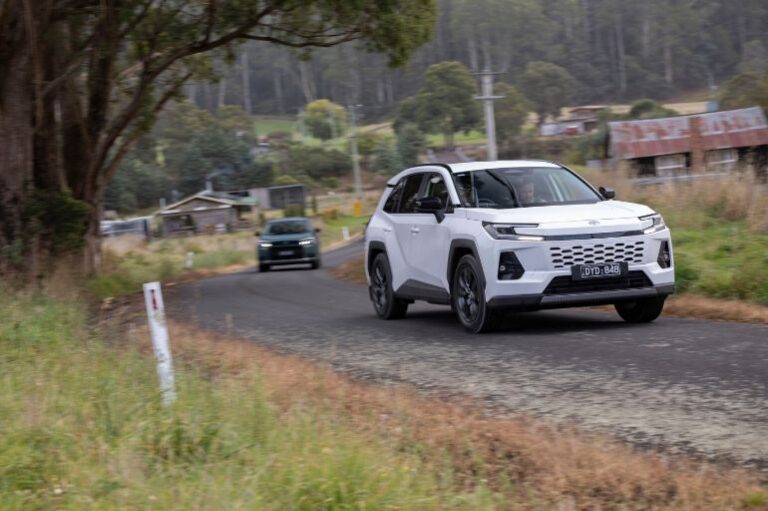
Resale value remains the strongest economic argument for the Toyota RAV4, with new data presented at the launch of the sixth-generation model reinforcing its position as a market leader in retained value.
Speaking at the national media launch, John Pappas, Vice President of Sales, Marketing & Franchise Operations at Toyota Australia, pointed to residual value performance as a defining advantage for buyers navigating rising living costs and tighter financing conditions.
“Another key strength of RAV4 is its resale value,” Pappas said. “According to Glass’s Guide, the Toyota RAV4 is by far the market leader when it comes to retaining the highest value at up to 75 percent.”
The figures presented at the launch compared the RAV4 GXL two-wheel drive against leading competitors, measuring retained value after four years and approximately 80,000 to 90,000 kilometres of use. The results reinforced a long-standing perception among buyers that the RAV4 delivers financial certainty beyond the initial purchase price.
For many households, that certainty matters more than ever.
“A vehicle is the second largest purchase they’ll make,” Pappas said. “Strong resale protects that investment, particularly for customers on novated leases or finance plans.”

Residual Value Drives Demand
The strength of resale performance is closely tied to the RAV4’s sustained demand in the Australian market. Toyota confirmed that more than 10,000 orders were recorded within days of wholesale deliveries beginning for the new model, reflecting ongoing buyer confidence in the nameplate.
Pappas said that loyalty within the RAV4 customer base remains a significant contributor to that demand.
“Approximately half of all RAV4 buyers have previously owned a Toyota,” he said, highlighting the brand’s ability to retain customers across product cycles.
That loyalty, combined with strong resale outcomes, creates a reinforcing cycle: buyers are more willing to commit to a vehicle when they have confidence in its long-term value, and strong resale performance supports sustained demand in the used-vehicle market.
Economic Confidence in Uncertain Times
The emphasis on retained value comes at a time when affordability and ownership costs are under greater scrutiny from consumers. Higher interest rates and cost-of-living pressures have shifted attention away from headline pricing and toward the total financial impact of vehicle ownership.
In that environment, resale value becomes a practical measure of economic resilience.
Pappas linked the RAV4’s financial performance directly to the broader trust built by the Toyota brand over decades in the Australian market.
“At times of uncertainty, consumers turn to brands they trust,” he said.
That trust, he noted, is supported by an extensive national dealer and parts network designed to provide long-term support for customers across metropolitan and regional areas.
A Consistent Value Proposition
While the new generation introduces updated technology, electrified powertrains and expanded connected services, the underlying value proposition remains consistent: reliability, durability and predictable ownership costs.
Pappas framed resale value as a continuation of those fundamentals rather than a new marketing message.
“RAV4 has always represented the best of what Toyota stands for — quality, durability and reliability — and of course, unbeaten resale value,” he said.
That continuity is likely to remain central to the vehicle’s appeal as the market transitions toward electrified powertrains and more complex vehicle technology.
For buyers weighing long-term financial outcomes, the message from Toyota is straightforward: technology may evolve, but retained value remains the benchmark by which ownership success is measured.
- FleetPartners takeover race narrows to three as Sumitomo joins the hunt
 The FleetPartners takeover contest has entered a more serious phase, and the latest update confirms something the market already suspected: there is real strategic value in this business. SG Fleet, ORIX and the Sumitomo Consortium have all returned with higher offers after getting access to FleetPartners’ books, while Element Fleet Management has decided not to
 - Novated leasing growth pushes Smartgroup past 91,000 vehiclesSmartgroup has reported continued growth in its novated leasing business, with the number of leases under management reaching 91,600 at the end of June 2026. The total was up 11,600 vehicles, or 15%, compared with the same period a year earlier. Smartgroup had 80,000 novated leases under management at June 2025 and 64,600 at June
- Everything Electric Gives Fleets a Chance to Put EVs to the TestFleet managers weighing up electric vehicles will have an opportunity to compare a growing range of models in one place when Everything Electric returns to Sydney Showground from 18–20 September 2026. More than 100 electric vehicle models are expected to feature at this year’s event, spanning passenger cars, vans, trucks and other forms of electric
- Why now could be the perfect time to buy FleetPartnersFleetPartners has suddenly become the hottest acquisition target in Australian fleet management. SG Fleet, Element Fleet Management and ORIX are all circling the business, with FleetPartners now considering competing non-binding proposals. It raises an obvious question: why now? The answer may be that FleetPartners has spent the best part of a decade doing the difficult work
- ORIX makes it three in the fight for FleetPartnersThe battle for FleetPartners has gone from an approach, to a bidding contest, to something resembling a fleet industry heavyweight bout. And we’re only in round three. ORIX Corporation has become the latest company to enter the process, lodging an indicative, non-binding and conditional cash offer of $3.80 per FleetPartners share. Its arrival follows Element