Toyota’s latest powertrain rollout reflects a principle Fleet Managers have applied for decades: the best vehicle is not necessarily the newest technology, but the one that is fit for the work it needs to do.
With hybrid, plug-in hybrid, battery-electric, diesel, performance hybrid and hydrogen technologies now part of its Australian product plan, Toyota is positioning its multi-pathway strategy around application rather than a single answer to fleet decarbonisation.

That means different powertrains for urban passenger vehicles, regional service fleets, mine sites, towing work, remote operations and high-utilisation commercial vehicles.
John Pappas, Vice President of National Sales, Marketing and Franchise Operations at Toyota Australia, told Fleet News Group said the company’s strategy was based on providing “the right vehicle with the right powertrain for the right time”.
“Toyota has long approached decarbonisation through a multi-pathway strategy that aims to offer Australians the right vehicle with the right powertrain for the right time,” Pappas said.
“Our role at Toyota is not to tell customers what they should drive. Our role is to provide the broadest possible range of practical lower emission solutions and allow our customers to dictate the pace of change.”
For fleet buyers, that approach shifts the conversation away from whether battery-electric vehicles will replace every diesel or petrol vehicle, and back towards the operational questions that determine vehicle suitability.
How far does the vehicle travel each day? Does it return to base? Can it be charged at work or at home? Does it need to tow? Is payload critical? Does it operate in regional or remote locations? How much downtime can the business tolerate?
Ray Munday, Senior Manager Product Planning and Pricing at Toyota Motor Corporation Australia, said no current powertrain could meet every requirement across Australia’s diverse vehicle applications.
“Toyota recognises there’s no silver bullet powertrain solution with current technology that meets the fit-for-purpose needs of all customers and all usage cases,” Munday said.
“Each powertrain has to balance the amount of energy that can be stored, the efficiency of using that energy, including under load, the mass, and the size of the powertrain, which impacts things like payload, the time it takes to refuel, and, of course, the cost.”
Matching powertrains to fleet tasks
Toyota’s recent product announcements provide a clearer picture of how it sees each technology fitting into the Australian market.
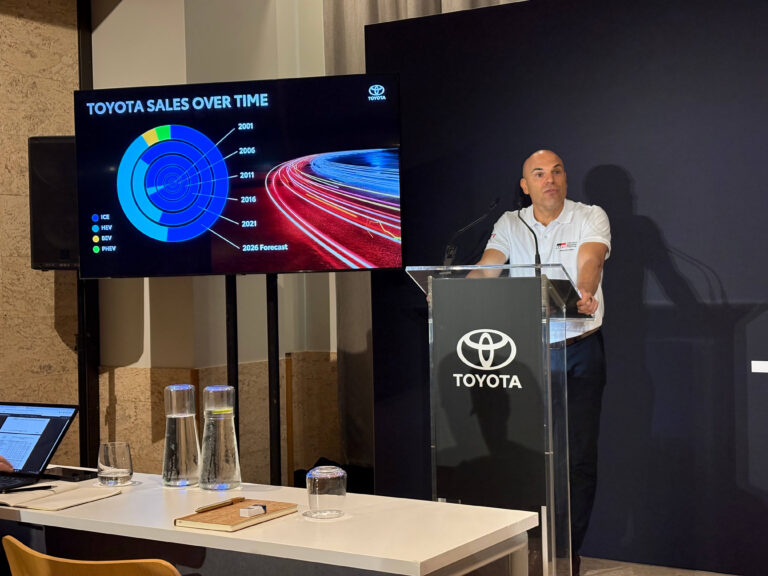
Hybrid remains the volume option for fleets that want lower fuel use and emissions without charging infrastructure or changes to driver behaviour. Toyota expects efficiency hybrids to account for 39 per cent of its Australian sales in 2026.
Pappas said Toyota’s hybrid experience showed that customers adopted new technology when it was convenient, affordable and reliable.
“Hybrid technology allowed customers to lower emissions without changing their behaviour,” Pappas said.
“There was no need for charging infrastructure, no changes to ownership routines, and importantly, hybrids delivered strong fuel efficiency alongside the quality, durability, and reliability Toyota is known for.”
Plug-in hybrid vehicles are likely to become the next step for many passenger and SUV fleets. The new RAV4 PHEV offers up to 154km of electric-only range on the NEDC test cycle, while retaining petrol-hybrid capability for longer trips.
However, the fleet benefit will depend on how well organisations manage charging. A PHEV used primarily as a petrol vehicle will not deliver the same emissions or fuel-saving outcome as one charged consistently at a workplace or driver’s home.
Munday said PHEVs suited customers who completed shorter daily trips but still needed long-distance flexibility.
“PHEV plug-in hybrid electric vehicles allow a customer who spends most of their time doing shorter commutes the opportunity to run on EV alone with the convenience of long-range ICE driving when needed,” Munday said.
“This is particularly useful for customers who can charge at their home or office daily.”
HiLux BEV targets defined fleet work
The HiLux BEV is Toyota’s clearest example of a vehicle designed around a specific operating task rather than broad consumer appeal.
Toyota has developed the electric ute for mining, government, construction, energy and fleet operations that have accessible charging and can work within predictable operating ranges.
Its 59.2kWh battery provides a claimed 315km range for pick-up variants and 245km for cab-chassis models. Toyota says the vehicle retains payload capacity of up to 855kg, 2,000kg braked towing capacity, 700mm water wading depth and four-wheel-drive capability.
Munday said the smaller battery was a deliberate choice to balance packaging, weight, durability and work capability.
“While the driving range is relatively low compared to other BEVs, the HiLux BEV was developed for specific applications,” Munday said.
Toyota says it has already secured more than 300 customer orders for the HiLux BEV, including orders from BHP, Newcastle Coal, Acciona and Essential Energy.
Pappas said the early orders showed industrial fleets were prepared to electrify vehicles where the duty cycle and infrastructure made sense.
“These are organisations that depend on their vehicles in some of the most demanding conditions Australia has to offer,” Pappas said.
“Their confidence in HiLux BEV demonstrates that our multi-pathway approach is delivering real solutions for commercial customers who are serious about reducing emissions without compromising on quality, durability, and reliability.”
Diesel remains part of the plan
Toyota is also making it clear that diesel will remain relevant for applications where long range, towing, payload and remote operation are still difficult to achieve with battery-electric technology.
Munday said diesel remained well suited to highway towing, remote-area work and applications where fuel could be stored on farms, construction sites and other operating locations.
“Diesel engines maintain efficiency under load, and the fuel can be stored on farms and construction sites,” Munday said.
“[Diesel] is therefore ideal for highway towing and remote area usage applications, where payload is critical.”
Toyota is also looking to renewable diesel as one potential pathway for reducing emissions from vehicles that cannot yet be readily electrified.
The real test is fleet support
For fleet buyers, the product range is only one part of the equation.
Managing multiple powertrains will require consistent dealer capability, technician training, parts availability, recovery arrangements, battery health assessment, charging advice and data management across metropolitan, regional and remote Australia.
Pappas said Toyota’s dealer network would become increasingly important as more technologies entered the market.
“Customers want reassurance, they want trained technicians, they want access to servicing expertise, and they want confidence that they will be supported wherever they travel,” Pappas said.
Toyota expects 30 per cent of its Australian sales to come from PHEVs, BEVs and fuel-cell electric vehicles by the end of 2030.
For Fleet Managers planning replacement programs over the next 10 years, Toyota’s message is becoming clearer: decarbonisation will not be a single vehicle decision. It will be a series of fit-for-purpose decisions based on how each vehicle is used.