
Mazda is no longer quietly participating in the fleet market — it’s stepping forward with a structured national program and clear intent to compete for a greater share of business buyers across all sectors.
That’s the message from Jarrod Gieschen, Mazda Australia’s Director of Sales and Marketing, who says the company’s new four-tier fleet structure is more than a relaunch — it’s a signal to the market that Mazda is ready to play a bigger, more visible role in fleet.
“We’ve formalised what we’ve been doing for some time,” Gieschen said. “But now we’re communicating directly with the broader fleet audience. We’ve had many fleet customers with passenger and SUV models already — this program gives us the framework and the visibility to grow that business.”
Formal Program, Broader Reach
The new Mazda Fleet Program spans the full range of passenger cars, SUVs and BT-50 utes. It introduces a structure designed around four distinct buyer types — ABN (retail) fleet, large fleet (11–49 vehicles), corporate (50+ vehicles), and government and not-for-profit customers.
Until now, Mazda’s fleet program was primarily focused on large organisations purchasing BT-50s. The new framework extends the offering to include all model lines and all buyer categories, supported by Business Development Managers in every state and Mazda’s network of 148 dealer partners.
“Our dealer network is one of our biggest strengths,” Gieschen said. “Most dealerships are already geared up to support business customers, but this program tells the market that Mazda is trained, ready and serious about fleet.”
Why Now? A Strategic Shift, Not a Stopgap
When asked if the move was a short-term reaction to a slowing retail market, Gieschen was clear that Mazda’s fleet focus is part of a longer-term strategy.
“It’s probably a little bit of both,” he admitted. “Private buyers make up around 61% of our sales. Economic challenges are affecting the private market, and at the same time competition is intense. We’ve got the scale and infrastructure to sell at these levels — to do that sustainably, we need to be talking to every buyer type more formally.”
The timing also coincides with an expanded product portfolio and solid supply out of Japan, giving Mazda a competitive advantage in delivery speed — a factor that proved decisive during COVID and continues to appeal to fleet customers today.
“Our nimble production processes mean we can deliver quickly,” Gieschen said. “That flexibility helped us win business during the supply shortages, and we’re now using that same strength to grow our presence in fleet.”
Preparing for 2026: New CX-5 and Mazda’s First EV Sedan
Gieschen confirmed that 2026 will be a transformative year for Mazda, headlined by the arrival of an all-new CX-5with hybrid technology and a new ANCAP five-star rating. Despite being in its final model phase, the current CX-5 remains one of Australia’s top-selling medium SUVs — and its successor is expected to play a central role in Mazda’s fleet growth strategy.
Adding to that momentum, Mazda will introduce its first battery electric sedan, developed in partnership with long-time manufacturing partner Changan. The vehicle, already on sale in Europe, will be positioned as a competitively priced mid-size EV — a first for Mazda’s Australian lineup.
“It’s the first time this collaboration has seen a vehicle sold outside of China,” Gieschen explained. “It combines the benefits of a Chinese cost base with Mazda’s design, engineering, and dealer infrastructure. The sedan format will appeal to parts of the fleet market that value practicality and value-for-money.”
Mazda plans to showcase the new EV to major fleet buyers before its retail launch — a first for the brand. Selected fleet customers will be invited to a private track event to test the vehicle ahead of its public debut.
BT-50 and the Road Ahead
While the BT-50 continues to anchor Mazda’s fleet volume, Gieschen emphasised that the program isn’t built solely around utes. The addition of new models and powertrains will help Mazda balance future National Vehicle Emissions Standards (NVES) requirements across its portfolio.
“We’ll focus on what customers want and manage NVES accordingly,” he said. “The BT-50 remains a big part of our fleet business, but with new technologies like the upcoming EV and hybrid CX-5, we can balance our range effectively.”
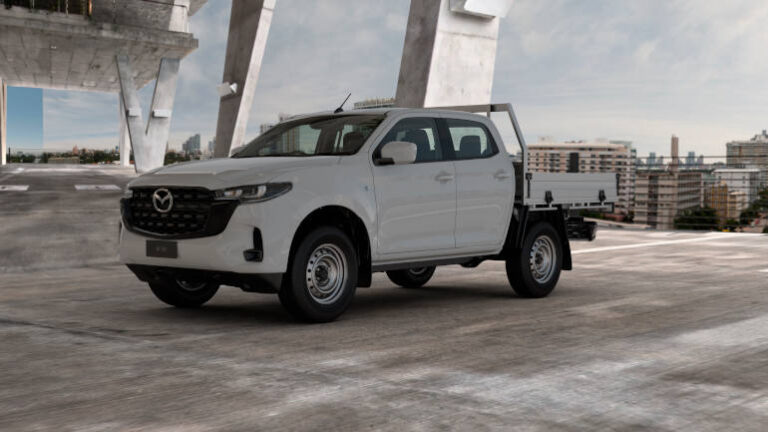
Mazda recently launched a 2.2-litre BT-50 variant, aimed at fleet buyers seeking lower fuel use and improved running costs. The Dual Cab Pick Up XS only produces 167 grams/km of CO2 compared to 185 grams/km for the XT 3.0L in the same model.
Fleet Confidence, Brand Consistency
Mazda’s strength in the used market — consistently among the top performers for resale value — remains a key attraction for fleet buyers. Gieschen attributes this to consistency in product quality, pricing discipline, and customer trust.
“There’s a lot of trust in our brand and in the experience people have when they buy a Mazda,” he said. “We’ve always considered our customers — including those in the used market — in every decision we make.”
The Message to Fleet Managers
For Fleet Managers, the message is clear: Mazda’s move into the fleet space isn’t a passing phase — it’s the start of a more structured, strategic engagement with business, government, and community operators.
With a dedicated team, nationwide dealer support, and a product lineup that’s expanding into hybrid and electric vehicles, Mazda is positioning itself to be a major contender in 2026 and beyond.
“This isn’t a short-term play,” Gieschen concluded. “We’re setting ourselves up for the next period — with the right products, the right structure, and the right support in place. Fleet is a big part of Mazda’s future.”