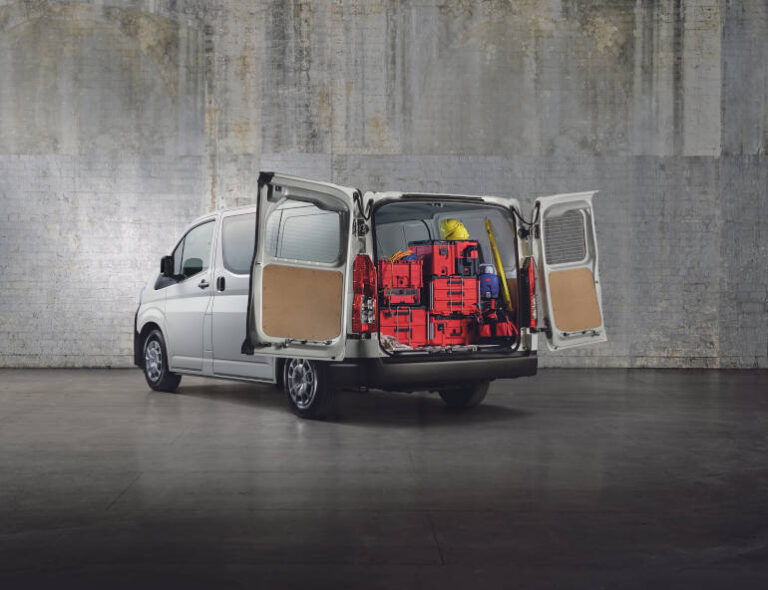
Toyota has updated its HiAce van range, adding new safety and convenience features that will appeal to businesses and operators who rely on the model as a workhorse.
Expanded Safety Suite
The HiAce now comes standard with an expanded Toyota Safety Sense package. Key additions include:
- Lane Trace Assist – helps keep the van centred in its lane when adaptive cruise control is active.
- Emergency Driver Support System – works alongside Lane Trace Assist to detect if the driver becomes unresponsive. If alerts are ignored, the system activates hazard lights and brings the vehicle to a safe stop.
- Safe Exit Assist – links with the blind spot monitor to warn occupants of approaching vehicles or cyclists when opening doors roadside.
Cruise control has also been updated, with high-speed adaptive capability on manual grades and full-speed function for automatic grades.
Existing safety features such as automatic high beam, lane departure alert, pre-collision safety system, and speed sign assist remain part of the package.
Passive safety has been bolstered too, with a new centre airbag taking the total to eight. LWB Crew variants now have 10 airbags thanks to two additional side units.
Driver Comfort and Convenience
The updates include electric power steering, making manoeuvring easier, and enabling the new Lane Trace Assist function.
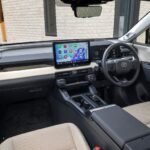
All models now feature a 7.0-inch digital instrument cluster with nine driver-selectable displays. Other enhancements include:
- Electric parking brake (all grades except the entry-level manual LWB)
- Improved air conditioning performance with a new refrigerant
- Black exterior mirrors across the range
- Twin rear wipers for SLWB barn door variants
Range and Powertrain
The HiAce continues to be offered in a wide variety of configurations to suit commercial applications, including long wheelbase (LWB) and super long wheelbase (SLWB), with options for lift-up tailgates or barn-style rear doors.
All grades are powered by Toyota’s 2.8-litre four-cylinder turbo-diesel engine (130kW / 450Nm with automatic, 420Nm with manual). A six-speed automatic is standard, with the six-speed manual limited to the entry LWB Van.
Why It Matters for Fleets
For businesses that put drivers on the road for long shifts, the new driver monitoring and emergency stop system is a notable safety enhancement. It addresses fatigue and medical emergencies, offering an extra layer of protection.
The improvements to steering and instrumentation also support driver comfort, which can have flow-on effects for productivity and safety.
Sean Hanley, Toyota Australia Vice President Sales, Marketing and Franchise Operations, said:
“These latest upgrades ensure improved levels of safety for both occupants and other road users, which is of particular importance given how much time drivers spend on the road in their HiAce.”
Pricing (Manufacturer’s RRP)
- LWB Van MT – $51,880
- LWB Van AT – $53,880
- LWB Van Barn Door AT – $54,630
- LWB Van GL Package AT – $54,880
- LWB Van GL Package Barn Door AT – $55,630
- LWB Crew Van AT – $56,880
- SLWB Van AT – $62,440
- SLWB Van Barn Door AT – $63,190
(Excludes on-road costs. Pricing may vary by state.)
- Bigger trucks, older bridges and new drivers are reshaping bridge strike risk
 Australia’s bridge strike problem is not simply a question of drivers failing to read a clearance sign. The combination of growing freight volumes, pressure for more productive heavy vehicles, an ageing road network and a changing driver workforce is making the issue more complex for fleet operators. That was one of the themes to emerge
 - Can in-cab coaching prevent the incident before it happens?Real-time alerts and video verification are moving fleet safety technology beyond post-event investigation. The Teletrac Navman research suggests drivers can accept these tools when alerts are clear, reliable and used as part of a fair coaching process. Traditional fleet safety processes often start after an event: a near miss, collision, complaint or telematics exception is
- BYD Shark 6 recall highlights the hidden fleet cost of a 30-minute repairBYD Australia has announced a safety recall affecting approximately 32,009 Shark 6 vehicles, providing Fleet Managers with a timely reminder that the real cost of a vehicle recall can extend well beyond the time spent in the workshop. The recall covers certain Shark 6 vehicles produced between 29 August 2024 and 15 June 2026. BYD
- Driver inductions matter more as vehicle technology changesFleet safety has always involved choosing the right vehicle, maintaining it correctly and making sure drivers understand their responsibilities behind the wheel. But as new vehicles become more sophisticated, there is another part of the safety management system that deserves more attention: driver induction. Modern cars are arriving with new safety systems, different control layouts,
- Kia tackles the ‘bings and bongs’ challenge as fleet safety requirements riseFive-star ANCAP ratings remain an important requirement for many Australian fleets, but achieving those ratings increasingly requires active safety systems that can generate alerts some drivers find frustrating. Kia Australia says it is trying to balance the two requirements by pursuing high safety ratings while making driver assistance systems easier for vehicle operators to manage.