
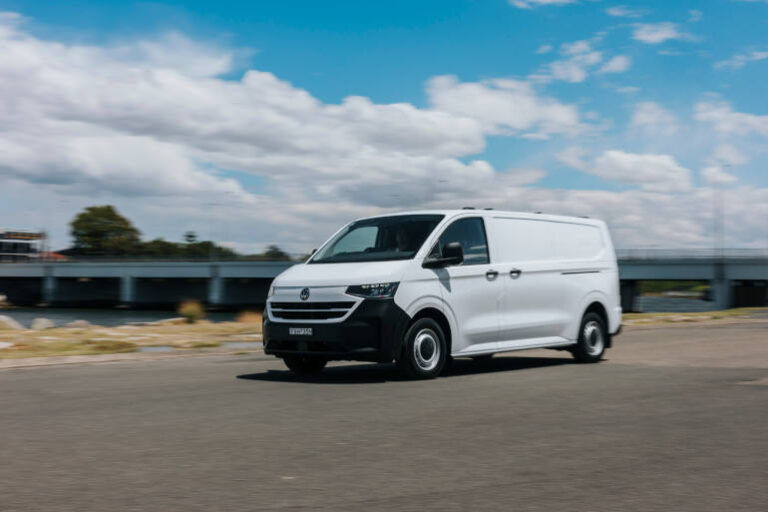
Few nameplates have the heritage, loyalty, and sheer versatility of the Volkswagen Transporter. Across seven generations, this van has become more than a fleet vehicle — it’s been a trusted workmate, a camper, a delivery van, and a brand ambassador for countless small businesses. And now, with the arrival of the all-new Transporter T7, Volkswagen Commercial Vehicles is writing the next chapter in a story that stretches back more than 70 years.
From the T1 to Today — A Van With a Legacy
The Transporter story began in 1950 with the original T1 Kombi, inspired by the simple idea of turning the Beetle’s rear-engine layout into a practical work van. That first generation gave birth to a global phenomenon: a van that could carry tools, people, and dreams in equal measure.
Through the decades, the Transporter has evolved — from the T2 “Bay Window” that became a symbol of the 1970s surf and camping culture, through the T3 and T4 models that modernised the platform with front-mounted engines and improved safety, to the T5 and T6, which cemented Volkswagen’s reputation for refinement and reliability in the commercial segment.
Fleet buyers have long gravitated to the Transporter for its balance between car-like handling and cargo practicality. It’s been the dependable choice for trades, couriers, and converters — anyone who needed a van that worked as hard as they did. As Volkswagen’s engineers often say, the Transporter has always been a tool for professionals, but one with a distinctly human touch.
The Fleet Favourite
In Australia, the Transporter has been a quiet achiever in fleet garages for decades. Many small and medium-sized businesses — from electricians to councils — have relied on it for its durability and refinement. Volkswagen’s current collaboration with converters such as Frontline, AutoSafe, and Sortimo has made it one of the most flexible platforms on the market.
“Volkswagen Commercial Vehicles works closely with converters, small and large businesses and individuals to get the best out of their Transporter,” said Michelle Rowney, Head of Product and Marketing at Volkswagen Commercial Vehicles Australia.
That collaborative approach has enabled the brand to create fit-for-purpose solutions across trades, logistics, and even emergency services. With the Volkswagen Partner System, fleet buyers can specify vans directly for their needs — from racking systems to dual-battery setups and camper preparations — with the assurance of full factory support.
The All-New T7: Built for the Next Era
The Transporter T7, launching in Australia in late 2025, represents the first all-new generation in a decade. Available with diesel, plug-in hybrid (PHEV), and battery-electric (BEV) powertrains, it marks Volkswagen’s shift toward electrification while retaining the practicality fleets depend on.
The new lineup starts with a 2.0-litre 125 kW/390 Nm TDI diesel with front- or all-wheel drive (4MOTION), and expands to a 210 kW/415 Nm BEV offering 330 km of range and fast DC charging from 10–80% in just 38 minutes. A PHEV variant follows in mid-2026 with 171 kW of power and up to 60 km of electric-only range.
Payloads stretch up to 1,062 kg, and the towing capacity peaks at 2.8 tonnes — proof that capability hasn’t been sacrificed for sustainability. The T7’s new body offers up to 6.8 m³ of load volume, an improved turning circle, and a lower load sill, all key benefits for urban fleets.
Inside, the Transporter has gone digital. The cabin now features a 13-inch touchscreen paired with a 12-inch digital cockpit, wireless App-Connect, seven USB ports, and multiple storage solutions. Standard safety has taken a major leap, with Front Assist, Lane Assist, Adaptive Cruise Control, Blind Spot Monitoring, Reverse Emergency Braking, and Traffic Sign Recognition included on every variant.
For fleet buyers, Volkswagen’s service schedule — every 12 months or 30,000 km, whichever comes first — promises lower downtime and predictable running costs, with roadside assistance included after each scheduled service.

Fleet-Ready and Future-Focused
At the Australian launch, Nathan Johnson, Director of Volkswagen Commercial Vehicles, described the new Transporter as the “completion of the Volkswagen vans portfolio,” joining the updated Caddy, Crafter, and the electric ID. Buzz Cargo to give businesses more options than ever before.
“This completes it,” Johnson said during the launch presentation. “We can offer a solution to every customer or fleet operator in Australia — the right vehicle, the right options, and the flexibility to get the job done.”
That flexibility extends to the Volkswagen Conversions Program, a network of approved partners who can upfit vehicles for trades, logistics, government, and lifestyle buyers. From the Sortimo One-Click shelving system — which can be configured, financed, and transferred between vans — to fully integrated ambulance and camper solutions, Volkswagen’s conversions team has turned modularity into a selling point.
Andrew Hester, National Manager of Vehicle Conversions and Partner Solutions, says that’s deliberate: “We want every Volkswagen van to be a platform for possibility. When you use one of our partners, it’s backed by warranty, quality, and factory integration.”
The Evolution of a Fleet Icon
Over seventy years after the T1 rolled off the line, the Transporter remains a cornerstone of Volkswagen’s commercial vehicle range — now evolving to meet modern fleet challenges like CO₂ reduction, uptime optimisation, and lifecycle cost management.
As fleets increasingly evaluate whole-of-life costs and emissions profiles, Volkswagen’s multi-powertrain approach offers something rare: a familiar badge with modern options. Diesel remains efficient and proven; plug-in hybrids bridge the gap; and the new BEV provides zero-tailpipe-emission operation without compromising capability.
The Volkswagen Transporter T7 isn’t just another generation — it’s the bridge between heritage and the electric future. For the tradies, couriers, and businesses that built their reputation on a Transporter, it’s reassuring to know the badge still stands for what it always has: reliability, adaptability, and that unmistakable Volkswagen feel.