

Parkes Shire Council is a finalist in the Fleet of the Year category in the 2026 Fleet News Group Awards.

The third story in our Parkes Fleet of the Year series
In the first two articles in this series, we explored how Parkes Shire Council manages a complex regional fleet and how it is using telematics data to help identify potential road defects. This week, the same technology is being used to tackle a simpler but expensive problem: engines running when they do not need to be.
750 hours of idling every week
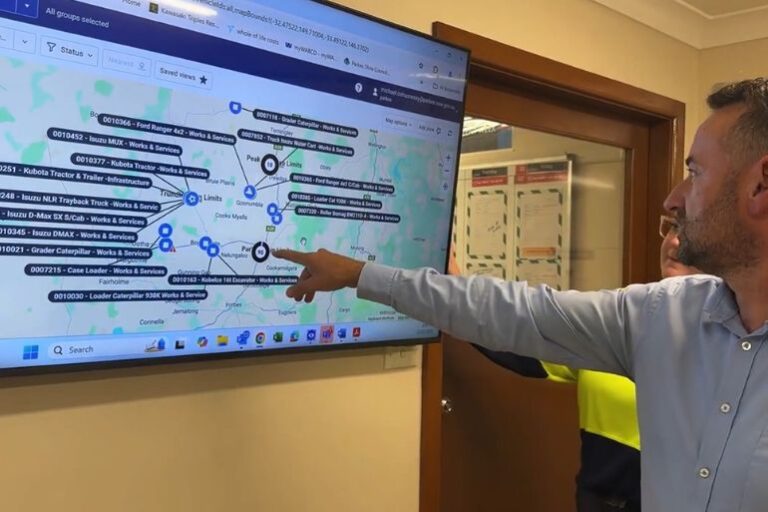
Parkes monitors around 150 connected fleet assets. When the fleet team examined idle-time data, it found the group was accumulating approximately 750 hours of idling each week.
For a fleet that includes mowers, graders, loaders, trucks and other plant, those idle hours represent more than fuel. They also add unnecessary engine hours, contribute to maintenance requirements and can affect the operating cost and eventual resale position of an asset.
The council began sharing the information with operational teams and having conversations with supervisors and influential employees in the yards. The objective was not simply to issue a directive to switch engines off. It was to make the scale of the issue visible and help people understand the financial and operational impact.
From 750 hours to about 500
According to the finalist interview, weekly idling across the monitored fleet fell from around 750 hours to about 500 hours. That is a reduction of approximately 250 engine hours every week.
Parkes uses an average estimate of four litres of fuel consumed for every hour of idling across the mixed fleet. On that basis, reducing idling by 250 hours avoids roughly 1,000 litres of fuel each week. At the $2.20-per-litre assumption used by the council during the interview, the saving is approximately $2,200 a week.
The exact consumption varies considerably between a mower, truck, loader or grader, but the fleet-wide calculation gives managers a practical way to understand the scale of the opportunity.
Sustainability before the next replacement cycle
Parkes has started its transition towards electric vehicles and has introduced a Kia EV5 as a pool vehicle so a broad group of employees can gain experience with an EV. Telematics data is also being used to build future business cases for electric, hybrid and conventional replacements.
But the council’s sustainability approach is broader than simply counting the number of electric vehicles purchased. Most of the current fleet will remain in service for years, particularly specialist plant with long replacement cycles. Reducing unnecessary idling produces a benefit now.
The council is also increasingly looking for equipment with automatic engine-stop functionality. On some loaders, rollers and graders, the engine can shut down when the machine is stationary, in park and the handbrake is applied. This helps turn the desired behaviour into a feature of the equipment itself.
The whole-of-life benefit
Reducing idle time can improve more than the fuel line in the budget. Heavy plant is often managed and disposed of partly by engine hours. Unproductive idling adds hours without delivering service to the community.
Lower idle hours can therefore support better maintenance outcomes, reduce operating costs and potentially improve the condition of an asset when it reaches disposal. It also improves the accuracy of utilisation analysis because operating hours are more closely aligned with productive work.
This is where Parkes’ sustainability story connects with its whole-of-life management approach. Fuel, maintenance, utilisation and resale are not treated as separate issues. They are different parts of the same asset-performance equation.
Measure it, show it, improve it
Parkes’ experience reinforces a straightforward fleet-management principle: behaviour is difficult to improve if it is not visible. Once the council could quantify idle time and report it to operational teams, the issue became easier to discuss and manage.
For fleets considering a sustainability program, it is also a reminder that some of the fastest emissions reductions may come from changing how existing assets are operated while the longer-term transition to new technology continues.
Next week: inside the Parkes workshop
In article four, we’ll go inside the Parkes Shire Council workshop to see how services are planned a month ahead, parts are prepared against individual work orders, technicians use tablets and visual management helps the team target 96 per cent fleet availability.
Vote for Parkes Shire Council
Vote for Parkes Shire Council in the 2026 Fleet News Group Fleet of the Year Award
Industry voting is now open. Visit the Fleet News Group Awards voting page to cast your vote.
Awards Night – 14 October 2026, Sydney
The winner of the Fleet of the Year Award will be announced at the Fleet News Group Awards Night in Sydney on 14 October 2026. Register your interest to attend the Awards Night.