

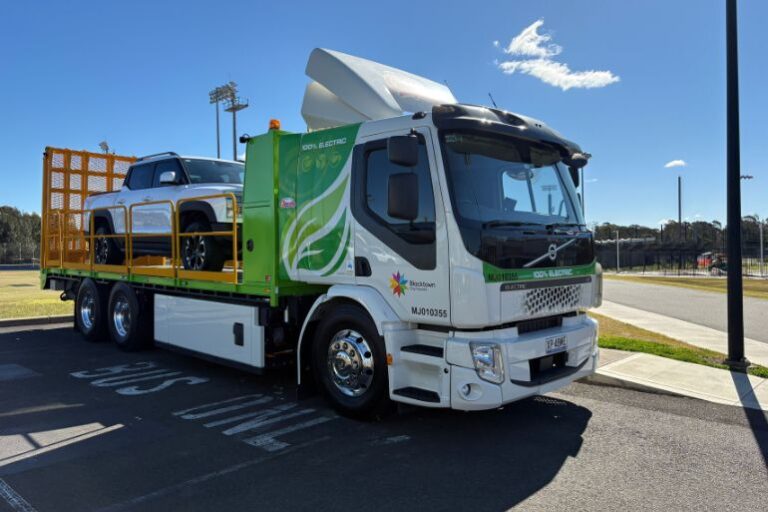
Blacktown City Council is a finalist in the Fleet of the Year category in the 2026 Fleet News Group Awards.
In the third article in our six-part series, we look at how the council has accelerated its transition to hybrid and electric vehicles while bringing drivers and operational teams along for the journey.
Two years before the Fleet News Group Awards interview, Blacktown City Council estimated that around five per cent of its fleet was ready for electrification.
At the time of the interview, 43 per cent of the fleet was hybrid, plug-in hybrid or fully electric. The rate of change has been significant.

Not just a procurement exercise
The council did not approach the transition by simply buying new vehicles and handing over the keys. The fleet team involved users in trials, test drives, vehicle selection, delivery and handover.
That helped operational teams understand how the technology would affect their daily work and gave the fleet team an opportunity to identify practical issues before wider deployment.
The aim was to bring drivers through the transition rather than impose it on them.
Duty cycle still decides the vehicle
Blacktown is not treating electrification as an automatic answer for every asset.
Telematics, utilisation and duty-cycle information are used to assess whether the best replacement is electric, hybrid or a conventional diesel vehicle. That means the technology choice remains connected to the job the vehicle has to perform.
The fleet team’s specialist technical and innovation roles support this process by reviewing operational requirements, vehicle design and procurement documentation.
Lower energy and maintenance costs
Blacktown also reported early financial benefits from parts of the transition.
During the interview, the fleet team described an example where a diesel light vehicle may have used around $20,000 in fuel over a comparable period, while an electric equivalent incurred approximately $4,000 to $5,000 in electricity costs.
The council also noted lower routine maintenance requirements for some electric vehicles.
These figures were presented as an operational example rather than a whole-of-fleet average, but they illustrate why the council is continuing to explore suitable electric applications.
Driver experience matters
The fleet team also highlighted the importance of driver acceptance. Once employees become familiar with electric vehicles, the feedback can shift quickly from uncertainty to preference.
That experience reinforces why Blacktown invested time in familiarisation and support rather than assuming drivers would adapt automatically.
Why this matters for Fleet of the Year
Blacktown City Council’s electrification program is about more than replacing petrol and diesel vehicles.
It combines duty-cycle analysis, driver engagement, operational trials and whole-of-life thinking to make sure each new technology suits the job.
Blacktown City Council is a finalist in the 2026 Fleet News Group Fleet of the Year Award. If you believe fleet electrification should be practical, evidence-based and supported by good change management, you can vote for Blacktown.
Vote for Blacktown City Council in the Fleet of the Year Award
The winners will be announced in Sydney on 14 October 2026.
Register your interest for the Fleet News Group Awards Night
Next week: Modern fleet management needs different skills. We look at why Blacktown created specialist roles in analytics, innovation and zero-emission planning.