

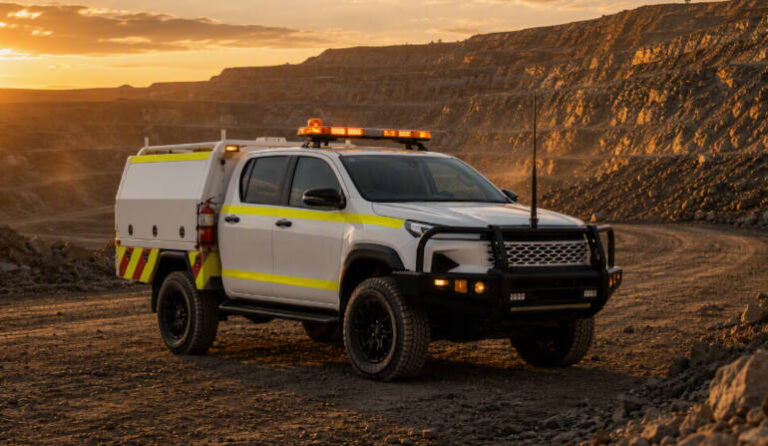
Fleet operators looking to increase Toyota HiLux payload capacity without adding unnecessary compliance costs are being encouraged to consider GVM upgrades that keep vehicles within the 3500kg NA category.
Pedders says selecting the highest available payload upgrade is not always the most cost-effective answer, with fleet operators needing to balance legal compliance, operational efficiency and the specific requirements of the worksite.
That consideration can be particularly important for government, utilities, infrastructure and mining fleets, where moving beyond a 3500kg Gross Vehicle Mass can trigger additional site requirements.

According to Pedders, many Australian mine sites require vehicles with a GVM above 3500kg to be fitted with a Roll Over Protection Structure, or ROPS. Keeping a HiLux at or below the 3500kg NA category threshold can therefore help fleets avoid the additional weight, cost and complexity associated with fitting that equipment.
Pedders offers an NA Category 3500kg GVM upgrade for the Toyota HiLux, designed to provide additional payload capacity while retaining the vehicle’s NA classification.
For fleet managers, that creates another option when developing vehicle specifications around payload, accessories, site compliance and whole-of-life operating requirements.
Rather than simply specifying the maximum possible GVM increase, fleets can assess how much additional carrying capacity is actually required and whether remaining below the 3500kg threshold delivers a better operational outcome.
Pedders says its upgrade kits feature increased axle capacities and are available with different spring options to suit varying applications and operating conditions.
The company also matches the vehicle manufacturer’s warranty period on GVM upgrade kits when they are installed before first registration.
The approach is aimed particularly at organisations seeking additional capability while managing compliance risks and avoiding modifications that may not be necessary for the vehicle’s intended application.
Pedders says its fleet solutions are engineered and tested for specific vehicles, with support available through a national network of 120 stores across every Australian state and territory.
For fleet managers operating HiLux vehicles in demanding environments, the 3500kg option highlights an important procurement consideration: the best GVM upgrade may not necessarily be the biggest one, but the one that most closely matches the vehicle’s payload, compliance and operational requirements.
- Want to cut fleet emissions? Start with fewer vehicles
 For fleet operators under pressure to reduce emissions, ordering electric vehicles can look like the obvious first move. But Travis Weir from Geosecure believes there is another step fleet managers should take first: understand the fleet they already have. Speaking during a supplier panel at Everything Electric Sydney, Weir said utilisation data, right-sizing and fit-for-purpose
 - ConnectAbility Australia wins 2026 Fleet Technology AwardConnectAbility Australia has been named the winner of the 2026 Fleet News Group Fleet Technology Award, recognised for using fleet technology to solve a significant administrative challenge while delivering broader improvements in passenger safety, compliance and fleet management. The organisation was one of three finalists alongside Blacktown City Council and the City of Port Phillip, with all three organisations
- Toyota Fleet Management named 2026 Fleet Supplier of the YearToyota Fleet Management has been named Fleet Supplier of the Year in the 2026 Fleet News Group Awards, following an industry vote by fleet professionals across Australia and New Zealand. The award is particularly significant because the organisations competing for Fleet Supplier of the Year did not simply put themselves forward. Finalists were nominated by their customers or
- Townsville City Council wins 2026 Safe Fleet AwardTownsville City Council has been named the winner of the 2026 Fleet News Group Safe Fleet Award, recognised by the fleet industry for an approach that combines telematics, driver engagement, incident investigation and practical safety technology to reduce risk across a large and diverse fleet. The Safe Fleet Award recognises organisations that integrate fleet safety into
- Blacktown City Council wins 2026 Fleet Sustainability AwardBlacktown City Council has been named the winner of the 2026 Fleet News Group Fleet Sustainability Award, recognising a comprehensive, data-led approach to reducing fleet emissions across passenger vehicles, heavy vehicles, plant and equipment. The award was presented at the Fleet News Group Awards Night in Sydney on 14 October, following an industry voting process that