
For years, aftermarket GVM upgrades, trays and service bodies have been an accepted part of fleet life. They solved a problem OEMs didn’t — or couldn’t — fully address. Fleets needed more payload, more durability and more capability, and the aftermarket stepped in to fill the gap.
But as fleets head into 2026, the environment is changing.
Budgets are tighter. Utilisation expectations are higher. Downtime is less tolerable. And Fleet Managers are being asked to do more with fewer assets — while lifting safety, compliance and reporting standards at the same time.
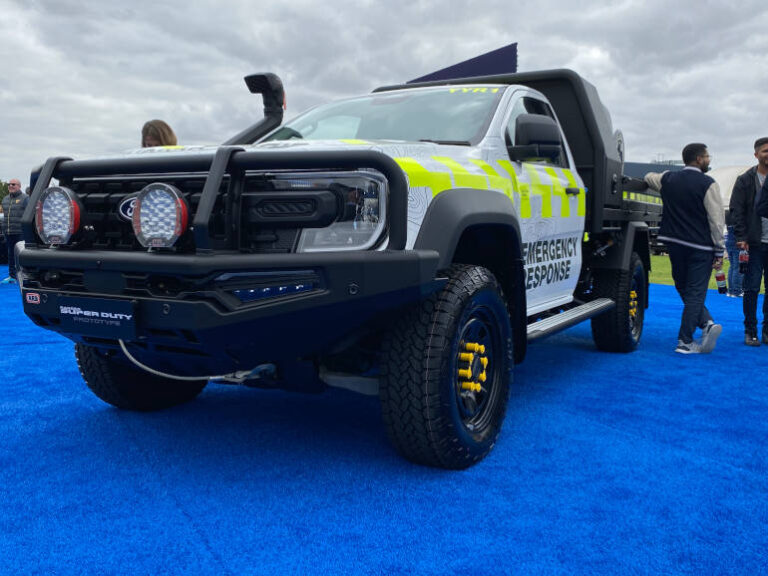
Against that backdrop, the Ford Ranger Super Duty presents an uncomfortable but important question for fleet buyers: Is the aftermarket still the most efficient answer — or just the most familiar one?
Why Fleets Defaulted to the Aftermarket in the First Place
To be fair, fleets didn’t turn to aftermarket solutions by choice — they turned to them out of necessity.
Standard utes couldn’t legally or safely carry the loads required. Factory offerings often fell short. And specialist fleet requirements rarely aligned neatly with OEM model ranges.
So fleets adapted. They built strong supplier relationships. They developed bespoke solutions. And they accepted the trade-offs that came with them:
- longer delivery timelines
- split warranties
- complex compliance management
- variable integration quality
In many cases, this became “just how it’s done”. But Ford’s Ranger Super Duty program was born out of listening to exactly those frustrations.
Factory Engineering vs Aftermarket Compromise
One of the clearest messages from Ford executives during the Ranger Super Duty launch was that aftermarket solutions often come with unavoidable compromises.
Justin Capicchiano, Chief Program Engineer for Ranger Super Duty, was candid about what Ford observed when testing vehicles fitted with aftermarket upgrades.
“When we drove vehicles with aftermarket upgrades, there were always compromises,” Capicchiano said. “Ride quality, safety system integration, handling when laden — you were giving something up somewhere.”
For fleet buyers, those compromises often show up later:
- inconsistent vehicle behaviour
- increased wear
- driver complaints
- higher incident rates
- and more unplanned downtime
By contrast, the Ranger Super Duty was engineered as a complete system — chassis, axles, suspension, electronics and safety systems developed together, not adapted after the fact.
That OEM integration is a fundamental shift.
Lower Total Cost, Not Just Lower Complexity
At face value, aftermarket solutions can appear cost-effective — particularly when compared line-by-line against factory pricing.
But Ford’s argument, echoed repeatedly by fleet customers involved in development, is that whole-of-life cost tells a different story.
Andrew Birkic, President and CEO of Ford Australia, pointed to the operational inefficiency fleets experience during vehicle changeovers.
“Quite often these vehicles require multiple fit-outs,” Birkic said. “Supplier A, then B, then C — and depending on the fit-out, it can take four to six months.”
For fleets, that delay translates directly into:
- extended downtime
- delayed utilisation
- hire vehicle costs
- or asset life extensions elsewhere
A factory-engineered Super Duty, paired with Ford Pro Convertor solutions, shortens delivery timelines and gets vehicles earning sooner.
In a 2026 environment where capital is scrutinised more closely, time off-road is becoming just as expensive as purchase price.
Efficiency Gains = Maturity Gains
One of the underlying themes from the Ranger Super Duty program is fleet maturity. Jeremy Welch, Conversion Development Manager at Ford IMG, admitted that Ford initially misunderstood what fleet buyers really wanted.
“We thought fleets wanted the cheapest thing,” Welch said. “What we found was they wanted the safest thing they could get — because that’s what gives them the most uptime.”
This reflects a more mature fleet mindset:
- fewer incidents means fewer repairs
- fewer repairs means higher utilisation
- higher utilisation means fewer vehicles required
That’s not just operational efficiency — it’s strategic fleet management. And it’s exactly the type of thinking Fleet Managers will need in 2026 as they’re asked to deliver more service with fewer assets.
Safety and OEM Accountability
Another key argument for reconsidering the aftermarket is safety accountability. OEM-engineered vehicles like the Ranger Super Duty:
- retain full factory warranty
- integrate safety systems properly
- remove ambiguity around responsibility
From a governance and WH&S perspective, this matters. Andrew Birkic framed it in terms of confidence.
“Everything we’ve done is very intentional,” he said. “It’s about optimising the outputs based on what customers value.”
For fleets, that intention translates into:
- clearer compliance pathways
- stronger audit defensibility
- and fewer grey areas when things go wrong
The Case For the Aftermarket — Still Valid
That said, the aftermarket isn’t going away — and nor should it. There are still compelling reasons fleets continue to work with specialist suppliers:
- long-standing trusted relationships
- proven product quality and reputation
- flexibility to adapt quickly
- bespoke solutions for niche operations
For highly specialised fleets, bespoke development will always play a role — particularly where innovation and rapid iteration are required. The difference now is that fleets have a credible factory alternative for a much broader range of applications. And that changes the decision-making process.
Ford Pro Convertor: A Middle Ground
One of the more important developments for fleet buyers is the role of the Ford Pro Convertor program.
Rather than forcing fleets to choose between factory and aftermarket, Ford has created a certified ecosystem where trays and service bodies, electrical integrations, and specialist fit-outs can be delivered with OEM backing and warranty alignment.
This addresses one of the biggest historical risks of aftermarket builds — fragmented accountability. For Fleet Managers, that means fewer supplier interfaces to manage and less risk sitting on the fleet team.
What Fleet Buyers Should Be Asking in 2026
The Ranger Super Duty doesn’t eliminate the aftermarket — but it does force fleets to ask better questions. In 2026, those questions should include:
- does this upgrade improve utilisation or just add complexity?
- does it reduce downtime or extend delivery timelines?
- does it simplify compliance or increase risk?
- does it align with our long-term fleet strategy?
As budgets tighten and expectations rise, efficiency gains will increasingly define fleet management maturity.
And as the Ranger Super Duty demonstrates, sometimes the biggest efficiency gain isn’t a new process — it’s rethinking old habits.