
When Fleet Managers compare light commercial vehicles, engine outputs and fuel economy often dominate the discussion. Yet one of the most important specifications sits further down the data sheet—vehicle weight.
Gross Vehicle Mass (GVM), payload, axle capacities and tare mass determine what a van can legally carry and how suitable it is for different applications.
With the introduction of the new hybrid and battery-electric variants, the 2026 Hyundai STARIA Load now offers three distinct weight profiles, giving fleet buyers more choice depending on the task.

What do the weight terms mean?
Before comparing models, it’s worth understanding the terminology.
- Tare Mass is the weight of the vehicle ready to drive, including fluids but without occupants or cargo.
- GVM (Gross Vehicle Mass) is the maximum legal operating weight of the vehicle, including passengers, cargo and accessories.
- Payload is the difference between tare mass and GVM—essentially how much the vehicle can carry.
- Permissible Axle Weight (PAW) is the maximum load allowed on each axle. Exceeding an axle limit can make a vehicle illegal even if the total GVM hasn’t been exceeded.
STARIA Load at a glance
| Specification | Diesel | Hybrid |
|---|---|---|
| GVM | 3,060 kg | 3,130 kg |
| Tare Mass | 2,019 kg | 2,052 kg |
| Payload | 997 kg | 1,039 kg |
| Front Axle Limit | 1,610 kg | 1,610 kg |
| Rear Axle Limit | 1,780 kg | 1,780 kg |
One of the surprises is that the hybrid actually carries more payload than the diesel.
Although the hybrid’s electrified powertrain increases tare mass by around 33kg, Hyundai has increased the GVM by 70kg, resulting in a payload increase of 42kg.
For many fleet applications, that extra payload may be more valuable than expected.
Diesel: Built for versatility
The diesel remains the traditional fleet workhorse.
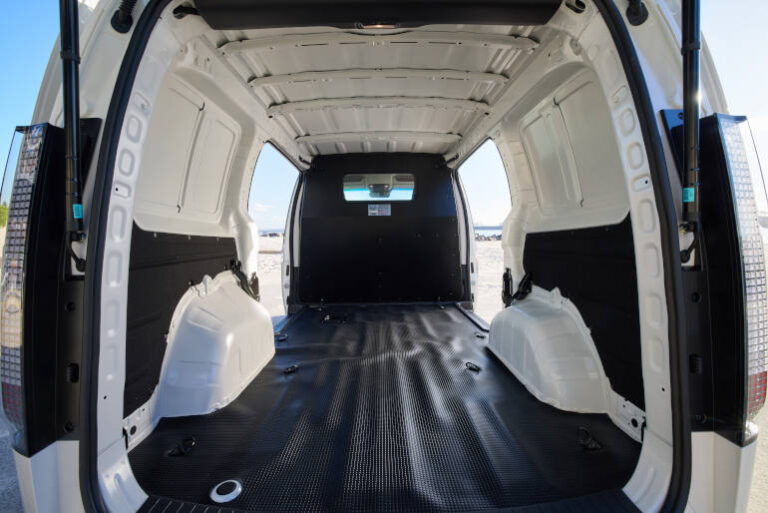
With a 3,060kg GVM and 997kg payload, it comfortably accommodates tools, equipment and multiple occupants while retaining its 2,500kg braked towing capacity.
The diesel’s lower tare mass also means slightly more flexibility when accessories such as ladder racks, shelving, cargo barriers or roof storage are fitted.
For operators regularly towing trailers or travelling long regional distances, the diesel remains the most versatile option.
Hybrid: More carrying capacity than expected
At first glance, many buyers assume adding batteries reduces payload.
The STARIA Load Hybrid demonstrates that isn’t always the case.
Hyundai has certified the hybrid with a 3,130kg GVM, allowing it to legally carry 1,039kg despite the heavier electrified drivetrain.
For fleets that don’t tow, this makes the hybrid an attractive option for urban deliveries, maintenance teams and service technicians looking to reduce fuel consumption without sacrificing carrying capacity.
The trade-off, of course, is towing. Hyundai has deliberately not approved the hybrid for trailer towing, making application analysis essential during vehicle selection.
Axle weights matter
Fleet managers often monitor total payload but overlook axle loading.
Both diesel and hybrid variants share identical axle ratings:
- Front axle: 1,610kg
- Rear axle: 1,780kg
This becomes particularly important when fitting heavy accessories.
For example:
- shelving systems
- refrigerated bodies
- service bodies
- tool drawers
- generators
- compressors
- water tanks
Many of these installations place most of their weight behind the rear axle.
A vehicle can remain under its GVM while exceeding its rear axle limit, making it non-compliant and potentially affecting braking, tyre wear and vehicle handling.
That’s why axle weight calculations should always form part of an upfit assessment.
Accessories affect payload
It’s easy to assume the published payload is available for cargo.
In reality, every accessory reduces the remaining carrying capacity.
Typical additions include:
- Bullbars
- Roof racks
- Ladder racks
- Cargo barriers
- Shelving systems
- Additional batteries
- Towbars
- Refrigeration equipment
Each kilogram added to the vehicle reduces the available payload by the same amount.
For fleets specifying multiple accessories before delivery, conducting a weight assessment during procurement can prevent unpleasant surprises later.
Battery electric joins the range
Hyundai has also confirmed a battery-electric STARIA Load will join the range later in 2026.
While the current specification confirms a 160kW electric powertrain, detailed weight, payload and axle figures are yet to be released. Those figures will be of particular interest to fleets considering the impact of battery mass on carrying capacity.
Weight should drive the buying decision
Payload figures close to one tonne mean both diesel and hybrid STARIA Load variants remain highly competitive for typical fleet applications.
The diesel remains the logical choice for businesses that tow or operate over long regional distances.
The hybrid, meanwhile, offers slightly higher payload while delivering lower fuel consumption for urban operations.
The lesson for fleet buyers is simple: don’t stop at the headline payload figure. Understanding GVM, tare mass and axle limits ensures the chosen vehicle remains compliant once passengers, cargo and accessories are added.
It’s also a reminder that the best vehicle isn’t always the one with the biggest engine or the lowest fuel consumption—it’s the one whose weight ratings best match the work it’s expected to perform.