
Australia’s fleet industry is in the middle of the biggest technology shift in a generation — and the organisations leading the charge are learning fast.
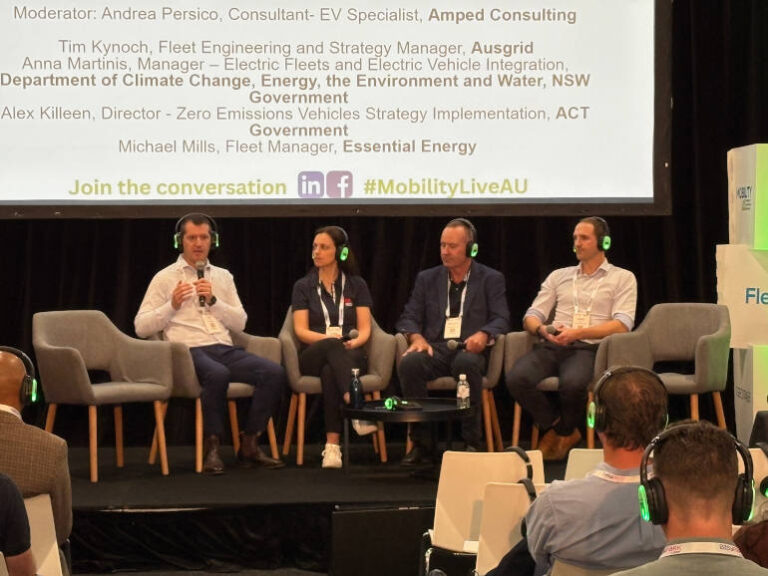
At Mobility Live 2025, a panel of fleet leaders discussed the real-world opportunities, benefits and challenges of decarbonising vehicle fleets. The session was moderated by Andrea Persico, Consultant and EV Specialist at Amped Consulting, and featured:
- Tim Kynoch, Fleet Engineering and Strategy Manager, Ausgrid
- Anna Martinis, Manager – Electric Fleets and EV Integration, Department of Climate Change, Energy, the Environment and Water (NSW Government)
- Alex Killeen, Director – Zero Emissions Vehicles Strategy Implementation, ACT Government
- Michael Mills, Fleet Manager, Essential Energy
Together, they represent some of Australia’s most advanced fleet transitions — from government to utilities — offering a rare view of what decarbonisation looks like in practice.
Why fleets are making the switch
Every panellist agreed that electrifying the fleet delivers far more than reduced emissions. It’s improving safety, lowering operating costs, and even changing the way drivers feel about their vehicles.
For Ausgrid, the immediate benefit has been the driver experience. “The tech upgrade, smoothness and quietness make any driver’s day better,” said Kynoch. “Once you get someone into an EV, they don’t want to go back.”
From the NSW Government’s perspective, fleet decarbonisation has also uncovered hidden inefficiencies. “When we analysed utilisation, we found vehicles doing less than 2,000 kilometres a year,” Martinis explained. “That means immediate savings through fleet rationalisation — and those funds can be redirected to electrify the vehicles you really need.”
Essential Energy’s Michael Mills said the shift is also strengthening the grid. “A more economical, better-maintained fleet means fewer moving parts and lower costs,” he said. “The more EVs across our footprint, the more electricity flows through the network, which drives down power prices for consumers.”
In Canberra, Alex Killeen pointed to health and safety gains as a hidden benefit. He shared the story of ACT’s Parks and Conservation team, who tested an electric mower for the first time. “They were resistant at first, but within 90 minutes they were sold,” he said. “It’s quieter, safer, no fumes, and they could work around kids and families without hearing protection. They ordered three the same day.”
The technology transforming fleets
Looking forward, the panellists identified several innovations that will accelerate Australia’s fleet transition.
For Kynoch, megawatt charging will be a game changer: “Once you can charge a vehicle within minutes, range anxiety disappears.”
Martinis described vehicle-to-grid (V2G) as the most exciting development on the horizon. “It’s the nexus between transport and energy,” she said. “An EV battery can soak up solar energy during the day and release it at peak times, reducing costs and even generating revenue.”
Mills agreed, adding that vehicle-to-load will help utilities provide community support: “Imagine keeping a customer’s house powered while we repair lines outside — less downtime, fewer outages.”
Killeen added that battery recycling and reuse will protect residual values and reshape total cost of ownership. “EV batteries will outlive the vehicles and have second or third lives in static storage,” he said. “That’s value that doesn’t exist in ICE vehicles.”
Beyond technology, Mills said the transition is opening new career opportunities. “It’s another skill set for our workforce. The next generation will be maintaining this technology and doing it for the climate.”
Challenges to overcome
Despite the optimism, all four speakers were candid about the hurdles.
Charging infrastructure remains the biggest barrier. “Some depots are so antiquated they need massive upgrades,” said Kynoch.
Martinis stressed the importance of right-sizing and load management. “Telematics data shows we don’t need a one-to-one ratio of chargers to vehicles — often one charger can support three EVs,” she said. “That can significantly reduce costs.”
Mills broke it down into three essentials: “Load management, solar on your roof, and some battery storage. Not every vehicle comes back empty and needs a full charge.”
Killeen urged fleet managers to avoid working in silos. “Talk to your facilities teams early. EVSE requires specialist expertise. Build a phased plan that avoids duplication and manages future load.”
The learning curve has been steep for everyone. “Advertised range is never the range,” Mills said. “Do your own testing.”
Kynoch added that the terminology and electrical engineering aspects can feel daunting at first. “It’s new and scary for fleet managers — but don’t be put off. Start small and scale up.”
Lessons for every fleet
For the panellists, success ultimately comes from collaboration and knowledge sharing.
“Don’t struggle in silence,” Mills urged. “Reach out to others — every fleet has faced the same challenges.”
Martinis agreed, noting that many issues stem from lack of communication. “Change management often happens too late,” she said. “Engage people early, make your plans visible, and back them up with facts.”
Moderator Andrea Persico summed it up perfectly: “Fleet decarbonisation isn’t just about vehicles and chargers. It’s about people, planning, and purpose.”
The takeaway from Mobility Live 2025 was clear — decarbonisation is no longer a pilot project. It’s a strategic, operational and cultural shift that demands leadership, data, and collaboration. As Australia’s leading fleets are proving, the journey may be complex, but the benefits are already within reach.