

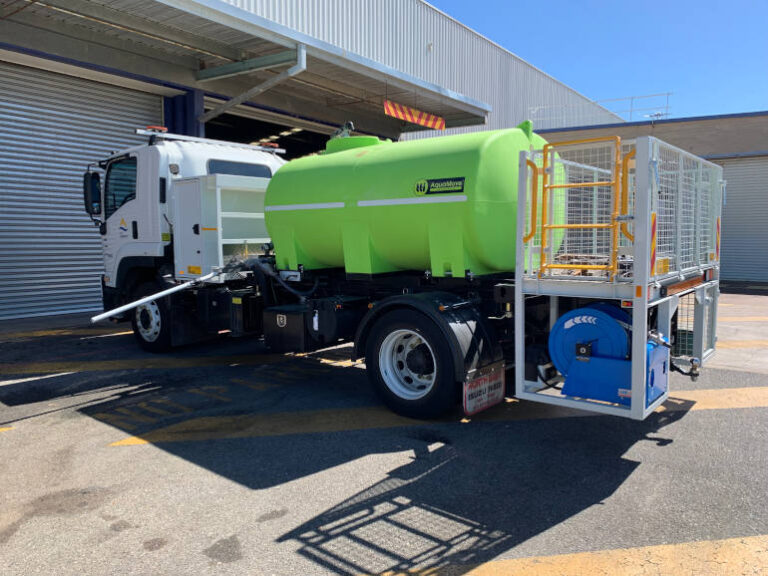
The City of Salisbury has demonstrated how thoughtful vehicle design can significantly improve fleet utilisation and operational efficiency by developing a dual-purpose street tree planting and watering truck. Instead of operating separate vehicles for planting and watering, the council created a single truck with interchangeable bodies that allows crews to switch between tasks in minutes, ensuring the asset remains productive year-round.
Turning an underutilised asset into a year-round workhorse
Street tree programs typically rely on separate vehicles: a water cart used mainly during summer and a tray truck used for planting in cooler months. This meant one vehicle often sat idle for half the year while another was used only for seasonal tasks.
The City of Salisbury addressed this inefficiency by developing a Dual-Purpose Street Tree Planting and Watering Truck built around a container-lock body system. The truck can switch between a 5,000-litre water cart and a purpose-built planting tray in less than five minutes using a forklift and quick-connect fittings.
By consolidating two roles into one vehicle, the council improved utilisation and ensured the truck remained productive across the full year rather than sitting idle outside the watering season.
Designed for safety and operational efficiency
A key feature of the design is the extendable side-mounted watering boom, which allows operators to water trees from inside the cab using a camera-guided control system. This approach avoids many of the issues associated with traditional front-mounted watering booms that can interfere with modern vehicle safety technologies such as radar, cameras and collision-avoidance systems.
The truck also includes a fixed rear platform with an auto-guided hose reel and a diesel auxiliary pump permanently connected to the vehicle’s main fuel tank. This removes the need for manual refuelling of auxiliary equipment, reducing spill risk and manual handling requirements while improving uptime.
For planting operations, the dedicated tray body provides integrated storage for tools, stakes and tree stock, helping crews work more efficiently when establishing new street trees.
Collaboration and continuous improvement
The concept was developed in collaboration with local manufacturers and council field staff to ensure the design met real operational needs. The first generation of multifunction tree-care trucks was introduced in 2021 and proved successful in supporting the city’s urban greening program.
Following this success, the City of Salisbury expanded the program and introduced a second generation of trucks in 2025 with further refinements, including the side-mounted watering boom and improved planting tray design.
The improved capability also allowed the council to bring previously outsourced tree planting and watering services back in-house, improving service delivery and control over operational scheduling.
Practical lessons for Fleet Managers
The project highlights several principles that are increasingly relevant for fleet managers responsible for specialised plant and equipment:
- Design vehicles for the task rather than adapting general-purpose assets
- Maximise utilisation by enabling a single asset to perform multiple roles
- Engage operational staff early to ensure the design works in real-world conditions
- Consider modular vehicle design to support seasonal or changing operational requirements
By redesigning a single truck to support both planting and watering functions, the City of Salisbury has created a practical example of how fleet innovation can improve productivity, safety and asset utilisation while supporting broader urban greening programs.
The case study was an entry in the 2026 IPWEA Fleet Innovation Award.
- SG Fleet wins FleetPartners race with $1.13 billion deal
 After months of bids, counter-bids, due diligence and speculation, the FleetPartners takeover race finally has a winner. SG Fleet has emerged from a highly competitive process to sign a binding Scheme Implementation Deed with FleetPartners, agreeing to acquire 100 per cent of the company for $5.30 per share in cash. The deal values FleetPartners at approximately $1.131
 - ConnectAbility Australia wins 2026 Fleet Technology AwardConnectAbility Australia has been named the winner of the 2026 Fleet News Group Fleet Technology Award, recognised for using fleet technology to solve a significant administrative challenge while delivering broader improvements in passenger safety, compliance and fleet management. The organisation was one of three finalists alongside Blacktown City Council and the City of Port Phillip, with all three organisations
- Toyota Fleet Management named 2026 Fleet Supplier of the YearToyota Fleet Management has been named Fleet Supplier of the Year in the 2026 Fleet News Group Awards, following an industry vote by fleet professionals across Australia and New Zealand. The award is particularly significant because the organisations competing for Fleet Supplier of the Year did not simply put themselves forward. Finalists were nominated by their customers or
- Townsville City Council wins 2026 Safe Fleet AwardTownsville City Council has been named the winner of the 2026 Fleet News Group Safe Fleet Award, recognised by the fleet industry for an approach that combines telematics, driver engagement, incident investigation and practical safety technology to reduce risk across a large and diverse fleet. The Safe Fleet Award recognises organisations that integrate fleet safety into
- Blacktown City Council wins 2026 Fleet Sustainability AwardBlacktown City Council has been named the winner of the 2026 Fleet News Group Fleet Sustainability Award, recognising a comprehensive, data-led approach to reducing fleet emissions across passenger vehicles, heavy vehicles, plant and equipment. The award was presented at the Fleet News Group Awards Night in Sydney on 14 October, following an industry voting process that