
BYD may have concentrated on private buyers and salary-sacrificers for its first two years in Australia, but for the past 12 months the Chinese manufacturer has increasingly concentrated on building out a fleet-friendly local product mix.
Turbocharged by BYD’s May 2025 switch to direct factory importation—rather than relying on a separate Australian distributor—the focus on models that suit fleet needs has been characterised by four trends:
- Expansion of BYD’s Australian model lineup to include not just full battery EVs, but also plug-in hybrids (PHEVs)
- Availability of multiple trim variants with differing levels of specification, but all with five-star ANCAP safety
- Entry to the commercial vehicles sector via the Shark 6 ute, with more utes to come in future
- Lower cost of entry and total cost of ownership (TCO) metrics to many established rivals
Shark 6 to Remain Key BYD Fleet-Focussed Model with Service Body Integration Planned for Future
Local BYD senior executives have announced an overall fleet sales target of 20 percent of the brand’s overall Australian mix—up from 10 percent currently.
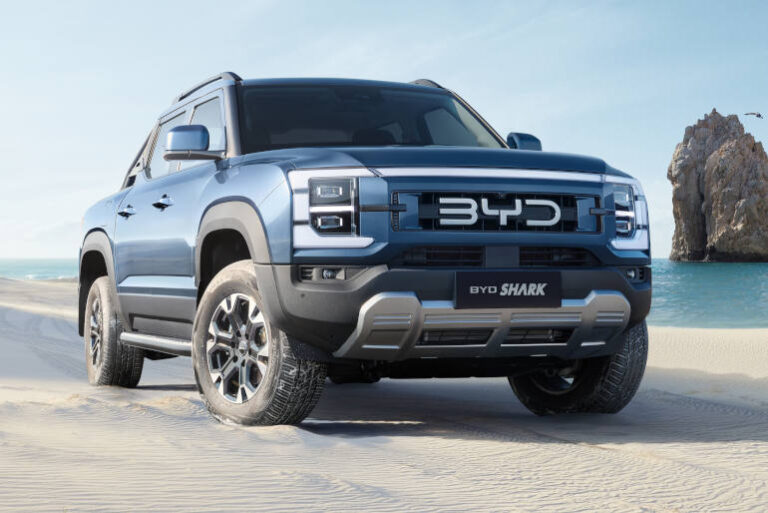
Key to achieving this doubling in fleet business, while growing overall sales, will be continuing to market the Shark 6 ute to government and corporate fleet managers cognisant of a need to decarbonise the contribution of their light commercial vehicles.
Typically a market segment dominated by diesel-powered, non-hybrid models, the Shark 6 has successfully carved out a PHEV niche among utes—and 8.5 percent market share overall—despite only having launched this year.
BYD Australia chief product officer told Fleet News Group that the Shark 6 is a “no-brainer” for fleets that need to balance a need for light commercial vehicles with increasingly important ESG targets, while also realising FBT benefits.
Chief operating officer Stephen Collins also hinted at expanded aftermarket partnerships that may allow BYD to, in time, deliver fully built-up Shark 6 examples to fleet customers taking delivery of new utes.
“We work with Ironman pretty closely on accessorising, and that is a good relationship. We have a good understanding of those specialist applications—consigning parts to miners is a good example. Are we there yet? No—but we [know] what ‘really good’ looks like, and we need to walk before we run.”
“It is not an overnight job, but a slow burn, a longer-term thing. We are [currently] resourcing with people, loan cars, and we will do the same with parts, tech support, and whatever else needs to happen to make it successful.”
Fleet Managers take note
BYD Australia intends to build a capacity to be an end-to-end partner for fleet operations of the Shark 6, possibly leveraging the established partnership with Ironman.
Plug-in Hybrid Focus to Grow with Sealion 5 SUV and Rival to Toyota Camry Likely for 2026
Operations boss Stephen Collins confirmed to Fleet News Group that BYD Australia’s strategy of typically importing models with both a BEV and a PHEV powertrain option will continue in 2026. The powertrain types sit at different price points and have varying appeal to different types of fleet customers.
However, the current suitability of PHEVs for Australian customers—both fleet and private—will see BYD put the foot down on hybrid in 2026. Confirmed and first up is the Sealion 5 PHEV midsize SUV, while the Chinese brand is also set to challenge the Toyota Camry’s sedan dominance next year.
“For Sealion 5, we are definitely targeting [a price] that is going to be very attractive to fleet customers as more modest brother to the [$42,990] Sealion 6, in that it won’t be as premium, plush or high-performance because those are things fleet customers don’t really appreciate so much,” said Hasan.
“It has the size, packaging, efficiency, whole of life costs and safety: all the things that fleet customers prioritise.”
While fleet and private buyers alike have shifted considerable demand to SUVs, the efficiency and handling benefits of lower-set sedans continue to play a role and BYD is firming up plans to import a Camry rival to Australia, likely in both BEV and PHEV formats.
“We have a few options that we could launch in that space. We have a PHEV, as well as an EV. We are evaluating which is the right one to drop in and seeing how that fits with our total product strategy…maybe we will see something, in the near future,” Hasan said.
Implication for fleets
The focus at BYD is to offer a full-service lineup with BEV and PHEV options in most categories and at fleet-friendly price points.
Affordable New Full EV Models Help Fleets Supercharge Decarbonisation
BYD launched in Australia as a BEV brand—and while it has broadened its offer to include, and even prioritise, PHEVs, it is also expanding its fully-electric model range to supplement existing models with cheaper alternatives.
With a trio of BEV options, comprised of the Atto 3 small SUV (from $39,990), Seal sedan (from $46,990), and Sealion 7 upper-midsize SUV (from $54,990) relatively established in market, early 2026 will see BYD offer fleets two much more aggressively-priced Atto BEV options.
The Atto 1 is a city-sized hatchback that BYD expects to drum up considerable novated lease business thanks to a low cost of entry—$23,990 for 220km range or $27,990 for 310km range.
“We have had enormous interest from the fleet leasing companies, particularly in the novated space. You will see online, Atto 1 [FMO offers from] around $99 per week. For a teacher or a nurse who is FBT-exempt, it is extremely affordable motoring,” said Hasan.
Meanwhile, the Hyundai Kona-sized Atto 2 is a small SUV that BYD will be marketing more aggressively to government and corporate fleet buyers seeking a fully-electric option for urabn running, and with five seatbelts—as the Atto 1 is a four-seater.
“It might be a good option for fleets looking to decarbonise where the principal purpose of the vehicle is to carry mainly one or two employees from business to business, or for home and site visits around town,” Hasan said.
Overseas, a PHEV version of the Atto 2 is available—including in right-hand drive—and BYD Australia is interested in bringing that option to market locally.
Takeaway for fleets
For fleets that can cope with the reduced driving range of a BEV as compared to a PHEV, BYD is bringing more affordable fully-electric options to the table.
Final Word: An Increasingly Broad Product Line to Satisfy Fleets
In the last three years BYD has expanded its Australian lineup from a single BEV (the Atto 3) to eight models—six BEVs and two PHEVs. Another two hybrids arrive imminently, and 11 product launches or updates are planned for 2026.
It’s all part of BYD’s local strategy to:
- Meet various customer needs for different price points, driving ranges, CO2 emissions and levels of equipment
- Appeal to fleet needs by combining standard levels of safety kit with appealing entry price and TCO metrics
- Earn credits—to sell to rival manufacturers—under Australia’s New Vehicle Efficiency Standard (NVES) emissions regime via rangewide compliance
Whether that’s sufficient to continue BYD’s upward sales trajectory locally while building out demand—and trust—from fleet customers will be revealed over the coming year.