
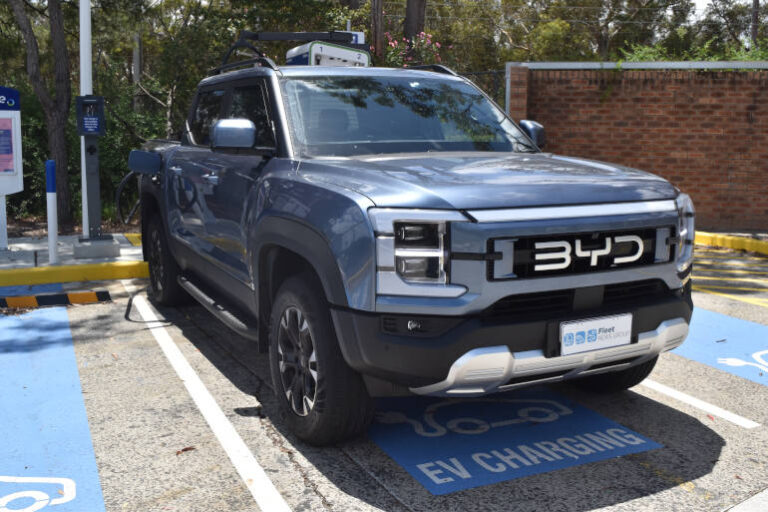
The BYD Shark 6 arrives as one of the most interesting new entrants in Australia’s dual-cab ute market, not because it out-muscles the established players, but because it takes a very different approach. Instead of chasing maximum towing and payload, BYD is targeting fleets and novated lease buyers who want lower emissions, strong performance and everyday usability without jumping straight to a full battery-electric vehicle.
Powertrain and Performance
At the heart of the Shark 6 is BYD’s Super Hybrid system, pairing a 1.5-litre turbo petrol engine with dual electric motors in an all-wheel drive layout. Combined system outputs are a substantial 321kW and 650Nm, delivering brisk on-road performance with a claimed 0–100km/h time of 5.7 seconds.
The Shark 6 can operate in full EV mode for shorter trips, with BYD claiming up to 100km of electric range when the battery state of charge is between 25 and 100 per cent. For drivers who keep the battery topped up, combined fuel consumption can be as low as 2.0L/100km, while longer trips see consumption rise once the battery drops below that threshold.
Total combined driving range is listed at up to 800km, helped by a 60-litre fuel tank and a 29.58kWh BYD Blade Battery.
Fleet-Relevant Numbers
From a fleet perspective, the Shark 6 is clearly positioned as a light-duty or mixed-use ute rather than a heavy hauler. Gross Vehicle Mass is 3,500kg, with a kerb weight of 2,710kg, delivering a payload of around 790kg. Braked towing capacity is 2,500kg, which is lower than many diesel competitors but sufficient for a wide range of urban, trade and lifestyle use cases.
Off-road credentials are respectable rather than extreme. Ground clearance sits at 230mm, wading depth is 700mm, and multiple terrain modes (Mud, Sand, Snow and Mountain) support occasional off-road work. It’s AWD rather than a traditional part-time 4WD, which will suit most users who want capability without hardcore touring ambitions.
Interior, Technology and Safety
Inside, the Shark 6 feels more SUV-like than workhorse. Standard equipment includes a 15.6-inch rotating touchscreen, 10.25-inch digital instrument cluster, head-up display, ventilated and heated front seats, wireless phone charging and a premium Dynaudio 12-speaker sound system.
Safety is a strong point, with a five-star ANCAP rating and a comprehensive suite of driver assistance systems including AEB, adaptive cruise control, lane keep assist, blind-spot monitoring, front and rear cross-traffic alert, trailer stability control and a 360-degree camera.
For fleet and recreational users, Vehicle-to-Load (V2L) is a standout feature, with power outlets in both the tub and cabin capable of running tools, appliances or campsite equipment.
Ownership and Running Costs
BYD backs the Shark 6 with a six-year / 150,000km vehicle warranty and an eight-year / 160,000km battery warranty. Service intervals are every 6 months or 20,000km, with capped-price servicing available for long-term ownership certainty.
Verdict
The BYD Shark 6 isn’t trying to be a diesel Ranger or Hilux replacement — and that’s exactly the point. For fleets and novated lease buyers looking for an electrified ute with strong performance, low reported emissions and high equipment levels, it offers a compelling alternative. If your work doesn’t demand maximum towing every day, the Shark 6 makes a strong case as a modern, lower-emissions dual-cab option worth serious consideration.
- New Nissan Patrol Enters Production
 Production of the all-new Nissan Patrol has commenced in Japan, with the first right-hand-drive vehicles destined for Australia rolling off the line at the Nissan Shatai Kyushu plant. First Australian customer deliveries are scheduled for the first quarter of 2027, giving fleet buyers a timeframe to consider the new-generation SUV in upcoming replacement plans. For
 - UK Sales Signal a Changing Market for Fleet BuyersBattery electric vehicles accounted for approximately 26% of the UK automotive market in September 2026, finishing just two percentage points behind vehicles powered solely by internal combustion engines, according to GlobalData. The figures highlight how closely electric vehicles are competing with conventional petrol and diesel models, while hybrids continue to play a significant role in
- Honda Makes its Next Hybrid MoveHonda will begin rolling out its next-generation hybrid system globally from 2027, promising improved fuel efficiency, a new vehicle platform and electric all-wheel-drive technology. Named Honda Hybrid, the system builds on the company’s existing two-motor e technology. Honda plans to launch 15 next-generation hybrid models globally by the end of its financial year on 31 March 2030,
- Toyota acknowledges service parts supply disruptionToyota has acknowledged a temporary issue affecting the supply of some service parts following an upgrade of its core business systems, with the company working to restore normal operations. Speaking to Fleet News Group during Toyota’s latest sales market update, Vice President of Sales, Marketing and Franchise Operations John Pappas confirmed the disruption when asked
- Green Comeback for Mazda MX-5Mazda has expanded the MX-5’s driver assistance equipment for 2026, adding cyclist detection to its autonomous emergency braking system and introducing lane-keep assist across the range. The changes cover both the Roadster and retractable-roof RF models, alongside new seats and interior trim for the GT RS and an additional exterior colour. The autonomous emergency braking