

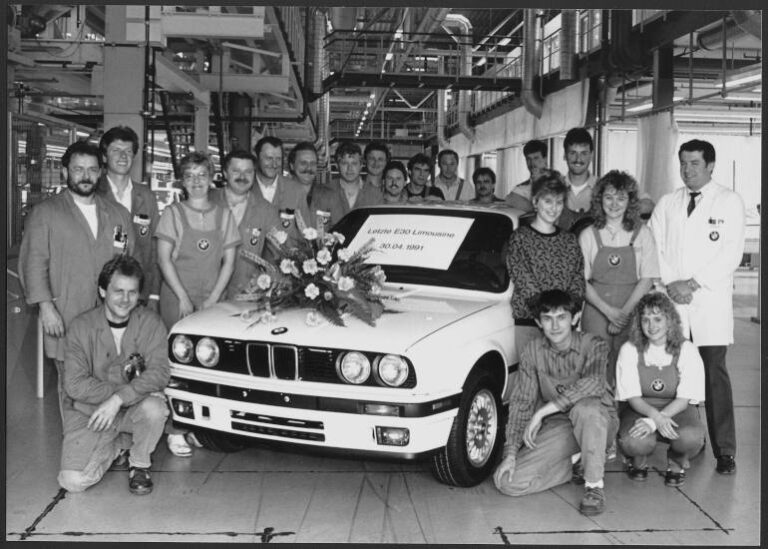
The BMW Group is marking 50 years of BMW 3 Series production, celebrating a model that has played a central role in shaping the company’s global manufacturing footprint and production technologies.
Since production began in 1975, more than 18 million BMW 3 Series vehicles have been built worldwide. Over five decades, the model has been manufactured at 18 plants across 13 countries, making it one of the most widely produced and strategically important vehicles in the BMW Group portfolio .
Munich: the birthplace and technology testbed
Production of the BMW 3 Series began at BMW Group Plant Munich, which has remained a core manufacturing site since the model’s inception. From the outset, the plant was used to pioneer flexible manufacturing techniques, including overhead conveyor systems and programmable welding machines.
A major milestone came in 1982 with the introduction of a fully automated body shop for the second-generation BMW 3 Series. The use of industrial robots delivered an automation rate of more than 90 per cent, significantly increasing capacity while setting new benchmarks for efficiency and quality. Over subsequent decades, the plant continued to evolve through innovations such as powder coating technologies, computer-controlled engine production, and, more recently, AI-supported quality systems and advanced digitalisation tools .
Driving global expansion
The success of the BMW 3 Series was instrumental in expanding BMW’s production network beyond Munich. In 1980, production was extended to Dingolfing, followed by Regensburg in 1986. International expansion soon followed, with production commencing in Rosslyn, South Africa, in 1984 and later in Spartanburg, USA, in 1994.
These sites enabled BMW to supply key markets locally and laid the foundations for the globally distributed production network the company operates today. The BMW 3 Series effectively became the catalyst for BMW’s international manufacturing strategy, supporting growth while reducing reliance on single-region production .
Enabling new plants and powertrains
With the exception of the Debrecen plant, every new BMW manufacturing facility has ramped up production with the BMW 3 Series. Plants in Spartanburg, Leipzig, San Luis Potosí, and the BMW Brilliance Automotive joint venture in China all began operations with the model.
Over time, a wide range of BMW 3 Series derivatives have been produced, including sedan, Touring, Convertible, Coupé and high-performance M variants. Importantly for fleet and procurement audiences, BMW has demonstrated the ability to manufacture multiple derivatives and powertrains on the same production line, including internal combustion engines, plug-in hybrids and fully electric vehicles .
Current production and what’s next
Today, the seventh-generation BMW 3 Series is produced at BMW plants in Munich, Shenyang (China), San Luis Potosí (Mexico), and regional plants in India, Thailand and Brazil, alongside selected partner facilities.
Looking ahead, BMW is preparing for the eighth generation of the BMW 3 Series, which will include a fully electric version as part of the NEUE KLASSE lineup. Production of the electric BMW 3 Series is scheduled to commence at Plant Munich in the second half of 2026, with China and Mexico to follow. BMW has also confirmed plans for the BMW 3 Series to return to production at Dingolfing .
A consistent force in BMW’s production strategy
Across seven generations, the BMW 3 Series has remained a constant driver of manufacturing innovation, global expansion and production flexibility. For fleet buyers and procurement teams, the model’s history highlights BMW’s long-term commitment to scalable production, multi-powertrain capability and continuous improvement—principles that continue to underpin the brand’s approach as it transitions into its next electrified phase.