

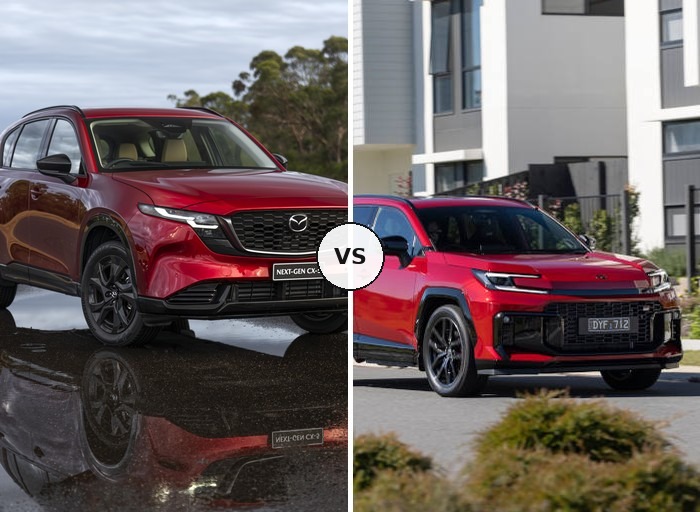
The all-new Mazda CX-5 and Toyota RAV4 are set to continue one of the most closely watched battles in the Australian new car market. But which SUV is the better choice for Fleet Managers, novated lease buyers and private owners?
For years, the Toyota RAV4 and Mazda CX-5 have traded blows as two of Australia’s best-selling SUVs. Both have built loyal followings, strong resale values and reputations for reliability, but they’ve appealed to different buyers.
Fleet Managers have overwhelmingly gravitated towards the Toyota RAV4 Hybrid because of its low running costs and proven Whole of Life Cost (WOLC) performance. Meanwhile, novated lease buyers have consistently favoured the Mazda CX-5, attracted by its premium styling, engaging driving experience and value proposition.
Now both models have entered a new chapter.
The all-new Mazda CX-5 introduces fresh styling, new technology and a five-star ANCAP safety rating from launch. Toyota’s latest RAV4 arrives with its well-established hybrid credentials, but Australian buyers will need to wait for the new model to complete local ANCAP testing before it receives an updated safety rating.
So which one comes out on top?
Fleet Managers will still lean towards Toyota
For organisations managing dozens or even hundreds of vehicles, operating costs remain the deciding factor.
Toyota has spent years refining its hybrid system and the RAV4 continues to be one of the benchmarks for fuel efficiency in the medium SUV segment.
Lower fuel consumption translates directly into lower operating costs and reduced CO₂ emissions, making it easier for Fleet Managers to meet sustainability targets without changing driver behaviour or introducing charging infrastructure.
Toyota’s hybrid system has also become a known quantity in Australian fleets. Maintenance requirements are well understood, resale demand remains exceptionally strong and drivers appreciate the quiet, effortless nature of the drivetrain.
Combined with Toyota’s extensive dealer network and strong reputation for reliability, the RAV4 remains one of the safest fleet purchasing decisions available.
Mazda still delivers the emotional appeal
If Toyota wins with logic, Mazda continues to appeal through emotion.
The CX-5 has long been regarded as one of the best driver’s cars in its class. Mazda’s “Zoom-Zoom” philosophy has evolved into a more mature focus on driver engagement, steering feel and chassis balance without compromising everyday comfort.
The latest model builds on that formula.
Its exterior design remains one of the most attractive in the segment, while the cabin moves even closer to premium European competitors through improved materials, technology and refinement.
For buyers spending their own money—or selecting a vehicle through a novated lease—those emotional factors often matter just as much as fuel economy.
It’s why the CX-5 has remained one of Australia’s favourite family SUVs for so many years.
Safety credentials differ at launch
Safety has become an increasingly important purchasing consideration for fleets and private buyers alike.
Mazda has started strongly, with the new CX-5 achieving a five-star ANCAP safety rating from launch.
Toyota’s new-generation RAV4 will undergo ANCAP assessment once Australian specification testing is completed, meaning buyers won’t see an updated local rating immediately.
That shouldn’t necessarily be interpreted as a weakness. It simply reflects the timing of new vehicle assessments, but organisations with strict procurement policies that require a current five-star ANCAP rating may find the CX-5 easier to approve in the short term.
Resale remains a strength for both
One area where neither manufacturer gives much away is resale value. Both the RAV4 and CX-5 have consistently demonstrated excellent residual values in the Australian market.
That benefits Fleet Managers through lower depreciation—the single biggest operating cost for most passenger vehicles—and helps novated lease customers by supporting competitive lease calculations.
The difference is often driven more by powertrain selection, market demand and vehicle specification than by the badge itself.
Historically, Toyota’s hybrid models have enjoyed particularly strong demand in the used vehicle market, while well-maintained Mazda CX-5s continue to attract buyers looking for a stylish, reliable family SUV.
Different buyers, different priorities
The comparison ultimately comes down to priorities.
If the goal is minimising Whole of Life Cost, reducing fuel consumption and lowering fleet emissions without changing established operating practices, the Toyota RAV4 continues to make a compelling case.
Its hybrid drivetrain has become the benchmark against which many competitors are measured.
If the focus shifts towards driver enjoyment, premium styling and cabin ambience, the Mazda CX-5 offers a different proposition.
It delivers an ownership experience that often feels more premium than its price tag suggests, which helps explain its enduring popularity with novated lease customers and private buyers.
Technology race continues
Both manufacturers have significantly lifted their game when it comes to in-car technology.
Larger digital displays, improved connectivity, advanced driver assistance systems and over-the-air software capability are becoming expected rather than optional in this segment.
Toyota has concentrated on improving usability and efficiency, while Mazda continues to focus on creating a clean, uncluttered cabin that places the driver at the centre of the experience.
Neither approach is objectively better—it depends on what buyers value most.
The verdict
Rather than replacing one another, these SUVs continue to represent two different philosophies.
Toyota builds vehicles around efficiency, predictable operating costs and long-term ownership value. Those strengths explain why the RAV4 remains a favourite among Fleet Managers responsible for balancing budgets, sustainability targets and driver satisfaction.
Mazda approaches the market from the opposite direction. The CX-5 is designed to create an emotional connection through styling, driving dynamics and refinement, making it particularly attractive to novated lease buyers and families who want their daily commute to be a little more enjoyable.
The good news for Australian buyers is that both manufacturers have continued to invest heavily in improving two of the country’s most successful SUVs.
The rivalry that has shaped the medium SUV market for the past decade is far from over. If anything, the arrival of these new-generation models means the competition has only just become more interesting.




