

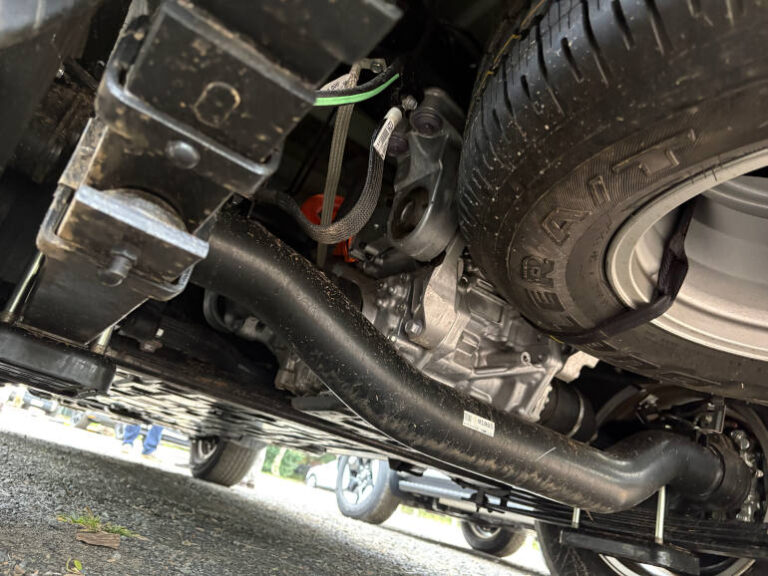
The De Dion axle has become one of the more interesting engineering details of the electric Toyota HiLux. It is not a fully independent rear suspension, but it is also not a conventional live axle. Instead, it is a practical middle ground that can retain the durability and predictable wheel geometry valued in work vehicles while reducing the amount of heavy driveline hardware moving with the wheels.
Toyota has introduced a De Dion rigid-leaf rear suspension for the HiLux BEV to accommodate its rear eAxle while protecting the hardware and retaining the ute’s rough-terrain capability. It is a layout also appearing in other electric pick-ups, including the Isuzu D-Max EV, showing that an old suspension idea has fresh relevance for electric commercial vehicles.
What is a De Dion axle?
A conventional live axle uses one large housing to connect the rear wheels, with the differential and much of the driveline carried inside that moving axle assembly. When the wheels move over bumps, the heavy differential moves with them.
A De Dion system still links the left and right wheel hubs with a rigid tube or beam, so the wheels remain connected. The key difference is that the differential, transaxle or electric drive unit is mounted to the vehicle’s chassis rather than carried by the axle tube. Torque reaches the wheels through separate half-shafts, which must accommodate suspension movement through joints or sliding sections.
The result is lower unsprung mass than a live axle. Unsprung mass is the weight of components that move directly with the wheels over bumps, including tyres, wheels, hubs and axle hardware. Reducing it can help the suspension react more effectively to uneven roads and rough tracks.
Why does it suit the HiLux BEV?
Toyota needed to package a rear electric drive unit in a ladder-frame ute without compromising the qualities fleet and off-road users expect from a HiLux. The De Dion arrangement gives Toyota a rigid rear wheel connection and leaf-spring layout, while allowing the rear eAxle to be mounted and protected separately from the moving axle assembly.
This is particularly useful in an electric ute, where the drive unit, battery protection, payload requirements and wheel articulation all compete for space beneath the vehicle. Toyota says the arrangement was chosen to accommodate the rear eAxle without risking damage or compromising performance on rough terrain.
The advantages
- Less moving mass than a live axle: Keeping the heavy drive unit attached to the chassis reduces the weight moving with the wheels, potentially improving ride control, tyre contact and refinement.
- Stable wheel geometry: Because the hubs are connected by a rigid tube, wheel camber remains more consistent as the vehicle carries loads or travels over uneven ground.
- Useful for payload work: The design retains the predictable behaviour and strong wheel relationship of a rigid axle, which suits vehicles that move between unladen and heavily laden conditions.
- Good electric-drive packaging: It can help engineers mount motors, reduction gears and differential hardware higher or more securely within the chassis.
- Off-road suitability: A robust axle connection and leaf-spring arrangement can be well suited to rough roads, fleet work and applications where durability matters as much as ride comfort.
The compromises
- It is not independent suspension: A bump affecting one rear wheel can influence the other because the wheels are physically linked.
- More complex than a live axle: It needs half-shafts, joints and additional mounting arrangements for the chassis-mounted drive unit.
- Higher cost: The De Dion layout is generally more sophisticated and expensive than a conventional live axle.
- Less tuning freedom than multi-link suspension: Engineers have fewer options to independently tune each rear wheel’s movement, camber and compliance.
- Not automatically better in every vehicle: A well-engineered independent rear suspension can deliver greater comfort and handling refinement, particularly in passenger-focused vehicles.
Where are De Dion axles commonly used?
De Dion axles have historically appeared in specialist performance cars, premium vehicles and racing applications because they offer lower unsprung mass than a live axle while retaining stable wheel geometry.
More recently, the layout has become relevant again in electric commercial vehicles, utility vehicles and off-road-capable EVs. Toyota’s HiLux BEV and Isuzu’s D-Max EV are two prominent electric ute examples, while Mercedes-Benz has also used a redeveloped De Dion rear axle in its electric G-Class.
For fleet buyers, the important point is not the name of the axle but what it signals. In the HiLux BEV, Toyota has selected a layout that aims to preserve the work-ready character of a leaf-sprung ute while making room for an electric rear drivetrain. It is a pragmatic engineering compromise: more sophisticated than a live axle, less complex than a fully independent rear end, and potentially well suited to an electric vehicle expected to carry loads and leave the bitumen.