

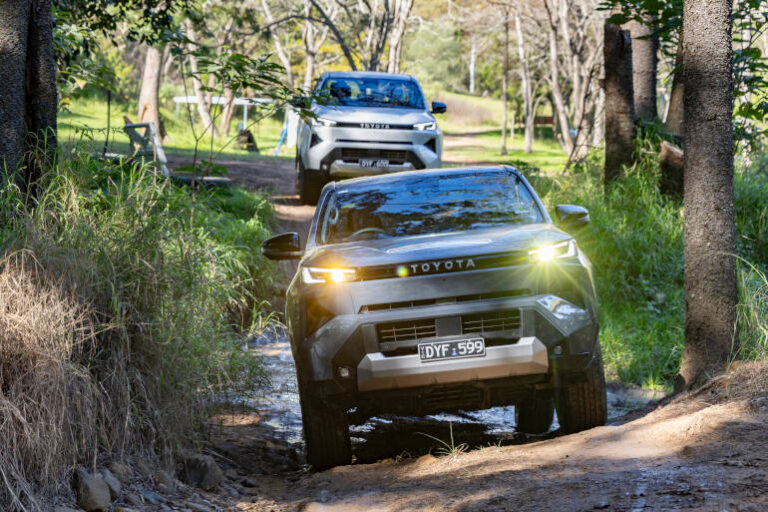
There is something faintly suspicious about climbing a rocky hill in a HiLux and hearing almost nothing.
Normally, a serious off-road climb has a soundtrack. There is diesel revving, tyres scrabbling, a little gravel being aggressively relocated and someone in the passenger seat asking whether that rock was meant to be there.
The Toyota HiLux BEV removes much of the drama.
On the launch off-road course, the battery-electric ute tackled steep climbs, loose gravel, rocky sections, descents and water crossings with the calm confidence expected from the HiLux badge. It is heavier than a diesel version and ground clearance is slightly lower, but neither appeared to compromise its ability to complete the course.
And it did so without making a fuss.

The dual-motor all-wheel-drive system uses front and rear transaxles, with Toyota saying torque can shift automatically from a 50:50 front-rear split to full rear-drive operation as conditions change. That means the driver does not need to be a drivetrain engineer every time the surface turns slippery.
The vehicle works it out for you.
Toyota has also included a six-mode Multi-Terrain Select system, allowing drivers to tailor traction control and power delivery to different surfaces. It is useful technology, although the best part may be the display showing power delivery at each wheel.
Watching the graphic as the HiLux sends power around is part off-road tool and part video game. The difference is that, in this version, a bad score may involve getting mud on your boots.
When tyres begin to slip, the electric drivetrain feels calmer than a diesel. There is no engine flare or sudden soundtrack of mechanical effort. The vehicle simply applies power and keeps moving. It makes the off-road experience feel more controlled and less theatrical.
That does not mean it is doing nothing.
Toyota has retained the kind of suspension design needed for a working ute. The HiLux BEV uses independent front suspension and a leaf-sprung De Dion rear axle. The rear transaxle is mounted to the chassis, helping reduce unsprung mass while allowing Toyota to preserve the leaf-spring arrangement that fleet buyers expect from a load-carrying vehicle.
It is an important distinction.
The HiLux BEV is not a soft-roader with a battery and a tray attached. It is still designed around work. Payload varies by model, topping out at 855kg for the SR cab-chassis, while towing is rated at 2,000kg across the range.
The off-road course used for the launch was likely more difficult than most fleet drivers will face during a normal week. It included proper hills, loose rocks, water crossings and uneven tracks rather than just a damp grass carpark behind a depot.
For the type of work undertaken by utilities, mining, government and energy fleets, the HiLux BEV should be more than capable. It will comfortably handle access roads, worksites, gravel tracks, muddy pads and the occasional rough route to an asset that was clearly not positioned with driver comfort in mind.
The standard tyres also performed without complaint on the launch route. The HiLux BEV climbed, descended and crossed obstacles with enough confidence to suggest Toyota has not made off-road capability a casualty of electrification.
Hill descent control helped on the steeper sections, taking some of the pressure off the brake pedal and allowing the driver to focus on line selection. That is particularly helpful because electric silence makes steep descents feel slightly surreal. You are moving downhill over rocks in a HiLux, but the usual diesel engine braking soundtrack has gone missing.
The full-size spare remains mounted beneath the rear, another small but meaningful detail for remote operations. Electric drivetrains may be new territory for many fleets, but tyre damage remains a very old problem.
There are limits, of course.
A fleet ute regularly facing extreme off-road work still needs the right tyres, recovery equipment, driver training and operating procedures. A battery does not make ground clearance irrelevant, and it does not stop drivers from choosing a line that looked sensible until the vehicle was halfway through it.
But for most fleet roles, the HiLux BEV has the capability required.
It keeps the familiar HiLux formula: four-wheel-drive ability, useful payload, a tough chassis and practical off-road systems. It just delivers them with smooth electric torque and a level of calm that feels almost unnatural at first.
The diesel HiLux has always had a reputation for getting into remote places. The HiLux BEV can do much the same thing. It simply does not feel the need to shout about it.