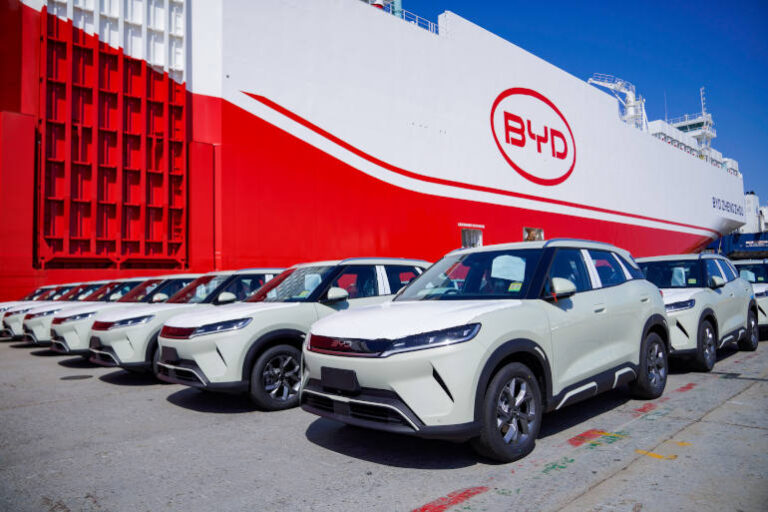
BYD Australia and New Zealand has set its sights on becoming one of the country’s top three automotive brands as rapid growth in electric and plug-in hybrid vehicle sales continues to reshape the local market.
Speaking at the launch of the BYD Shark 6 Cab Chassis and Shark 6 Performance, Chief Operating Officer Stephen Collins said the company had moved from challenger brand to major market player in just four years, with ambitions to continue its upward trajectory through 2026.
“We’re still a growing brand, and we have ambitions to grow further,” Collins said.
The growth story has been remarkable. BYD launched in Australia in 2022 with a single model and has since expanded to become Australia’s leading EV brand and the leading Chinese automotive brand.
“In 2024 we were ranked 16th,” Collins said. “Last year we sold just over 50,000 units. We finished eighth with close to a seven per cent market share. This year, today, we’re ranked fifth. We’re around nine per cent market share, and we’re growing enormously.”
The company’s success comes as Australian consumers increasingly embrace electrified vehicles. Collins highlighted that EVs and PHEVs now account for 21 per cent of the market, up from 13 per cent a year earlier and 11 per cent the year before that.
“So basically, in less than two years, it’s more than doubled, and we’re seeing growth, enormous growth in both electric and PHEV,” he said.
Shark drives growth
A major contributor to BYD’s rise has been the Shark 6 ute, which Collins described as a transformative vehicle for both the company and the wider ute market.
Since its launch in February 2025, BYD has sold approximately 24,000 Shark 6 vehicles, creating what Collins described as an entirely new PHEV ute segment.
“It really has transformed the ute market, and it’s created this PHEV ute market, of which I think we have around 70 per cent market share,” he said.
The addition of the new Shark 6 Performance and Cab Chassis variants is expected to further boost volumes. Collins said BYD believes Shark sales can return to around 1,500 units per month following a slight easing from launch levels.
“We think this is going to add incremental volume to us,” he said. “It’s actually unbelievable to think that we’ve sold that many cars and been so dominant in this segment with just one grade.”
Building for the long term
While sales growth has captured headlines, Collins said BYD’s focus is increasingly shifting towards establishing itself as a long-term automotive brand through customer experience, dealer expansion, fleet sales and aftersales support.
“What’s really important for us is that we’re building this brand for the long term,” Collins said.
“It’s not just about the sales ladder. It’s about how we represent ourselves to customers, fleet customers, retail customers, and do as good a job in the back end as we are doing in the front end.”
BYD delivered its 100,000th vehicle in Australia during April, a milestone Collins believes demonstrates the speed at which the brand has been adopted by local buyers.
The company is also investing heavily in dealer coverage, growing from fewer than 50 dealerships nationally in 2024 to 100 dealerships today, with plans to reach 150 dealerships before the end of 2026.
“We’re filling out mainly our rural and provincial network,” Collins said. “This is a massive part of making sure that we have a fully serviced sales and service and parts network right across the country.”
Fleet becomes a key focus
One of the strongest growth opportunities for BYD in 2026 is expected to come from fleet customers.
Collins said fleet currently represents around 35 per cent of the Australian new vehicle market, but BYD’s fleet penetration remains below that level, creating significant upside potential.
“Our target for 2026 is about 20 per cent of the mix,” he said. “We’ve still got plenty of work to do in fleet, but this is a big part of our future strategy.”
The Shark 6 Cab Chassis is already attracting attention from councils and commercial operators looking for alternatives to traditional diesel utes.
“We’re selling to councils, we’re selling to a whole host of fleet customers that never imagined buying a BYD or buying an EV or a PHEV,” Collins said.
New models and technology coming
Looking ahead, Collins confirmed BYD’s product offensive is far from over.
“We have more to come,” he said. “In the next six months, we’ll have two all-new models, two all-new models in all-new segments, and two major upgrades.”
He also confirmed BYD’s ultra-fast flash-charging technology will eventually be introduced to Australia and New Zealand, beginning with Denza before expanding across the BYD range.
The company is also investing in local engineering resources, with around 15 engineers now working on Australian-specific vehicle development, helping tailor products for local customer needs and driving conditions.
Aiming for the podium
Despite uncertainty in the broader automotive market, Collins remains confident about BYD’s trajectory.
He stopped short of providing a specific sales forecast but made it clear where he believes the brand belongs.
“Everyone asks me how much volume we’re going to do for the year,” Collins said.
“I don’t know because it’s too uncertain, but I would still be disappointed if we’re not finishing somewhere around the top three OEMs.”
For a brand that only entered Australia four years ago, that would represent one of the fastest rises ever seen in the local automotive industry.