

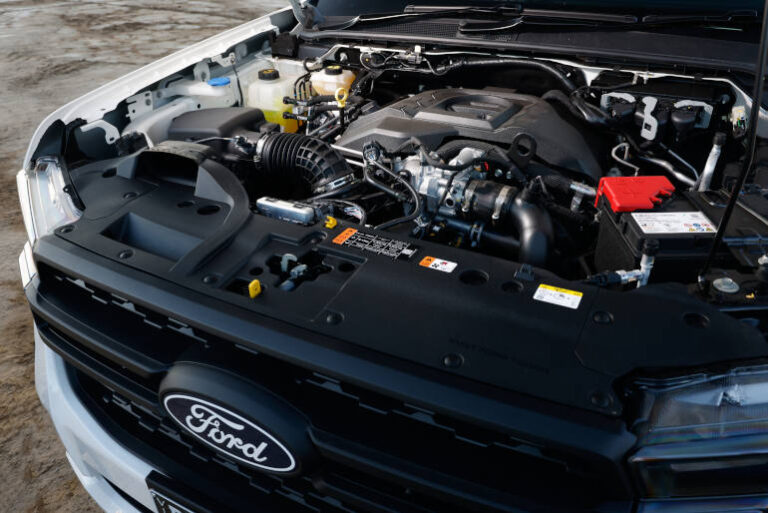
Ford Australia has strengthened its Ranger and Everest line-up for MY26.5 with a broader range of powertrain choices, significant updates to the 2.0-litre diesel engine, and wider availability of the popular 3.0-litre V6 diesel.
The changes reflect Ford’s customer-led approach to product development, with engineers focusing on delivering the capability, efficiency and durability that fleet operators and private buyers expect from Australia’s best-selling ute and one of the country’s most popular large SUVs.
Speaking at the MY26.5 Ranger and Everest launch, Mario Brandini, Vehicle Program Director Global Truck – T6 Ranger/Everest/Amarok at Ford Motor Company, said customer feedback continues to drive the evolution of Ford’s products.
“The secret sauce is probably that our people live and breathe the product every day,” said Brandini.
“Our engineers don’t just sit in an office. Our people are out in the field, towing, camping, using the cars, and experiencing the extremes themselves. We’re also out with fleets, mines and customers understanding what they need and then coming back here and solving those problems.”
According to Brandini, the diversity of the Ranger and Everest powertrain range is a direct result of listening to customers with different operational requirements.
“When we developed Ranger Super Duty, people wanted a vehicle that could tow, carry maximum loads and be more flexible, but they also wanted it in a Ranger-sized package,” he said.
“The hybrid was another example. Customers didn’t want to lose capability, but they wanted the benefits of hybrid technology and Pro Power Onboard. We innovated a vehicle that didn’t lose its towing, payload and off-road capability while giving customers more flexibility.”
Improved 2.0-Litre Diesel Targets Lower Running Costs
One of the key updates for MY26.5 is the continued refinement of Ford’s 2.0-litre turbo-diesel engine, paired with the 10-speed automatic transmission.
Pritika Maharaj, Ranger, Everest and Raptor OPD Chief Engineer at Ford Motor Company, said the engineering team recognised growing pressure on household and business budgets.
“We definitely understand that in this current environment there’s a lot of pressure for a lot of our customers with cost of living and fuel prices being high,” Maharaj said.
“What’s important and critical to us as the engineering team responsible for delivering Ranger and Everest is that we continue to listen and adapt. We need to respond to what customers need and what they value.”
The 2.0-litre turbo-diesel remains focused on delivering capability and efficiency without compromising towing performance.
“At the core of all that, based on listening and understanding our customers, we do recognise that capability is still core,” Maharaj said.
“With the 2.0-litre you get that capability, including 3.5-tonne towing, but you also get efficiency and refinement.”
Ford has recalibrated both the engine and transmission, while pairing the powertrain with a 3.73 final drive ratio to improve responsiveness.
“The 2.0-litre turbo is our most responsive diesel yet,” Maharaj said.
Ford has also introduced a range of durability-focused upgrades designed to reduce ownership costs over time.
“We’ve upgraded the fuel system, so we’ve got new fuel injectors and a new fuel pump,” she said.
“We’ve moved from the wet belt to a chain drive, and that’s really in response to understanding that cost of ownership is a key priority for our customers. We wanted to take out the servicing need and remove that concern.”
The engine also adopts steel pistons, which provide improved thermal performance during combustion.
V6 Diesel Now Available to More Customers
While efficiency remains a priority for many buyers, Ford has also responded to demand for greater performance and towing capability by making the 3.0-litre V6 diesel available in more variants.
For MY26.5, the V6 diesel has been expanded into Ranger XL and Everest Active models, giving customers access to Ford’s flagship diesel engine at lower price points.
“We understand that for some customers the priority is capability and efficiency, but for a lot of our customers it’s still all about power and torque,” Maharaj said.
“The V6 gives you that and more.”
She said the move was designed to give customers more choice based on how they use their vehicles.
“For those customers where heavy towing and having that power and torque available is important, we’ve now extended the V6 through the line-up,” she said.
“Basically, we’re giving customers a choice.”
A Powertrain for Every Customer
Ford’s MY26.5 Ranger and Everest line-up now offers one of the broadest powertrain ranges in the segment.
The 2.0-litre turbo-diesel is aimed at customers prioritising efficiency and everyday capability. The 3.0-litre V6 diesel targets those who regularly tow heavy loads and require additional performance. Ranger Raptor continues with its 3.0-litre petrol V6 for enthusiasts seeking maximum on-road and off-road performance, while the Ranger Plug-in Hybrid combines traditional Ranger capability with electrified technology and Pro Power Onboard functionality.
Maharaj believes the breadth of the line-up is one of Ford’s greatest strengths.
“We’ve got a powertrain in the vehicle for whatever it is that our customers need it for,” she said.
“We’re covering that full range, and we’re covering it with capability at its core.”
As Ford continues to evolve Ranger and Everest, the company’s Australian engineering team remains central to the development process, using local customer feedback and real-world testing to shape vehicles that are now sold in markets around the world.