Video telematics is no longer a bolt-on product. At Geotab Connect 2026, the message was clear: the market is shifting toward integrated, all-in-one video and telematics platforms — and Australia is next.
For Sean Killen, Senior Vice President at Geotab, the global trend is already established.
“Global telematics is going to consolidate into about three or four players,” Killen said. “It’s all video driven. And all in one.”
That means fleets are no longer looking for separate video subscriptions and standalone GPS tracking systems. They want a single platform delivering vehicle data, AI-powered insights and contextual video.
“You’re not going to see a lot of telematics-only or video-only deals,” Killen said. “They’re going to want both. I want everything off the vehicle. I want the video for safety. I want it all together. I want prediction. I want AI.”
Australia Is Following the Curve
While markets like North America have moved earlier, Australia is tracking the same trajectory.
“It hasn’t hit the Australian market yet,” Killen said, “but it’s very similar to what I saw in Mexico maybe two years ago.”
In that market, video adoption shifted rapidly. “Two years ago, that was 20 percent, maybe 15. And so now it’s just, you have to have it,” he said.
Killen expects the same evolution locally. “I will be shocked if you ever see in like three or four years a last-mile delivery guy without a camera.”
For industries with liability exposure — delivery, logistics, utilities — the direction is clear. “If there’s liability risk? Yes,” he said.
From Recording to Intelligence
The shift isn’t simply about adding cameras. It’s about embedding AI at multiple layers.
“There’s two bits of AI that are working here,” said Alkan Ciftci, Business Development Manager at Geotab. “There’s one in the camera that’s noticing that your eyes are down… that’s the AI picking up the actual event. The second part of AI is in the reporting that you see.”
That second layer is critical. Rather than overwhelming fleet managers with event counts, the system now “surfaces repeat and high magnitude offenders,” Ciftci explained, providing targeted coaching insights.
This dual-AI model changes the role of video from passive recording to proactive risk management.
Balancing Safety and Privacy
One of the barriers to video adoption has been driver concern about privacy. Connect discussions acknowledged that resistance remains real.
“There will be resistance, and there will be questions — valid questions around that,” Ciftci said.
However, configuration flexibility is helping fleets address those concerns. Cameras can operate in “sensor mode,” where AI detects events without automatically transmitting video.
“You can program the camera to work as a sensor and not a recorder,” Ciftci said. “It will notify the event… but it won’t actually send the video through.”
Organisations can define what behaviours matter — such as mobile phone use or seatbelt compliance — and disable others. That allows fleets to align monitoring with agreed safety objectives.
“It’s about interacting with, ‘Hey, pick up and show us these events and don’t show us those,’” he said.
From Punitive to Positive
Another theme emerging alongside the all-in-one model is behavioural reinforcement.
“It’s the ultimate carrot for the driver,” Ciftci said, referring to reward-based programs linked to safe driving performance. “Shift that whole conversation around from punitive measures into drive rewards.”
This reflects a broader safety maturity shift — where video is not positioned as surveillance, but as part of a structured coaching and incentive framework.
The APAC Investment
For Geotab’s regional leadership, the video expansion is a deliberate strategic focus.
Will Batty, Associate Vice President Business Development – APAC at Geotab, said 2026 will mark a stronger repositioning of the company around integrated video.
“You’ll see a big shift, I think, in the way that Geotab starts positioning itself as this all-in-one video solution,” Batty said. “Having the power of data now combined with the context of video to provide these end-to-end safety solutions.”
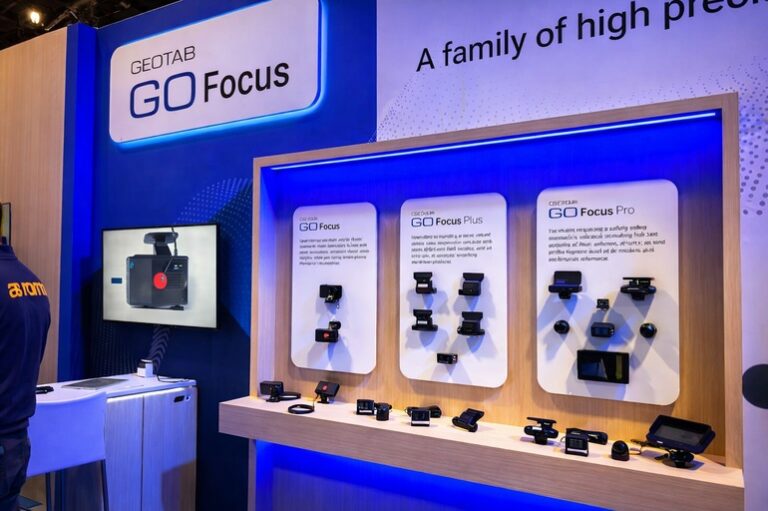
The upcoming release of more advanced video hardware expands external camera options and AI capabilities, strengthening that end-to-end proposition.
Why the Shift Is Inevitable
The convergence of telematics and video is being driven by three forces:
- Increasing liability and legal scrutiny
- Demand for predictive safety insights
- AI’s ability to process behavioural data at scale
Killen believes consolidation will follow. “The companies that are capable of doing that are just exploding right now in growth,” he said.
Australia may not yet be at the saturation levels seen in North America, but the trajectory is clear. Video is moving from optional enhancement to integrated platform expectation.
The question is no longer whether fleets will adopt video. The real question is how quickly they will transition to an all-in-one model — and how effectively they manage the organisational change that comes with it.
The shift has started.