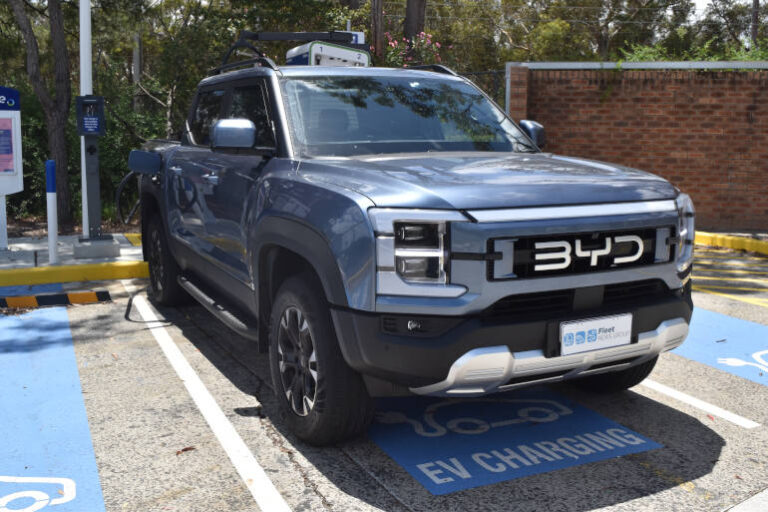
The BYD Shark 6 arrives as one of the most interesting new entrants in Australia’s dual-cab ute market, not because it out-muscles the established players, but because it takes a very different approach. Instead of chasing maximum towing and payload, BYD is targeting fleets and novated lease buyers who want lower emissions, strong performance and everyday usability without jumping straight to a full battery-electric vehicle.
Powertrain and Performance
At the heart of the Shark 6 is BYD’s Super Hybrid system, pairing a 1.5-litre turbo petrol engine with dual electric motors in an all-wheel drive layout. Combined system outputs are a substantial 321kW and 650Nm, delivering brisk on-road performance with a claimed 0–100km/h time of 5.7 seconds.
The Shark 6 can operate in full EV mode for shorter trips, with BYD claiming up to 100km of electric range when the battery state of charge is between 25 and 100 per cent. For drivers who keep the battery topped up, combined fuel consumption can be as low as 2.0L/100km, while longer trips see consumption rise once the battery drops below that threshold.
Total combined driving range is listed at up to 800km, helped by a 60-litre fuel tank and a 29.58kWh BYD Blade Battery.
Fleet-Relevant Numbers
From a fleet perspective, the Shark 6 is clearly positioned as a light-duty or mixed-use ute rather than a heavy hauler. Gross Vehicle Mass is 3,500kg, with a kerb weight of 2,710kg, delivering a payload of around 790kg. Braked towing capacity is 2,500kg, which is lower than many diesel competitors but sufficient for a wide range of urban, trade and lifestyle use cases.
Off-road credentials are respectable rather than extreme. Ground clearance sits at 230mm, wading depth is 700mm, and multiple terrain modes (Mud, Sand, Snow and Mountain) support occasional off-road work. It’s AWD rather than a traditional part-time 4WD, which will suit most users who want capability without hardcore touring ambitions.
Interior, Technology and Safety
Inside, the Shark 6 feels more SUV-like than workhorse. Standard equipment includes a 15.6-inch rotating touchscreen, 10.25-inch digital instrument cluster, head-up display, ventilated and heated front seats, wireless phone charging and a premium Dynaudio 12-speaker sound system.
Safety is a strong point, with a five-star ANCAP rating and a comprehensive suite of driver assistance systems including AEB, adaptive cruise control, lane keep assist, blind-spot monitoring, front and rear cross-traffic alert, trailer stability control and a 360-degree camera.
For fleet and recreational users, Vehicle-to-Load (V2L) is a standout feature, with power outlets in both the tub and cabin capable of running tools, appliances or campsite equipment.
Ownership and Running Costs
BYD backs the Shark 6 with a six-year / 150,000km vehicle warranty and an eight-year / 160,000km battery warranty. Service intervals are every 6 months or 20,000km, with capped-price servicing available for long-term ownership certainty.
Verdict
The BYD Shark 6 isn’t trying to be a diesel Ranger or Hilux replacement — and that’s exactly the point. For fleets and novated lease buyers looking for an electrified ute with strong performance, low reported emissions and high equipment levels, it offers a compelling alternative. If your work doesn’t demand maximum towing every day, the Shark 6 makes a strong case as a modern, lower-emissions dual-cab option worth serious consideration.
- Premcar Celebrates 30 years of Australian Engineering
 Australian automotive engineering and manufacturing company Premcar has celebrated its 30th anniversary, marking three decades of local vehicle development, performance engineering and secondary manufacturing. The Melbourne-based business began life as Tickford on 11 September 1996, initially working with Ford Australia on performance-enhanced Falcon models and right-hand-drive conversions of the Ford Mustang. Today, Premcar says its
 - Before buying another street sweeper, check what the ones you own are doingWhen an operational team says it needs another vehicle, the obvious fleet question is: why? For specialised plant such as street sweepers, answering that question can be difficult. The existing vehicles may be recording significant operating hours. Overtime may be increasing. Maintenance costs may be rising. And despite all that activity, the organisation may still
- Hyundai Signs on with UEFA Champions LeagueHyundai Motor Company will use one of the world’s biggest sporting competitions to showcase its next generation of vehicles after becoming the Official Automotive Partner of the UEFA Champions League. The multi-year agreement will begin with the 2026/27 season and run through to the end of the 2030/31 competition, extending Hyundai’s involvement in global football
- Safety, fuel and customers: the pressures shaping Australian fleet managementAustralian Fleet Managers are balancing safety, operating costs and rising service expectations, according to new research from Geotab. The Geotab Report 2026: Connected Fleets in Australia surveyed 517 Australian Fleet Managers, executives and mobile-business professionals about the technologies they use, the challenges they face and the outcomes they have achieved. Across the survey, driver fatigue and safety
- How Euclidic upgraded 650 vehicles without disrupting the fleetReplacing telematics hardware across a national fleet sounds straightforward until the vehicles are spread across Australia, operating on customer-controlled sites, working in remote locations and rarely available at a convenient time. That was the challenge facing SRG Global when it needed to migrate approximately 650 vehicles from 3G OBD plug-in telematics devices to new 4G