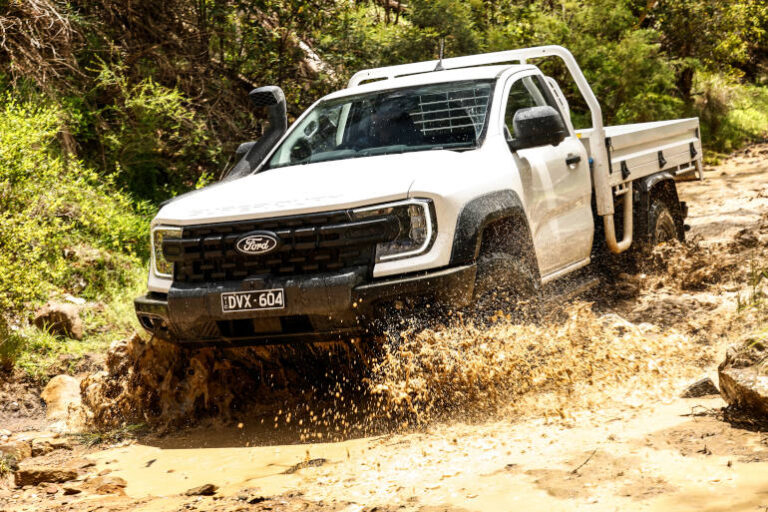
For a long time, vehicle capability has been measured in horsepower, torque and headline numbers. But talk to Fleet Managers today and you’ll hear a different language altogether — uptime, safety, durability, and risk reduction.
That shift was on full display during the Ford Ranger Super Duty launch, where one message came through loud and clear: fleet buyers didn’t ask Ford for more power. They asked for vehicles that stay working.
And that distinction shaped every major decision behind the Ranger Super Duty.
Fleet Conversations Changed the Brief
According to Ford, the Ranger Super Duty didn’t start as a product idea — it started as a problem-solving exercise driven by fleet feedback.
Andrew Birkic, President and CEO of Ford Australia, explained that the genesis of the vehicle came from sitting down with a large fleet operator and listening to their frustrations.
“The customer started to talk about their pain points — what inhibited productivity, what drove cost into the system, and what drove waste,” Birkic said. “By the end of it, we walked out and went, ‘There’s something here. There’s a spark.’”
That spark wasn’t about performance bragging rights. It was about operational reality — vehicles being pushed hard, often beyond their original design limits, simply because fleets didn’t have a factory-engineered alternative.
Why Safety Became a Productivity Feature
One of the most telling insights from the launch was Ford’s admission that its assumptions about fleet buyers were wrong.
Jeremy Welch, Conversion Development Manager at Ford IMG, said the team initially believed fleets would prioritise low purchase price over features.
“We thought fleets wanted the cheapest thing they could get,” Welch said. “What we found was they wanted the safest thing they could get — because that’s what gives them the most uptime.”
This feedback directly influenced the inclusion of driver-assist technologies, sensors and camera systems — not as luxury items, but as tools to reduce incidents.
“If you’ve got sensors, there’s less chance someone backing into hitting something,” Welch said. “That means your car is going to be on the road working — and that’s what they want.”
For Fleet Managers, this reflects a familiar truth: every minor collision, every damaged bumper, every trailer incident takes a vehicle out of service. Safety isn’t just about compliance — it’s about keeping assets productive.
Uptime Beats Power in the Real World
The Ranger Super Duty’s engineering brief focused on sustained operation under load, not peak performance.
Steve Crosby, Director of Product Development at Ford IMG, said earning the Super Duty badge required a mindset shift.
“Super Duty is an iconic name in the Ford world. You don’t just get it — you have to earn it,” Crosby said. “You have to demonstrate proof points at every step.”
Those proof points were measured in durability testing, load management and repeatability — not acceleration figures.
The message from fleets was simple: vehicles need to perform the same job every day, not just once.
Factory Engineering to Reduce Downtime
Another consistent fleet message was frustration with aftermarket complexity. Justin Capicchiano, Chief Program Engineer for Ranger Super Duty, explained that many fleets rely on GVM upgrades and modifications because there hasn’t been a factory solution capable of meeting their needs.
“When we drove vehicles with aftermarket upgrades, there were always compromises,” Capicchiano said. “Ride quality, safety system integration, handling when laden — you were giving something up somewhere.”
From a fleet perspective, those compromises translate directly into downtime, warranty uncertainty and administrative burden.
Andrew Birkic highlighted the operational impact of this approach.
“Quite often these vehicles require multiple fit-outs,” he said. “Supplier A, then B, then C — and depending on the fit-out, it can take four to six months.”
By engineering capability into the vehicle from the factory, Ford aimed to reduce those delays and deliver a vehicle ready to work sooner — another direct response to fleet priorities.
Payload: A Compliance Issue, Not a Marketing Claim
Payload was another area where fleet thinking diverged from traditional marketing.
Jeremy Welch described overloading as a widespread and serious risk.
“If one vehicle is found overloaded, the whole fleet can get grounded,” he said.
“That’s a massive issue for fleet operators.”
To address this, Ford focused on visibility and awareness, not just structural strength.
“Onboard scales were one of the features that no one specifically asked for,” Welch said.
“But once we showed them, they took their arm off for it.”
Andrew Birkic explained why this resonated with fleet supervisors and managers.
“Now there’s science behind it,” he said. “You can say to the drivers, ‘It’s over’ or ‘It’s under’. That’s peace of mind, and that’s important for OH&S.”
For fleets managing Chain of Responsibility obligations, that kind of real-time information helps reduce risk across the organisation.
Technology That Reduces Mistakes, Not Adds Complexity
One of the recurring themes in fleet discussions was driver variability. Not every driver has the same experience, confidence or skill level — especially when towing or operating in tight environments.
Capicchiano acknowledged this reality.
“The operators aren’t always the owners of the vehicles,” he said. “We found that features like cameras and trailer systems helped reduce mistakes that were happening regularly.”
This reinforces a key fleet principle: technology that simplifies tasks reduces incidents, training burden and downtime.
What Fleet Buyers Really Asked For
When you strip away the specs and marketing language, the Ranger Super Duty story is a clear reflection of modern fleet priorities.
Fleet buyers asked for:
- Fewer incidents
- Less downtime
- Greater compliance confidence
- Vehicles that perform consistently under load
- Factory-engineered solutions instead of aftermarket compromise
As Andrew Birkic summed it up:
“Everything we’ve done is very intentional,” he said. “It’s about optimising the outputs based on what customers value.”
Why This Matters for Fleet Decision-Makers
The Ranger Super Duty launch highlights a broader shift in how OEMs engage with fleets. Performance is no longer measured by horsepower alone. It’s measured by how often a vehicle is available, how safely it operates, and how confidently it can be deployed across varied tasks.
In today’s fleet environment, uptime is the new horsepower — and Ford built the Ranger Super Duty around exactly that principle.
For Fleet Managers, that may be the most important takeaway of all.