

Australian fleets are investing in vehicles with increasingly sophisticated safety technology, but new research suggests many drivers are switching those systems off because they don’t understand or trust them.
A landmark study led by IAG, in partnership with Queensland University of Technology (QUT) and the iMOVE Co-operative Research Centre, found greater use of Advanced Driver Assistance Systems (ADAS) could prevent more than 7,000 road casualties in Australia each year.
The study suggests the technology itself is only part of the solution. Driver education and familiarisation may be just as important.
IAG found 60% of Australian drivers surveyed said they actively turn off driver-assistance safety features, while many of those who continue using the systems learn how they work through trial and error.
For fleet managers, the findings highlight an emerging challenge as features such as Autonomous Emergency Braking (AEB), Lane Keeping Assist (LKA), blind spot monitoring and other driver assistance systems become standard across more fleet vehicles.
Simply purchasing a five-star safety vehicle may not deliver the expected safety outcome if drivers don’t understand the technology or choose to disable it.
Head of the IAG Research Centre Shawn Ticehurst said greater uptake of driver assistance systems had significant potential to reduce road trauma.
“We believe full uptake of driver-assist systems in Australia has the potential to prevent 20% of road casualties each year,” Ticehurst said.
Training could unlock the safety benefits
One of the strongest findings from the research was the impact of driver familiarisation.
QUT conducted controlled field research involving 50 participants using six different ADAS technologies. Researchers found that even a single test drive with an instructor significantly increased driver trust, confidence and willingness to use the crash-avoidance systems.
That finding has clear implications for fleet vehicle handovers and driver inductions.
As fleets introduce new models, handing over the keys and expecting drivers to work out unfamiliar safety systems themselves may no longer be enough.
The growing variation between manufacturers also makes vehicle familiarisation more important. Similar safety technologies can operate differently between brands and models, potentially creating frustration for drivers moving between vehicles.
IAG’s national survey found 72% of Australians driving ADAS-equipped vehicles believed they would benefit from more information or instruction about the systems.
For fleet operators, this creates an opportunity to make ADAS familiarisation part of the vehicle induction process, alongside existing policies covering vehicle operation, incident reporting and workplace safety.
Safety systems are working
The research also provides evidence that ADAS technologies are reducing the types of crashes they are designed to prevent.
QUT analysis of 100,000 Australian vehicle collisions found every driver-assistance system examined significantly reduced its targeted crash type.
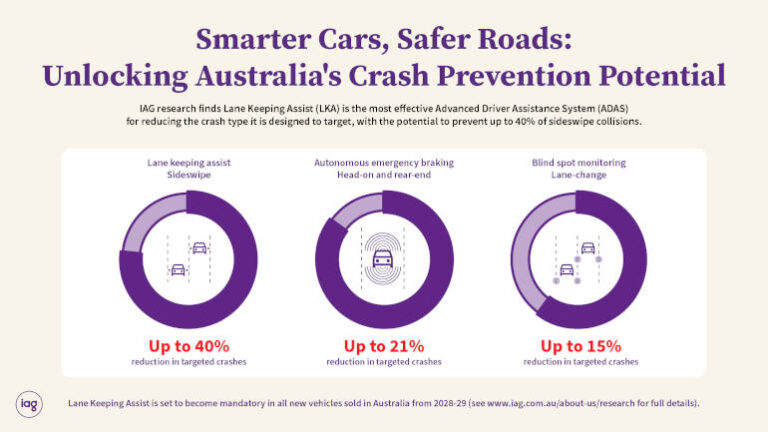
The largest reductions were recorded for sideswipe crashes, at up to 40%, followed by head-on collisions at up to 21% and lane-change crashes at up to 15%.
But one of the technologies offering significant potential also appears to be among the least popular with drivers.
Lane Keeping Assist generated the most negative feedback among participants in the field study, with drivers describing it as frustrating and annoying and identifying it as the feature they were most likely to switch off.
That presents an important challenge as the technology becomes more common.
All new passenger vehicles sold in Australia have been required to include car-to-car AEB since March 2025, while car-to-pedestrian AEB became mandatory from 1 August 2026. Lane Keeping Assist is scheduled to become the next mandated ADAS feature, with requirements coming fully into effect in March 2029.
QUT Professor in Intelligent Transportation Systems Sebastien Glaser said the effectiveness of the technology ultimately depended on drivers being willing to use it.
“The effectiveness of ADAS in delivering real-world safety benefits depends on strong driver engagement, which starts with overcoming existing negative attitudes and behaviours through targeted information and education,” Glaser said.
For Fleet Managers, the message is increasingly clear: vehicle safety doesn’t finish with the procurement decision.
As ADAS becomes standard across Australia’s vehicle fleet, organisations will need to consider how drivers are introduced to these systems and whether their induction programs are keeping pace with the technology.
The safest vehicle in the fleet can only deliver its full potential when the person behind the wheel understands what its safety systems do — and leaves them switched on.