

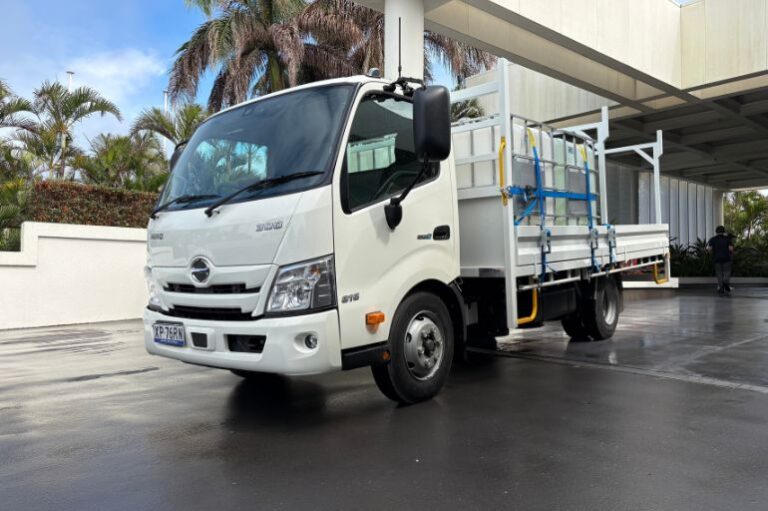
Hino’s updated Euro 6 300 Series brings changes to its engine, transmission and lighting, while retaining a cab designed around the practical demands of a working day.
For fleet managers, that driving environment deserves attention alongside payload and towing capacity. Drivers need to enter and exit safely, find a comfortable seating position, reach controls and maintain visibility throughout their shift.
During the 300 Series launch presentation, Daniel Petrovski, Department Manager of Product Strategy for Hino Australia, explained the thinking behind several established cabin features.
“They seem like little things, but they make a big difference when you’re in that truck the whole day,” he said.
Comfort starts at the door
For a delivery driver, council employee or tradesperson, the working day can involve repeated trips into and out of the cab.
Petrovski said Hino considers access part of the overall cabin design, with door openings and grab handles contributing to how drivers use the truck.
“Comfort’s not just when you’re in the cab, but it’s entry, exit,” he said.
That makes access an important part of a fleet evaluation. A vehicle that feels comfortable during a short demonstration drive should also be assessed for the repeated movements required by its intended task.
Door clearance, handhold placement and the ease of moving between the ground and driver’s seat can become particularly relevant on routes with frequent stops.
A driving position for different people
Shared fleet vehicles need to accommodate drivers of different heights and builds.
Petrovski described how the inclined seat rails in the Wide Cab help adjust the relationship between the driver, steering wheel and pedals.
As the seat moves forward, it also moves down. Moving it rearwards raises the seating position, providing additional room for taller drivers.
The arrangement allows the seat’s height and distance from the controls to change together. Tilt and telescopic steering wheel adjustment provides further scope to find a suitable position.
For fleet managers, the practical assessment is whether the people using the vehicle can comfortably reach the pedals and controls while maintaining a clear view of the road and instruments.
Standard and Wide Cab take different approaches
The presentation also clarified a distinction between the Standard and Wide Cab configurations.
A suspension driver’s seat is standard on Wide Cab models. Standard Cab models use independent front suspension and do not have the same standard suspension-seat arrangement.
Petrovski confirmed these were existing features carried into the updated range.
The distinction matters when selecting vehicles for different tasks. Fleets should assess the relevant cab configuration and its ride characteristics, rather than assuming all 300 Series variants provide the same seating and suspension equipment.
Controls within reach
Hino has retained the established dashboard layout, with accessible controls and instrumentation that includes a central speedometer and tachometer, alongside a 4.2-inch multi-information display.
A 10.1-inch multimedia unit provides wireless Apple CarPlay and Android Auto compatibility.
Petrovski highlighted the position of the transmission shifter as another element of the driving environment. The updated automatic now features sequential selection, allowing drivers to manually select gears or leave the transmission in Drive.
While much of the interior is familiar, that additional gear-selection control is part of the latest update.
For operators introducing the truck into a fleet, driver familiarisation should cover both setting up the seating position and understanding the transmission controls.
Visibility and safety remain part of the package
Petrovski also discussed the role of the cab’s relatively thin A-pillars in supporting outward visibility.
The updated range adds LED headlamps and fog lamps, while retaining Hino’s SmartSafe package. This includes a Pre-Collision System with Autonomous Emergency Braking, pedestrian detection and Lane Departure Warning.
Other equipment includes Vehicle Stability Control, a reverse camera, dual SRS airbags and four-wheel disc brakes. The cab is certified to the UN ECE R29 strength standard.
These features sit alongside the everyday requirements of seeing the road, reading instruments and operating the vehicle comfortably.
“Drivers can be in the cab for long periods of time – the cab is their office so it’s essential that it’s comfortable to reduce driver fatigue,” Petrovski said.
For fleets considering the updated 300 Series, the cabin assessment should involve the drivers who will use it. Trying the access, adjusting the seat and steering wheel, and driving a representative route can reveal details that a specification sheet cannot.