


Leighton Hamlin, National Fleet Manager for New Zealand Police, delivered one of the standout presentations at the 2025 EROAD Fleet Day, offering a rare behind-the-scenes look into the country’s most diverse and demanding fleet operation. With over 4,000 vehicles ranging from patrol cars to helicopters and maritime vessels, the NZ Police fleet supports an extraordinary breadth of frontline activity across Aotearoa.
A Fleet Like No Other
The scale and scope of NZ Police’s fleet is unlike most public or private sector operations. It includes:
- Land assets: patrol cars, 4WDs, scooters, motorcycles, and special-purpose vehicles.
- Sea and air assets: maritime vessels like Lady Liz, ribs, and helicopters.
- Special operations vehicles: dog wagons, custody vans, community hub vehicles, and even photography vans.
Each of the 12 police districts operates in unique terrain—from urban centres to remote islands—requiring flexible, durable, and often bespoke solutions.
Strategy Built on Six Pillars
The NZ Police Fleet Strategy ensures alignment with operational, financial, and environmental goals. The six pillars are:
- Safety and Reliability
- Operational Efficiency
- Sustainability
- Cost Effectiveness
- Technology
- Partnerships
From reducing idle time to exploring fit-for-purpose modular builds, each initiative aims to optimise public investment while supporting officers in the field.
Case Study 1: Salvaging Write-Offs to Save $1.2 Million
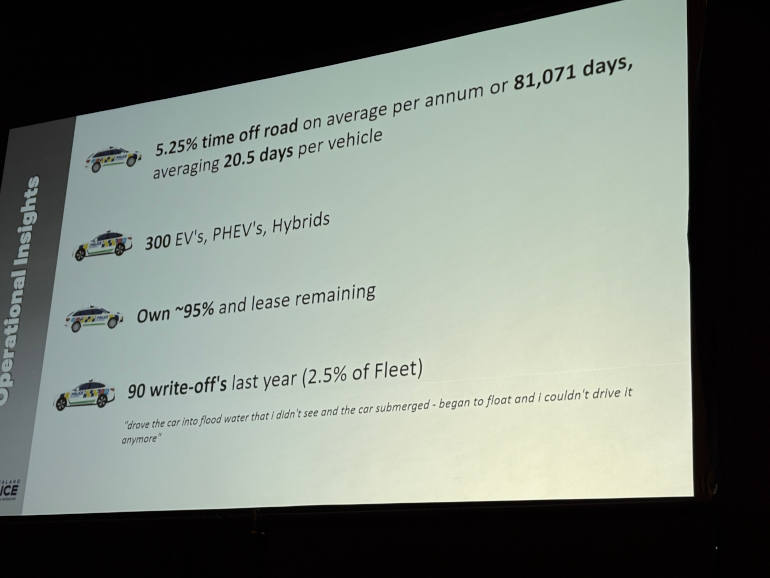
Every year, around 90 police vehicles are written off. Rather than scrap them, the team began stripping viable parts—engines, boots, doors—and reusing them.
“We’d get $3,000 to $4,000 for a write-off at auction. Now, we recover parts and save thousands per vehicle,” said Hamlin.
In one case, an engine worth $20,000 was salvaged and reused for just $4,000 in recovery and installation costs—saving $16,000 on a single repair.
FY2023 savings: $1.2 million
Projected FY2024 savings: $1.6–1.8 million
Case Study 2: Smarter Vehicle Replacement with Data Dashboards
Replacing 500–600 vehicles per year is no small feat. Traditionally managed via spreadsheets, the process has been overhauled using data dashboards developed in partnership with Custom Fleet. These now integrate:
- Kilometres travelled
- Time in service
- Whole-of-life cost
- Downtime (availability)
- Functional priority (e.g. urban vs frontline)
This smarter investment transparency has enabled the team to identify poor performers (like early-generation camera vans) and proactively manage replacement cycles.
Case Study 3: Modular Builds for Purpose-Fit Performance
Fleet builds have evolved from one-off configurations to repeatable, modular designs with long-term value. A great example is the photography van, which replaced traditional fibreglass-canopy utes.
Partnering with M2, the NZ Police introduced a service body setup on a Ford chassis designed for:
- Dust and water resistance
- Secure equipment storage
- Modular transfer to a second chassis (10-year service life)
Although more expensive upfront, these bodies offer lower lifecycle costs and better operational fit.
Case Study 4: Gen 1 vs Gen 2 Skoda Enhancements
Skoda patrol vehicles have undergone significant updates based on frontline feedback and operational learnings:
- Sump guards to reduce damage from speed humps
- Suspension upgrades for improved clearance
- Wheel downsizing from 19″ to 18″, reducing rim damage by 92% and saving $132,000
- Number plate lights on unmarked vehicles to increase visibility at intersections
“Frontline feedback shapes everything we do—what we learn from Gen 1 gets built into Gen 2 and beyond,” Hamlin explained.
Case Study 5: Right-Sizing the Fleet with Allocation Models
NZ Police uses a planning ratio of one vehicle to every three constabulary staff, but implementation revealed a mismatch between actual and assumed fleet distribution. A new Vehicle Allocation Model was developed to:
- Audit fleet presence across districts
- Model future needs by region
- Support EV transition planning
This work ensures that each district has the right number and type of vehicles for their needs, while uncovering inefficiencies (e.g. 47 vehicles miscounted across the organisation).
Rigorous Vehicle Testing: From Pursuits to Moose Tests
To maintain fleet safety, NZ Police vehicles undergo:
- Pursuit and emergency driving simulations
- Moose tests (high-speed obstacle avoidance)
- Radio Frequency Interference Testing to ensure compatibility with police comms
- Brake and high-speed stability tests
All new frontline vehicles go through this process at facilities like Manfeild and Ohakea.
Partnering for Performance
Success doesn’t come from strategy alone—it comes from collaboration. NZ Police partners with:
- Wade Group for national vehicle builds
- M2 for modular body design
- Skoda and GM for vehicle supply and support
- First Rescue, Motorhub, and Custom Fleet for logistics and fleet management
Leighton also acknowledged the value of shared learning via forums and industry associations.
“Excellence isn’t one big leap—it’s hundreds of small steps done better together, every day.”
Leighton Hamlin’s presentation was a masterclass in balancing complexity with clarity. Whether it’s saving millions on parts, refining replacement strategies, or designing vehicles that keep officers and communities safe, NZ Police is leading by example. For other fleet operators, the takeaway is clear: innovation doesn’t always mean high tech—it often starts with doing the basics better, backed by data, discipline, and a deep understanding of operational needs.