
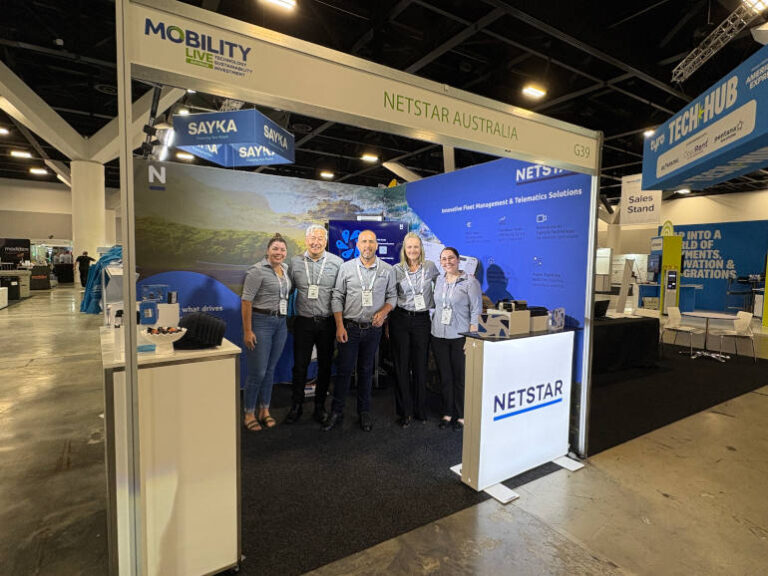
At this year’s Mobility Live Australia event in Sydney, Netstar showcased a powerful lineup of new products designed to make fleet management simpler, smarter, and more cost-effective. From AI-powered dash cams to the all-new STARtag range of low-cost asset trackers, the company demonstrated how telematics is evolving to meet the needs of modern fleet and logistics operations.
Introducing STARtag: Smart, Scalable Asset Tracking
Netstar’s STARtag family of devices is purpose-built for organisations looking to track a wide range of non-powered assets — from toolboxes and pallets to cages and high-value shipments.
“We’ve just launched a new range of low-cost asset trackers — the StarTag devices,” explained Nuno Marques, Netstar’s Head of Product and Marketing. “They come in a range of shapes and sizes, with different battery lives depending on what customers need.”
The STARtag range includes several compact form factors:
- STARtag Sticker – an ultra-thin adhesive tracker with around 60 days of battery life, ideal for short-term monitoring of parcels or temporary shipments.
- STARtag Card – a credit-card-sized tracker with a two-year battery life, suited for equipment and containers that move frequently.
- STARtag Pulse – a heavy-duty version offering up to five years of battery life, perfect for long-term tracking of assets such as trailers or large equipment.
Each device connects seamlessly to Netstar’s telematics platform, providing real-time location updates, motion alerts, and geofence notifications. The system helps fleet and logistics managers reduce loss, improve asset utilisation, and maintain visibility across large operations — even when assets don’t have a power source.
“These trackers can be attached to anything — toolboxes, parcels, pallets — and give operators peace of mind knowing where their equipment is and how long it’s been in use,” Marques added.
AI Dash Cams: From Compliance to Coaching
Alongside the StarTag range, Netstar drew strong attention to its AI dash camera solutions, designed to improve driver safety and compliance while supporting proactive coaching programs.
“The AI dash cam has been a real turning point for us,” Marques said. “Traditional GPS tracking was about ‘where is my vehicle,’ but now we’re giving customers context through video — understanding driver behaviour, fatigue, and risk in real time.”
The new camera systems feature advanced driver-assistance capabilities such as lane departure warnings, distraction detection, and event-triggered recording, all integrated with Netstar’s cloud platform for easy review and reporting.
Fleet Managers can use video data not only to enhance safety but also to exonerate drivers in the event of false claims and to reward safe driving behaviours — turning telematics from a compliance tool into a performance management asset.
A Smarter, Safer Future for Fleets
Netstar’s Mobility Live showcase reflected a clear shift in the industry: combining traditional telematics with video, data analytics, and automation to deliver greater insight and efficiency.
As Marques summed it up, “We’re seeing companies move beyond just GPS tracking. They’re embedding technology into their driver policies and safety programs — and tools like StarTag and our AI cameras make that transformation easy.”
- EV sales surge exposes a growing gap in Australia’s new-car market data
 Australia’s new-car market edged higher in September, but the headline result masks a much more significant change taking place underneath: almost one in four new vehicles sold during the month was battery electric. According to the Federal Chamber of Automotive Industries (FCAI), 102,924 new vehicles were sold in September 2026, an increase of 0.9 per
 - MG sees EV interest rise as Australian range expandsMG Motor Australia says its electric vehicle sales are accelerating as the company prepares to expand the choice of vehicles and powertrains available to Australian buyers. Speaking during the media tour at Everything Electric in Sydney, MG Motor Australia Marketing Director Dimitri Andreatidis said changing Australian buying patterns are being reflected in MG’s own results.
- FleetPartners takeover race narrows to three as Sumitomo joins the huntThe FleetPartners takeover contest has entered a more serious phase, and the latest update confirms something the market already suspected: there is real strategic value in this business. SG Fleet, ORIX and the Sumitomo Consortium have all returned with higher offers after getting access to FleetPartners’ books, while Element Fleet Management has decided not to
- Novated leasing growth pushes Smartgroup past 91,000 vehiclesSmartgroup has reported continued growth in its novated leasing business, with the number of leases under management reaching 91,600 at the end of June 2026. The total was up 11,600 vehicles, or 15%, compared with the same period a year earlier. Smartgroup had 80,000 novated leases under management at June 2025 and 64,600 at June
- Everything Electric Gives Fleets a Chance to Put EVs to the TestFleet managers weighing up electric vehicles will have an opportunity to compare a growing range of models in one place when Everything Electric returns to Sydney Showground from 18–20 September 2026. More than 100 electric vehicle models are expected to feature at this year’s event, spanning passenger cars, vans, trucks and other forms of electric