
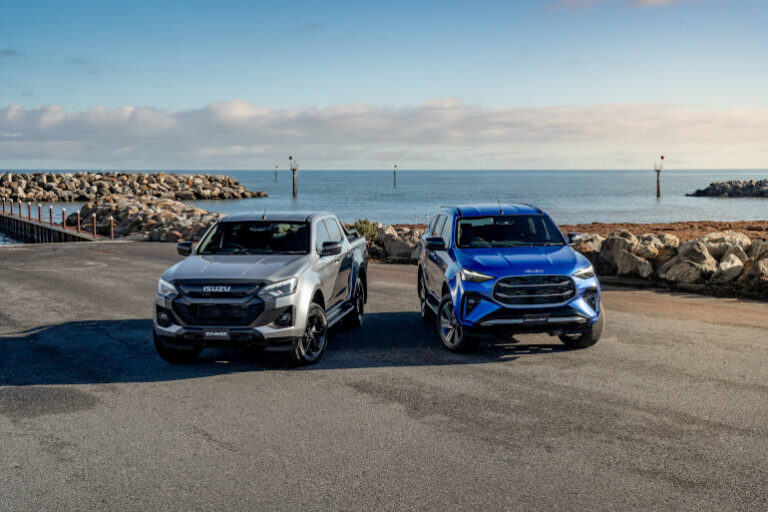
Isuzu Ute Australia has launched its new 2.2-litre diesel engine for the D-MAX and MU-X, giving fleet buyers a practical way to reduce emissions and fuel use without sacrificing towing performance or capability.
The new four-cylinder engine is paired with an all-new eight-speed automatic transmission, replacing the six-speed unit in previous models. This combination represents the latest step in Isuzu Ute’s strategy to align with the National Vehicle Emissions Standards (NVES) while maintaining the toughness and reliability fleets expect.
NVES drives innovation
The introduction of the 2.2-litre powertrain is a clear example of the “NVES effect”, where manufacturers are re-engineering vehicles to achieve measurable emissions improvements before the arrival of electric utes.
Fleet Managers can now achieve short-term CO₂ reductions through advances in diesel efficiency and driveline technology, buying valuable time while charging infrastructure and total cost of ownership models for EVs continue to mature.
Same performance, lower emissions
Despite its smaller capacity, the 2.2-litre engine delivers the same 3,500 kg braked towing capacity and identical Gross Combination Mass (GCM) as the larger 3.0-litre turbo-diesel.
The engine is newly developed for global markets and optimised for Australian conditions. Technical highlights include:
- 2.2-litre inline four-cylinder common rail turbo-diesel
- Eight-speed automatic transmission with wider gear ratios and tuned shift mapping for smoother performance
- Idle Stop-Start (ISS) technology introduced across all D-MAX and MU-X variants
- Fuel economy and CO₂ reductions through increased under-drive selection and lower cruising RPM
According to internal testing, the 2.2-litre engine achieves approximately 10–12% lower fuel consumption and CO₂ emissions than the 3.0-litre unit, depending on model and drive configuration.
With average combined-cycle figures improving from around 8.0L/100km (3.0L auto 4×4) to 7.0–7.2L/100km (2.2L auto 4×4), this equates to a reduction from 210 g/km to around 185 g/km CO₂ — a 12% improvement.
For fleet operators running 100 vehicles averaging 25,000 km annually, that reduction could save more than 60 tonnes of CO₂ each year without any change in vehicle type or operation.
Fleet confidence remains strong
Fleet and government buyers represent a major share of Isuzu Ute’s sales, accounting for an estimated 39% of D-MAXand 20% of MU-X deliveries.
Isuzu Ute says these customers are primarily motivated by total cost of ownership, reliability, and safety — areas where the new 2.2-litre powertrain continues to perform strongly.
The D-MAX SX and MU-X LS-T remain the most popular grades with fleets, while novated lease customers are showing growing interest in the new 2.2L X-RIDER, which brings a sportier appearance and lower running costs.
Technology upgrades across the range
For Model Year 25.5, Isuzu has introduced Idle Stop-Start (ISS) across all engines, cutting fuel use and emissions during idle periods — particularly valuable for urban fleets and local government applications with frequent stop-start driving.
Combined with the new eight-speed transmission and driveline refinements, the system delivers smoother operation and improved efficiency across both engine choices.
Fleet-ready future
While Isuzu Motors Japan has confirmed that production of an electric D-MAX has commenced for Europe, the Australian operation remains focused on ensuring the local line-up meets the “fit for purpose” needs of business and government fleets.
In the meantime, the 2.2-litre diesel provides a credible bridge to a lower-emission future. For Fleet Managers balancing sustainability targets and operational demands, it demonstrates how incremental advances in internal combustion technology can still deliver meaningful results under NVES.